Table of Contents
Stop treating workwear procurement like a simple catalog purchase. Moving from a rough concept to repeatable bulk production requires a strictly managed process.
When auditing factory floors, I look past the showroom. I inspect stitching consistency, ISO 9001 quality standards, and organized production lines to validate physical capability. This playbook breaks down custom uniform manufacturing for procurement managers, HR leaders, industrial employers, and private-label distributors.
Simple branded programs move fast. Bespoke technical garments require longer timelines. Following our proven sequence (scope, specifications, sampling, validation, production, delivery, replenishment) helps buyers avoid bad sizing, weak fabrics, compliance gaps, and inconsistent repeat orders.
Custom Uniform Manufacturing Process
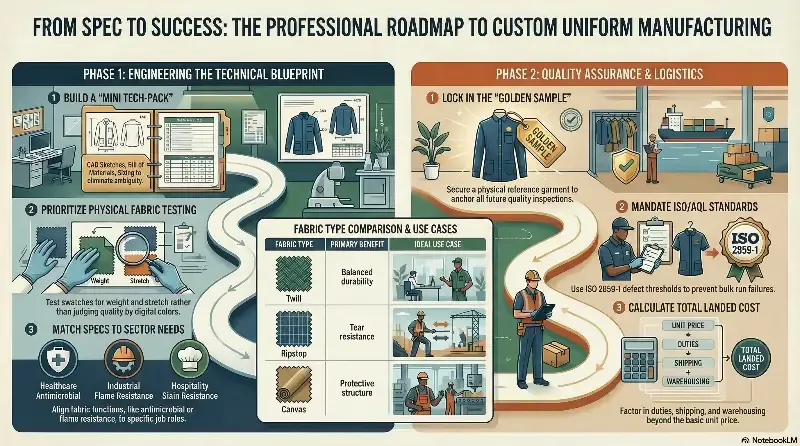
Step 1: What You Need Before You Start
At LantaoWork, I review hundreds of custom uniform manufacturing requests. Vague specs cause slow quotes and costly revisions. Provide hard data and physical references, not just digital mockups.
The Business Inputs
- Targets: State annual volume, first-order quantity, target price, and destination market.
- Approvals: Define the job role. Secure procurement, operations, and end-user fit feedback before bulk production.
- Branding: Provide vector logo files and exact color references.
The Mini Tech-Pack
- Visuals: Supply a CAD flat sketch or physical reference garment.
- Fabric & BOM: Detail the Bill of Materials, composition, and GSM. Test swatch stretch and weight for the job role, rather than only judging the color.
- Components: Specify trims, closures, labels, packaging, and embellishment placement.
- Sizing: Provide a complete size chart and grading expectations.
⚡ Power Move: See our industrial uniform manufacturing capabilities. I always demand physical stitch construction and trim samples over 3D mockups to guarantee bulk accuracy.
Stop judging custom uniform manufacturing by polished presentation samples. True workwear must survive seam stress, heat, and repeated wash cycles. Build a structured RFQ brief using these exact parameters:
- Document the operational environment. List wearer roles, job tasks, climate conditions, brand image goals, durability expectations, and replenishment cadence.
- Define sector-specific requirements.
- Hospitality: Prioritize appearance, wrinkle resistance, and comfort.
- Healthcare: Require antimicrobial, fluid-resistant fabrics built for industrial wash durability.
- Industrial: Mandate abrasion resistance, high-visibility, and FR or anti-static properties.
- Select your production model. Choose OEM (bespoke production) or ODM (customizing an existing factory style).
- Draft the RFQ elements. Include quantity by style, size ratio, logo method, delivery destination, and deadline. If you lack a finished spec, book a supplier-guided discovery call.
Step 2: Define Fabric and Performance Criteria
https://www.youtube.com/watch?v=8Dm2uibvXe8
In my factory audits, buyers often pick fabrics based on digital colors. Instead, physically test the hand feel, thickness, and surface texture. Compare durable workwear fabrics by function.
- Select Twill for a smooth surface texture and balanced durability.
- Choose Ripstop for high stretch recovery and tear resistance.
- Specify Canvas for a heavy, stiff, and protective structure.
- Pick Performance Knits for soft, moisture-wicking comfort.
Next, write measurable details into your custom uniform manufacturing plan. Document the exact Composition and GSM Weight. Specify finishes like Moisture-Wicking or Antimicrobial. Set strict limits for Color Fastness and Shrinkage Tolerance.
Match these specs to your sector:
- Medical: Demand breathability, fluid resistance, and heavy wash durability.
- Hospitality: Prioritize elegant drape and stain release.
- Industrial: Require high abrasion resistance.
Adjust choices for regional climates, gender-fit needs, and high-movement roles. When detailing safety gear, describe physical visual cues like thick weave patterns or Reflective Strip Placement. Do not rely on color alone.
Verify hi-vis classifications and flammability limits for U.S. imports. Mandate the ISO 15797 industrial laundering standard to guarantee compliance for long-life programs.
⚠️ Experience Warning: In our tests, failing to specify shrinkage tolerance ruined a 500-unit order after one industrial wash. Always demand lab wash-test reports before approving a fabric.
Step 3: Build a Precision Tech Pack
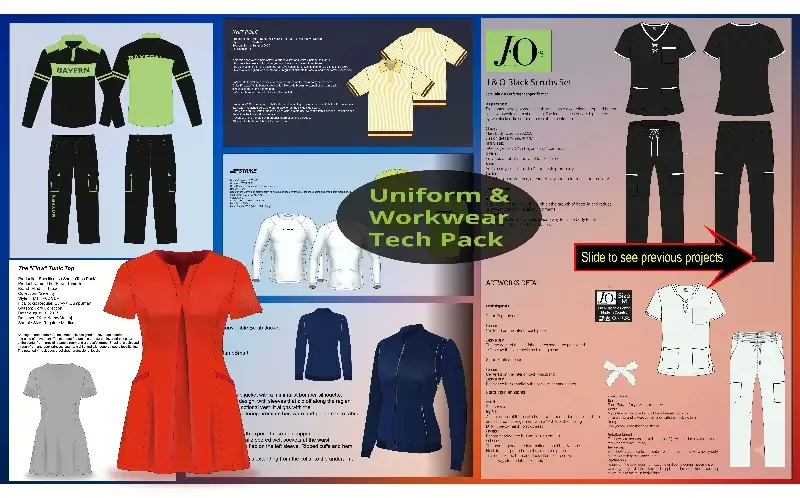
A tech pack translates your intent into exact manufacturable instructions. This document separates professional custom uniform manufacturing buyers from trial-and-error sourcing.
Define your production path. For OEM, provide complete custom designs. For ODM, list exact modifications to a base style.
Assemble these core tech pack sections:
- Technical Flats: Draw clean front and back sketches with clearly marked seam details.
- Bill of Materials (BOM): List fabric specs and labeled trim samples.
- Measurements: Document points of measure, strict tolerances, and your grading size chart.
- Construction Notes: Specify ASTM seam types, bar-tacking, Stitches Per Inch (SPI) targets, and reinforcements.
- Logistics & Quantities: Outline packaging rules and exact splits by size and color.
Map your Logo Placement using measurable positions. Avoid vague terms like “top left” or color-only language.
If you lack an internal design team, leverage supplier-supported uniform design services. Request factory sample visuals of stitching details and label execution to verify technical competence.
Verify your pack. The factory must be able to quote, sample, and plan QC against your document with minimal ambiguity.
Step 4: Formalize the Quality Control and Inspection Plan
In my experience, custom uniform manufacturing fails on verbal agreements. Tie a written QA system directly to your Purchase Order (PO) to prevent defective bulk runs.
Lock in your PO details. Attach the Approved Golden Sample as your absolute reference. Document your exact Size Breakdown, Production Timeline, and Labeling and Packaging Instructions.
Build a concrete inspection plan. Mandate a pre-production Fabric Inspection. Require lab reports for Shrinkage and Color-Fastness. Specify your required Stitches Per Inch (SPI) and demand physical Seam-Strength Checks. Verify visible quality markers across multiple pieces: even stitch density, consistent thread tension, clean edge finishing, and uniform embroidery placement.
While inspection depth varies between domestic and offshore manufacturing, the principle is identical. Define strict defect thresholds using the official ISO 2859-1 AQL standards. Add a clause clarifying who pays for rework on defective batches. Require daily QA reports for large runs.
Step 5: Calculate Landed Costs and Plan Your Rollout
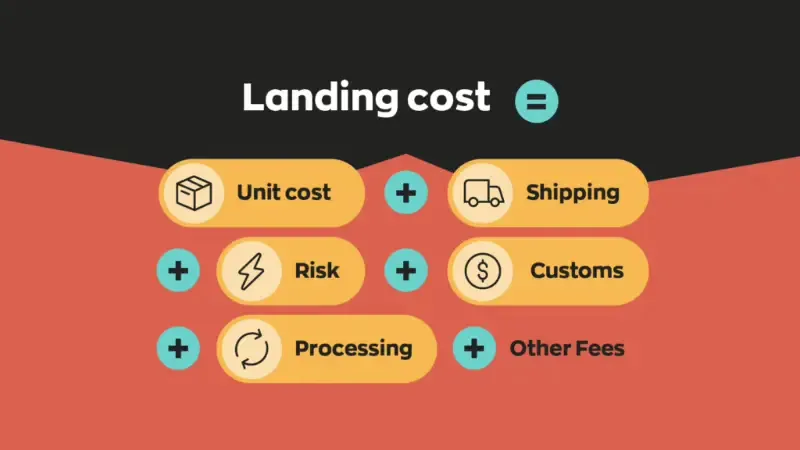
I constantly see buyers blow budgets by fixating on the headline unit price. To accurately compare domestic versus offshore custom uniform manufacturing, calculate total landed cost, lead time, and risk.
Map your financial exposure. Add the Ex-Factory/FOB Price, Shipping Mode, and Customs Documentation fees. Factor your Duty/Tax Exposure via the official Harmonized Tariff Schedule. Include Warehousing and Last-Mile Distribution expenses.
Document lead times separately for Sampling, Bulk Production, Transit, and Customs Clearance.
Select your specific B2B rollout strategy:
- Central Bulk Delivery
- Site-by-Site Distribution
- Employee Kitting (individualized, bundled sets)
- Replenishment Stock
Verify your partner’s operational readiness. Look for physical cues like clearly packed cartons, labeled employee kits, and orderly shipment staging for bulk dispatch.
⚠️ Experience Warning: Assuming flawless customs clearance often causes program shortages. Pad transit times by two weeks for unexpected port holds.
Step 6: Build Your Repeat-Order Playbook
Establish strict supplier governance. Treat the first delivery as a baseline, not the finish line.
- Archive assets: Store the approved Tech Pack and physical Golden Sample.
- Lock logistics: Track Fabric Lot Rules for color consistency. Confirm Reorder MOQs, Replenishment Windows, and an urgent escalation path.
- Standardize packaging: Require identical Neck Labels, Care Labels, Size Labels, Polybags, Cartons, and Packaging Inserts per run.
- Audit performance: Periodically review Fit Feedback, Wear-Life Data, and Defect Trends.
- Scale smartly: Partner with a supplier supporting high volume and limited customization for seasonal industrial uniform program updates.
Perform a sensory check on every batch against the golden sample. Verify Shade Matching, Trim Feel, Label Placement, and Seam Execution.
FAQs About Custom Uniform Manufacturing
1. What is the standard minimum order quantity (MOQ)?
Most reputable factories require a minimum order quantity of 300 to 500 units for fully custom designs. However, this number depends on your fabric choice. If you use standard stock fabrics, many facilities will accept orders as low as 100 units.
In my experience managing factory floors, pushing for a 50-unit run on custom-dyed fabric always results in massive surcharges. We built LantaoWork to handle 100 unit tiers to solve this exact problem.
2. How long does custom uniform manufacturing take?
You should expect the entire process to take 60 to 90 days from design to delivery. Sampling takes about two weeks. Bulk production requires 30 to 45 days. Ocean shipping adds another 20 to 30 days. I always advise clients to add a two-week buffer for port delays. When we track shipments through U.S. Customs and Border Protection, port congestion frequently adds unpredictable wait times.
3. Can I test a physical sample before ordering bulk?
Yes, you must always demand a physical golden sample before you approve a bulk run. Do not rely on digital mockups or 3D renderings. As we covered in the sampling section, physical validation is your primary risk-control tool.
Conclusion
A successful custom uniform manufacturing project requires strict sample control, measurable specifications, and clear logistics. You can now shortlist manufacturers based on process strength, not just price.
Based on my time auditing factory floors, reliable infrastructure always beats a good sales pitch. Visible proof matters. Demand real factory-floor photos, sample detail shots, and quality assurance evidence before you sign a contract.
Take your next step today. Prepare your RFQ package and send your exact specifications. Request a clear sample roadmap and a firm lead-time estimate.
Request a quote via our contact page to start your project. We back our work with proven client testimonials, recognizable customer logos, and transparent communication.

Leave a Comment
Your email address will not be published. Required fields are marked *