Get a Free Quote
Crew in flame resistant coveralls and hard hats reviewing a drawing on an offshore platform
Wuhan Factory · Factory-Direct FR Coveralls · Since 2015

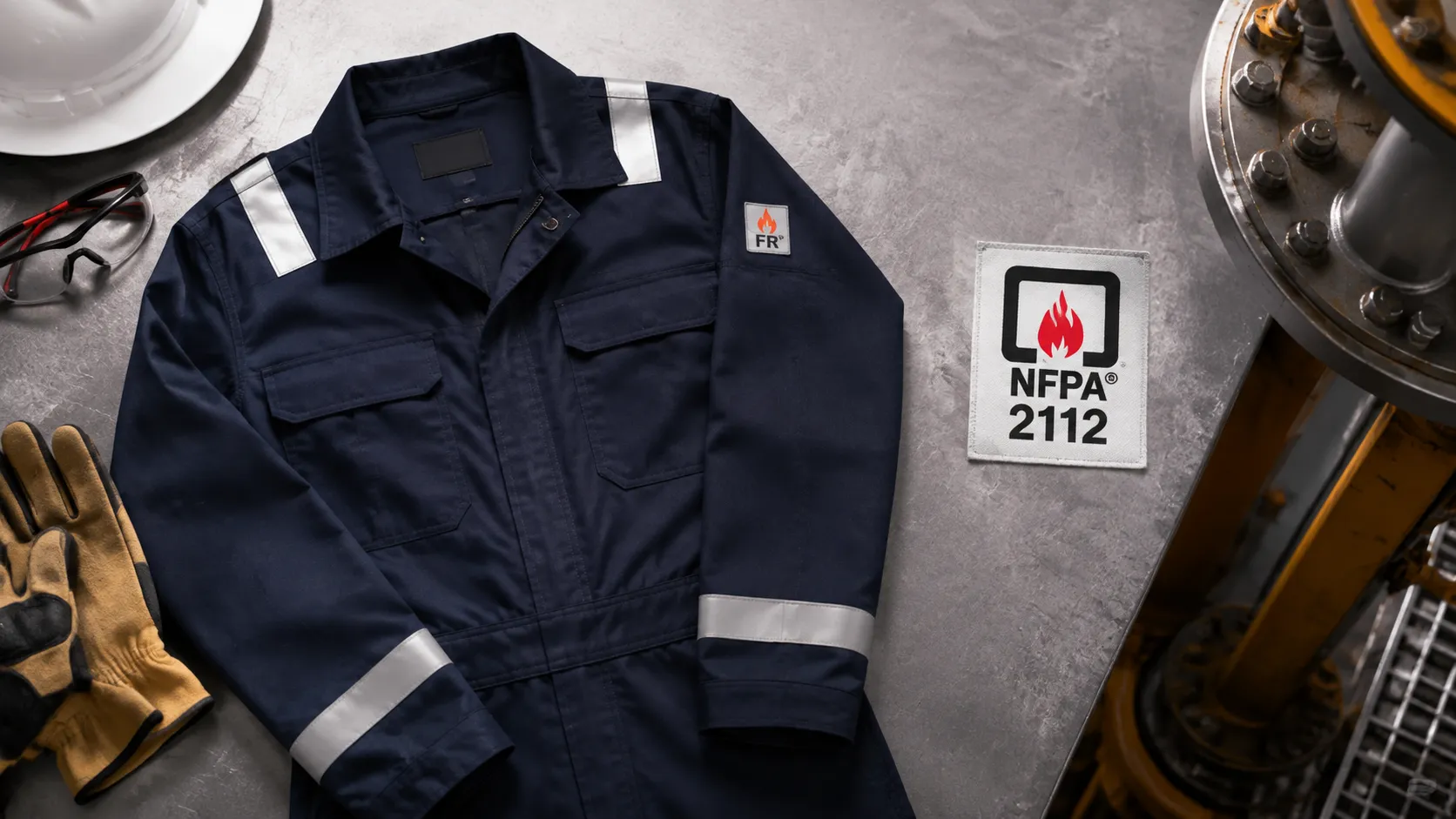
FR Coverall Manufacturers — Built to NFPA 2112, Tested per Lot

The certificate covers the mill’s fabric, the test data comes from an unwashed sample, and nothing ties the garment to the lot that arrived. An audit finds all three in minutes.

We build to that standard with aramid thread and FR-rated trims, then test the finished garment per lot. Every shipment carries a checkable file number, a lot report tied to the roll codes, and a build you can reorder unchanged.

MOQ
100 / style
Fit sample
7–10 days
Capacity
50,000+ units/month
On-time
98.7%
01 / Standard

FR Coveralls by Standard

Pick the hazard, the standard follows, the build follows the standard.

01 Flash fire

Flame Resistant, Flame Retardant and Fire Resistant Coveralls

Flame retardant and flame resistant describe the same garment under two trade names. Fire resistant is the loose third label.

Fireproof describes nothing — no woven shell survives unlimited heat.

Standard
NFPA 2112 · EN ISO 11612
Tests
ASTM D6413 vertical flame · ASTM F1930 manikin
Build
8–12oz FR duck or aramid blend
02 Electric arc

Arc-Rated FR Coveralls for Electrical Work

Arc rating is tested separately. A CAT 2 build is a different garment, not a heavier one.

ATPV marks a 50% chance of second-degree burn; ELIM marks the point below it. Both are measured on the finished garment.

Standard
NFPA 70E · ASTM F1506 · IEC 61482
Rating
ATPV or ELIM, in cal/cm²
Categories
CAT 1–4 · 4 / 8 / 25 / 40 cal
03 Weight

FR Coveralls by Weight: 6oz to 12oz

No standard mandates a weight. It sets a thermal floor and leaves the route open — two compliant coveralls can weigh 6oz and 12oz.

Hot plants sit at the light end, radiant heat at the heavy end. Below roughly 4.5oz, weight buys heat relief at the cost of thermal protection.

Standard
TPP floor 6 cal/cm², not a weight
Bands
6–7 / 8–9 / 10–12oz
Trade-off
Lighter shell, lower thermal protection
02 / Builds

FR Coverall Configurations

Four builds cover nearly all FR programs quoted here. Same pattern block, same trim spec — different hazard.

FR Work Coveralls

Navy FR work coverall, front view, with a zip front under a storm flap, chest pockets and reinforced knee panels

The default build for maintenance, field crews and heavy-industry programs. Two-way front under a storm flap, reinforced knees, room for a full uniform underneath.

Weight
8oz–12oz
Fabric
FR cotton duck · aramid blend
Knee
Reinforced panels
Pockets
Chest + rule pocket
Closure
Two-way zip + storm flap
Best for
Oil & gas · electrical utility · welding · foundry
Quote this build →

FR Bib Coveralls

Navy FR bib coveralls seen from three-quarter back, with buckled suspenders, a bib pocket and reinforced knees

FR coverall bibs for crews layering over a base layer, where a full sleeve is a heat or snag liability.

Weight
8oz–12oz
Fabric
FR cotton duck · modacrylic blend
Legs
Zipper option
Pockets
Bib pocket + tool loops
Closure
Suspender + snap front
Best for
Crews layering over a base layer
Quote this build →

Vented & Summer FR Coveralls

Back view of a navy vented FR coverall with reflective tape, beside a close-up of the underarm mesh vent

Underarm gussets, back vents and a 6–7oz shell for hot plants and enclosed structures.

Weight
6oz–7oz
Fabric
FR cotton · modacrylic blend
Vent
Underarm gusset, back vent
Sleeve
Short or long, same block
Tape
FR retroreflective, optional
Best for
Hot plants · enclosed vessels
Quote this build →

Men's & Women's FR Coveralls

Men's and women's FR coveralls side by side, showing the two pattern blocks and reflective tape

Two pattern blocks. Women’s fr coveralls use their own block, graded separately; fr coveralls for men run through the same matrix.

Grading
XS – 6XL
Fabric
FR cotton duck · aramid blend
Blocks
Men's and women's
Sign-off
Fit sample before bulk
Tape
FR retroreflective, optional
Best for
Mixed crews on any site
Quote this build →
03 / Fabric

Inherent vs Treated FR Fabric

Two routes to the same test result, with very different behaviour over the life of the garment.

Close-up of the yellow aramid and modacrylic FR fabric weave
Option A

Aramid & Modacrylic Blends

Protection is a property of the polymer rather than a finish. Nomex is one aramid brand inside this family, so nomex fr coveralls and aramid coveralls are the same construction.

  • Rating stays with the fibre
  • Survives industrial laundering
  • Higher cost per garment
Close-up of the natural-coloured treated FR cotton weave, shot at the same scale
Option B

Treated FR Cotton

Softer and cheaper to buy, but the finish is what degrades. Proban and Pyrovatex are the two routes used on treated fr cotton coveralls.

  • Comfortable from the first wear
  • Finish degrades with each wash
  • Right for fixed replacement cycles

Which Route Holds Its Fit Over Its Life?

Both routes pass the same flame test. They do not hold the same measurement after 50 industrial washes.

Ask for the wash limit → Laundering rules →
Shrink after 50 industrial washes
7.2%
Treated cotton
2.1%
88/12 cotton-nylon

Measured on the oil and gas program further down this page. Shrink is where fit goes, and fit is where coverage goes.

04 / Trims

Trims That Keep the Rating Intact

Most FR failures brought in for diagnosis are trim failures. Thread, hardware and tape bought on price after the shell was specified.

01

Thread

Aramid, continuous filament, 10–12 stitches per inch at every load-bearing seam

Substituted with

Standard polyester thread melts before the shell does

The seam is the first place an inspector looks, and a melting thread voids the rating there even when the fabric tests clean.

02

Closures & Hardware

Non-sparking brass with an insulating layer beneath, or FR-rated plastic

Substituted with

Exposed nickel snaps and standard nylon zip tape

Metal snaps conduct heat through the shell; a zip tape can melt even when the teeth are right. A storm flap short of the zip is a reject.

03

Reflective Tape & Interlining

FR-rated retroreflective tape, FR-rated interlining and fusible

Substituted with

Standard tape bonded onto an FR shell

The tape and interlining become part of the garment. A non-FR tape on an FR shell fails as a combined system even when the shell alone passes.

05 / Documentation

What Ships, What We Accept, How You Check It

A certificate on a website says nothing about the garments in the storeroom. A lot report does — when it survives the five checks below.

Form FR-01 · issued per shipment, per lot

Agreed before cutting, not after. Inline inspection at AQL 2.5, FR components tightened to zero; pre-shipment at AQL 4.0 on a random draw from finished cartons, with seam strength, trims, label and lot code in the same agreement.

Buyer inspectors and third-party agencies are welcome, and random pieces can go out for independent lab testing. An old report is never reissued under a new date, and a sample-room report is never reused for bulk.

Five checks that settle it in fifteen minutes

  1. 01

    Take the file number off the label

    A permanent label carries the certifier’s mark and a file number. Ask for a photograph of it on a garment out of the lot, rather than a certificate with no garment attached.

    Exposes borrowed or expired PDFs
  2. 02

    Look it up in UL Product iQ

    The directory is public. Search the file number, the company name or the Category Control Number, and confirm the entry is active rather than archived.

    Exposes a withdrawn listing
  3. 03

    Read what the listing covers

    Fabric scope and finished-garment scope are two different claims. Confirm the entry names the model and the fibre blend matches the order.

    Exposes a mill cert sold as a garment cert
  4. 04

    Tie the report to the lot

    Roll code to cut ticket to garment. If it cannot be matched to the rolls cut for your order, it describes somebody else’s shipment.

    Exposes a reused sample-room report
  5. 05

    Ask for the conditioning, not the result

    A flame result without the laundering behind it says nothing about year three. Ask which method ran and how many cycles preceded the test.

    Exposes an unwashed specimen

Three separate standards, not one — NFPA 2112, ASTM F1506 or IEC 61482, EN ISO 11612 and EN ISO 11611. Run these five checks against every supplier on the shortlist, this one included; a file number that fails to resolve in the public directory is ours to fix.

06 / Schedule & Cost

From Standard To Landed Cost

Two things decide an FR program: how long the run takes, and what it costs once it clears customs.

01 Time
  1. 01 24 hours Spec and standard confirmed

    Hazard, standard, weight band and quantity fixed before quoting. The clock starts at deposit and approved sample, not the enquiry.

  2. 02 7–10 days Fit sample

    Cut in the production fabric and signed off on a body rather than on a drawing.

  3. 03 25–35 days Cutting and sewing

    Standard run. Mill documents checked and the lot held before the rolls reach cutting; rush is quoted per order.

  4. 04 At shipment Inspection, lot report, shipment

    Checked on the line and on finished cartons at AQL 2.5 / 4.0, reported against the lot code.

02 Cost

The tariff heading follows the fibre, so the same coverall can land in a different bracket by blend alone. The six digits below are the international layer — HTSUS and TARIC extend them by two to four more, and the rate is set there.

Harmonized System headings for FR coveralls by fibre and gender
Fibre Men's / Boys' Women's / Girls'
Cotton 6211.32 6211.42
Man-made fibres aramid · modacrylic · nylon blends 6211.33 6211.43
Coated or laminated shell 6210 the heading moves, not just the rate
FOB You are the importer of record
Goods
In the price
Export clearance
In the price
Freight
Separate invoice
Duty
Separate invoice
VAT
Separate invoice

Freight, duty and VAT arrive as separate charges.

DDP We land it
Goods
In the price
Export clearance
In the price
Freight
In the price
Duty
In the price
VAT
In the price

Nothing arrives after the invoice.

The code is declared on the invoice; the rate itself is your broker’s call against the exact fibre content, not the word “workwear”. Classifications sit in the Harmonized Tariff Schedule, EU rates in TARIC.

Procurement Cases

TWO PROGRAMS,
TWO SETS OF BAD PAPERWORK

What each buyer held before the rebuild, and what turned out true once the garment, rather than the datasheet, became the unit of proof.

FR coverall detail sheet for the oil and gas program, showing sleeve, chest, belt and back patch pockets
Case 01 Flash fire Multi-site · 12-month programme
Challenge

Four regional suppliers, four fabric specs, and no batch record of which garment protected which worker. An internal audit had already found 30% of coveralls carrying illegible FR labels after 25 washes.

What We Built
  • Fourteen variants cut to four SKUs, all carrying finished-garment NFPA 2112 certification
  • A lot code on every coverall, tied to the cut ticket
  • Three weights TPP-tested; the 88/12 cotton-nylon blend won on shrink — 2.1% against 7.2% for treated cotton after 50 washes
  • Aramid thread at the load seams; AQL 2.5 inline with FR components tightened to zero; AQL 4.0 before shipment
  • One batch pulled when the flap stopped 4 mm short of the zip
Result

Cost per wear fell 41% and premature replacements fell 68%; the whole range now carries certification an auditor can check, and reorder points run off burn rate rather than a calendar.

HSE Director · Mewbourne Oil Company Full case →
Electricians in FR coveralls and arc-rated face shields working on a switchboard
Case 02 Flash fire + arc flash Two markets · trial then phased bulk
Challenge

Certificates that described the fabric rather than the coverall, test data drawn on unwashed samples, and a supplier reading NFPA 2112 as an arc rating. Quotes stopped at FOB with no HS code behind them, and trial and bulk shipments shared one schedule.

What We Built
  • Finished-garment certification with a file number the auditor can look up
  • ASTM D6413 re-run after 100 industrial wash cycles, not on an unwashed sample
  • Arc work on dual-certified shells — NFPA 2112 plus EN 61482-2 — with ATPV marked on the label
  • File number, model and lot code printed on the label
  • Landed cost built fibre-first; trial and bulk on separate calendars
Result

Both audits cleared on the first pass, the delivery schedule held across the project, and the shift to inherent aramid traded a higher unit price for a replacement cycle the buyer could finally forecast.

Misagh Bolhasani · Procurement & Safety Manager · Field Service and EPC Contractor, North America and Europe
07 / FAQ

Frequently Asked Questions About FR Coverall Manufacturers

Can FR coveralls be washed at home, or do they need industrial laundering?
+

Both are possible, but they are not equivalent. Home washing is acceptable for garments whose FR performance is inherent to the fibre, provided the care label is followed and no fabric softener or chlorine bleach is used.

Treated FR cotton is the one that degrades: the chemical finish is what burns out, and domestic machines with hard water and heavy detergent accelerate it. Where crews launder at home, specify inherent FR or budget for replacement sooner.

Is "fireproof coverall" a real category?
+

No. The defensible terms are flame resistant, flame retardant and arc rated, each tied to a test standard. A supplier advertising a fireproof coverall should be asked which standard the claim is measured against.

Can you match the fit and size grading of our current FR coveralls?
+

Yes. Send a worn-in reference garment plus a size chart and grading rules.

The pattern is reverse-engineered, graded from XS to 6XL with separate men’s and women’s blocks, and a fit sample is cut in the production fabric before bulk starts. The measurement method is in the coverall size chart.

What is the minimum order for custom FR coveralls?
+

100 pieces per style, unchanged by category. A program with four builds is four minimums of 100, cut on separate runs and consolidated into one shipment. Sizes can be mixed freely inside a style — the minimum is per style, not per size.

Can you supply the same FR build across several sites or countries?
+

Yes — that is usually why a program moves to a single source. Documents can be issued per shipment so each site gets a compliance file, and the approved sample is archived against the pattern for reorders.

What are the payment terms?
+

30% deposit to start production and 70% before shipment. After three completed orders, net-30 is open for discussion. T/T, L/C and trade assurance are all accepted, and all payments run against a proforma invoice carrying the full company and banking details.

What happens if a lot fails inspection?
+

It does not ship. A lot that misses the agreed acceptance criteria is held, and the failure is traced to the component or the operation that caused it before anything is recut.

Where the failure is on this side, rework or replacement is at no charge. Where it comes from a specification change made after cutting started, the rework is quoted before it begins.

Who owns the pattern and the tech pack?
+

The buyer owns the tech pack, the artwork and any measurement set sent in — those leave on request. The pattern block drafted for the program is never cut for another buyer. Losing a reorder is preferable to selling that block to a competitor.

Can we put our logo or a patch on an FR coverall without voiding the rating?
+

Embroidery in low-flex areas with FR-rated thread is routine and is written into the trim specification before cutting.

What does damage protection is a standard polyester patch, a heat-transfer film, or dense decoration over a flex or flame-exposed area — those melt, or block the shell from self-extinguishing.

Thread, backing and a placement map are fixed in the tech pack, so a reorder decorates the same coordinates. Placement and stitch counts sit under embroidery.

When should an FR coverall be retired?
+

Retire on evidence, not on a calendar.

A garment comes out of service when the label is no longer legible, the shell is torn or holed, it has absorbed a flammable substance, or industrial laundering has reached the cycle limit named on the lot report.

Those are the four conditions an auditor checks; a fixed replacement date substitutes for none of them.

Next Step

Send The Standard.
We Will Confirm The Build.

Send the hazard, the standard the audit runs against, and the crew size. The build, the weight band and the lot-report contents come back within 24 hours.

MOQ 100 per style · Fit sample in 7–10 days · Quote reply in 24 hours