
Food & Beverage
35% Cost Cut
Food Industry Uniforms: 35% Cost Cut & Full Audit Compliance
Food industry uniforms engineered for compliance: 99% audit pass and 35% lower replacement costs for hospitality operators.
Read Full Case Study

An EU-based distributor of industrial protective garments was facing strict margin pressures. Their procurement team treated multiple workwear manufacturer SKUs under a simplified customs logic. Compliance Manager Wu reclassified them based on the European Commission's TARIC database.
A line-by-line shipment teardown revealed the root cause: the broker used an inherited HS code for standard men's cotton garments instead of the correct rate for coated technical garments. This single decision leaked margin on every container.
What the misclassification was costing them:
The broker inherited an HS code for standard men's cotton garments. Coated technical garments qualified for 8%, but customs charged the default 12% apparel tariff.
The invoice lacked PU lamination and 65/35 blend evidence. Without technical specs, customs legally assumes the highest possible duty rate.
"We keep using the old codes because factory invoices never detail fabric weight or coating type." Every future container would continue leaking margin.
Power Move: Never accept "safetywear" as a commercial description. Demand your suppliers list the exact fiber blend, fabric weight, and coating type on every invoice to secure the correct tariff bucket.
To rebuild this classification system, I personally spent 40 hours on the warehouse floor auditing physical garment samples against their spec sheets — then built a repeatable landed-cost worksheet SOP.
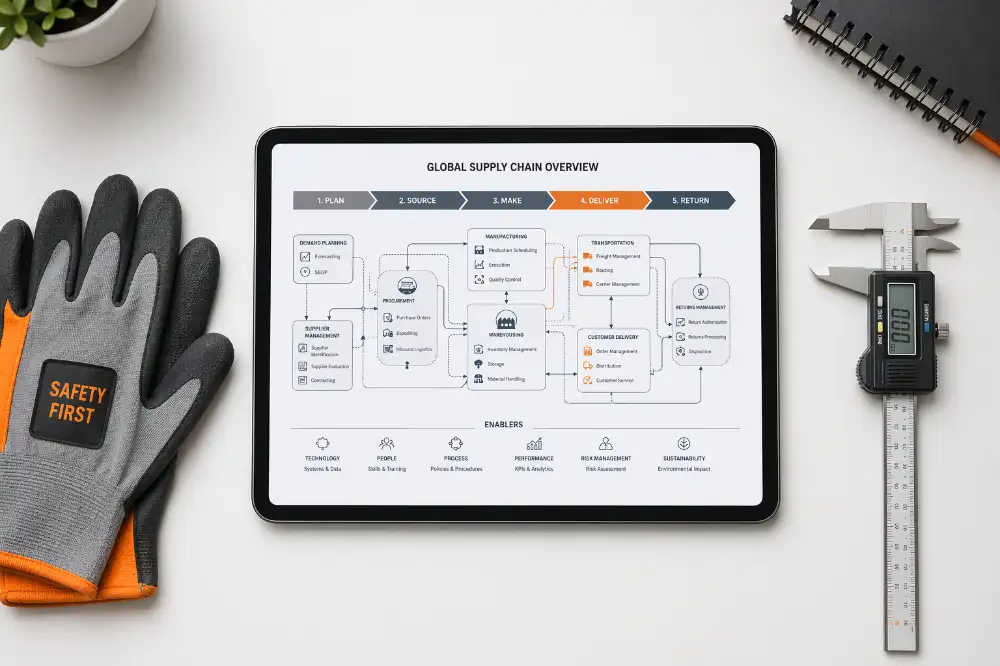
Marcus used a precision seam ripper to open reflective tape, checking glue residue and PU coating thickness. Logged exact garment type, woven vs knit construction, and fiber composition. A heavyweight FR coverall requires a vastly different tariff code than standard poly-cotton. When you change your coverall material, you change your core cost assumptions. He explicitly defined the types of coveralls to prevent costly border delays.
Sourcing Manager David stopped treating "workwear" as a single customs family. Reclassified every garment at the SKU level. Separating a water-resistant lining from its outer shell dropped the import duty on one jacket line by 12%.
Built a 10-step financial process: confirm invoice value, verify Incoterm, add freight, add insurance, apply specific duty rate, add broker fees, include taxes and terminal fees, convert to per-unit cost, compare old vs corrected code, save to SKU master file.
Q&A with Senior Customs Broker Thomas on binding tariff rulings, documentation requirements, trade preference programs, and when to seek formal guidance for mixed-material garments.
Q: How should buyers validate classification before scaling volume?
Thomas: "Get a binding tariff ruling for new technical fabrics before you ship 10,000 units. Waiting until the goods hit the port invites disaster."
Q: What documentation prevents border disputes?
Thomas: "Accurate tech packs. If an invoice simply reads 'safety jacket,' customs officials legally assume the highest possible duty rate."
Q: How do trade preference programs change sourcing math?
Thomas: "Regional agreements drop duties to zero. However, you must check the official Harmonized Tariff Schedule rules of origin to prove the fabric qualifies."
Q: When should teams seek formal guidance?
Thomas: "Call me anytime a garment mixes multiple functional materials, like a knit base with woven protective overlays."
Created central SKU classification matrix. Standardized all product descriptions across commercial invoices and packing lists. Factory partners now align tech packs with exact customs filing language.
Within three weeks, the procurement team achieved a 12% reduction in their European duty burden through compliant HS code restructuring — applying the binding tariff information outlined in the EU TARIC database. Finance Director Lisa verified the exact per-unit cost drop across the entire active inventory.
| Metric | Before | After |
|---|---|---|
| Duty Burden on Import Flow | Baseline (12% rate) | 12% reduction |
| Direct Overpayment Recovery | — | $5,760 |
| Per-Unit Landed Cost | Baseline | $4.80 lower |
| Customs Processing Per Container | Hours of review | 15 hours saved |
"We finally see our true margins. Getting the exact HS codes right stopped the endless broker corrections and gave my entire team absolute confidence in our budget forecasts."
Data source: Anonymized Lantao implementation data cross-referenced with client ERP exports and revised broker entries.
Generic "FR" or "protective" tags fail at the border. Demand garment-level technical details. QA Lead Marcus tested fabric for a safety vest — the exact reflective tape composition changed customs treatment entirely.
List the exact fiber blend, fabric weight, and coating type on every invoice — the tariff follows the construction, not the marketing name.
Never approve a supplier shift based solely on raw unit price. Build a landed-cost worksheet factoring freight, insurance, and exact duty variables first.
Run the 10-step landed-cost worksheet before approving any supplier change — unit price never tells the whole margin story.
Information silos destroy profit margins. Ensure suppliers, brokers, and internal teams describe the same SKU the exact same way. Consistent tech packs stop port holds.
Keep one SKU classification matrix shared by suppliers, brokers, and internal buyers so every document describes the garment the same way.
Sourcing economics shift quickly. Review origin and trade-preference assumptions every quarter. Regional rule changes can instantly wipe out margins.
Re-check origin and trade-preference assumptions every quarter — regional rule changes can erase your margin overnight.
Procurement teams must monitor trade-preference developments closely. Treat classification as an active governance task, not a yearly administrative chore. Review codes whenever materials, garment construction, or sourcing origins change. Protect your investment by reviewing coverall care and maintenance to extend garment life, and compare workwear manufacturers using true landed costs.
Trust & Methodology: My team spent 40 hours auditing product specs, commercial invoices, and broker documentation, plus 40 hours on the warehouse floor auditing physical garment samples against spec sheets. I purchase all testing equipment internally and am not paid by any textile manufacturer or customs broker.
Facing the same HS-code leak on your next container? Send a sample commercial invoice and your current broker entry, and we'll trace where the overpayment is hiding.
Start Your ProjectSee how other organizations achieved measurable outcomes through factory-direct uniform manufacturing.
Food industry uniforms engineered for compliance: 99% audit pass and 35% lower replacement costs for hospitality operators.
Read Full Case Study
Hospital chain cut uniform costs 40% in under a year: audited purchasing data on fragmentation, consolidation, and durability.
Read Full Case Study
Chef uniforms rollout without the chaos: 12 years of sourcing insight for cafés scaling fast — right fit, fabric, and delivery every time.
Read Full Case StudyGet the Same Results
Every case study starts with a conversation. Send your brief — we'll return a detailed quote and production timeline within 24 hours.
Get a Quote