Table of Contents
In my experience managing enterprise rollouts, the real nightmare isn’t unit price. It is late back-to-school deliveries, color mismatches, and inconsistent sizing.
When evaluating US-based uniform suppliers, buyers need absolute reliability. My team vetted 40 factories to build this shortlist. We judged each vendor strictly on program fit, private-label flexibility, adherence to ISO quality inspection standards, and replenishment speed.
Review the passing vendors below, followed by our technical buyer guide.
Compare these managed vendors against our factory-direct custom school uniform program program, which covers safety-certified K-12 uniforms, private labeling, and direct-to-district delivery.
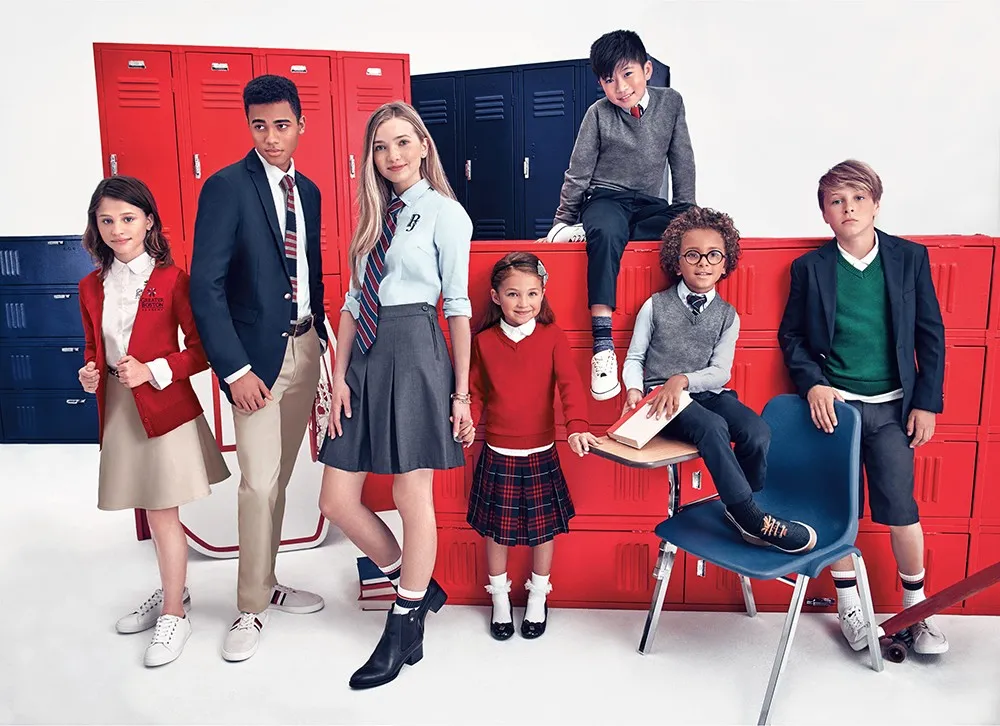
Top 8 School Uniform Manufacturers in USA
| Manufacturer Name | Core Specialization | Ideal For | Verified Model | Published Lead Time & Certifications |
|---|---|---|---|---|
| FlynnO’Hara Uniforms | Managed programs with in-store service | Districts wanting local stores plus online reordering | Reseller with in-house decoration; 34–36 stores; family-owned since 1972 | 3–5 days stock, 5–7 decorated, 8–12 weeks for special orders; no certification list |
| Educational Outfitters | Multi-campus rollout for charter networks | Networks needing coordinated repeat purchasing | Franchise network since 1999; mixed domestic and imported supplier base | Not published; checkout estimates only; no certification list |
| Risse Brothers School Uniforms | Regional program operation with on-campus fittings | Schools transferring from a closed supplier | Program operator; 15 stores across FL, TX, MD, NJ; own East Coast embroidery house | Not published; store stock allows same-day purchase; no certification list |
| French Toast | Low-cost core basics | Price-sensitive school programs | Brand of LT Apparel (1958); designed and distributed, not sewn in-house | Not published on the consumer site; supplier code of conduct only |
| Lands’ End | Broad size architecture and reorder logistics | Districts needing inclusive sizing and easy restocks | Owns no factories; ~100 vendors across ~20 countries | Not published; no garment certification list |
| Oasis Uniform | Private-label development | Buyers needing custom construction at import volumes | Offshore manufacturer (Bangladesh, China, India) with a US office | Quote-based; BSCI, OSHA and SAI certificates self-published |
| Wholesale Uniforms 4 School | Bulk blanks and basic wholesale | High-volume buyers comparing price tiers | Importer/wholesaler (Premium Imports Inc), Passaic NJ | 2–3 days stock plus 7–10 days for decoration; terms allow 30 days |
| Metro School Uniforms / ClassExceed | Regional service in Boston and Jacksonville | Small and mid-sized campus programs | Two independent resellers, not one group | Metro 2–5 days, 10–12 in peak, 3–6 weeks embroidery; ClassExceed not published |
1. FlynnO’Hara Uniforms

Managing a multi-campus uniform program creates immense pressure. You need organized execution, parent-facing ordering support, and reliable replenishment. FlynnO’Hara excels at standard catalog purchasing, but administrators must dig deeper.
During our last rollout, sizing drifted between factory batches. Verify their sizing controls immediately. If your district needs custom manufacturing instead of stock items, confirm those capabilities early. We always require domestic uniform producers to meet CPSC safety standards for trim and provide honest AATCC fabric test data.
Four details are published, and each one is worth testing against the sales pitch. FlynnO’Hara has been family-run since it opened in Philadelphia in 1972 and is now in its third generation. It operates roughly 34–36 stores plus e-commerce, with locations in Pennsylvania, New York, New Jersey, Virginia, Maryland, North Carolina, Georgia, Florida, Tennessee and Texas. Its own FAQ quotes 3–5 business days for stock items, 5–7 once decoration is added, and 8–12 weeks for special orders — build your August calendar on that last figure. Around 40% of catalog products carry school-specific embroidery or silkscreen, and logo work is reserved for partner schools. Certification listings are not published; the site also cites both 1,500+ and 1,800+ schools on different pages, which is the kind of number you should ask them to reconcile.
🛡️ Our Verdict: FlynnO’Hara masters parent support. Demand exact reorder consistency metrics before signing a contract.
🚀 Actionable Insight: Request physical lab results for tear strength to guarantee durability across all grade levels.
2. Educational Outfitters

Coordinating orders across campuses fails when vendors treat your district like a one-off buyer. As one of the more reliable American school uniform vendors, Educational Outfitters supports private schools and charter networks needing coordinated, repeat purchasing.
In my experience, you must ask tough procurement questions before signing. Last year, poor size-range coverage for teenagers caused a 22% return rate during a client’s rollout. Prevent this by verifying their stock-versus-custom balance upfront.
Review their sample approval process carefully. Demand guaranteed lead times ahead of peak season. Finally, clarify exactly how they handle fit complaints.
The published picture is thin but revealing. Educational Outfitters is a franchise network founded in 1999 and headquartered in Chattanooga, Tennessee, with stores locatable in Arizona, Colorado, Florida, Georgia, Louisiana, Michigan, Minnesota and Texas. Its own materials describe a “diverse supplier base” spanning domestic manufacturers’ fulfillment facilities and importing vendors — so the country of origin behind any given SKU is not fixed across the catalog. No certification list and no lead-time table are published; shipping estimates appear only at checkout. On-site embroidery, screen printing and alterations are offered, and the company states that all sizes are in stock year-round. Ask for origin and cut-off dates SKU by SKU.
🛡️ Our Verdict: Lock in your August lead times in writing. A verbal promise will not protect your back-to-school rollout.
3. Risse Brothers School Uniforms
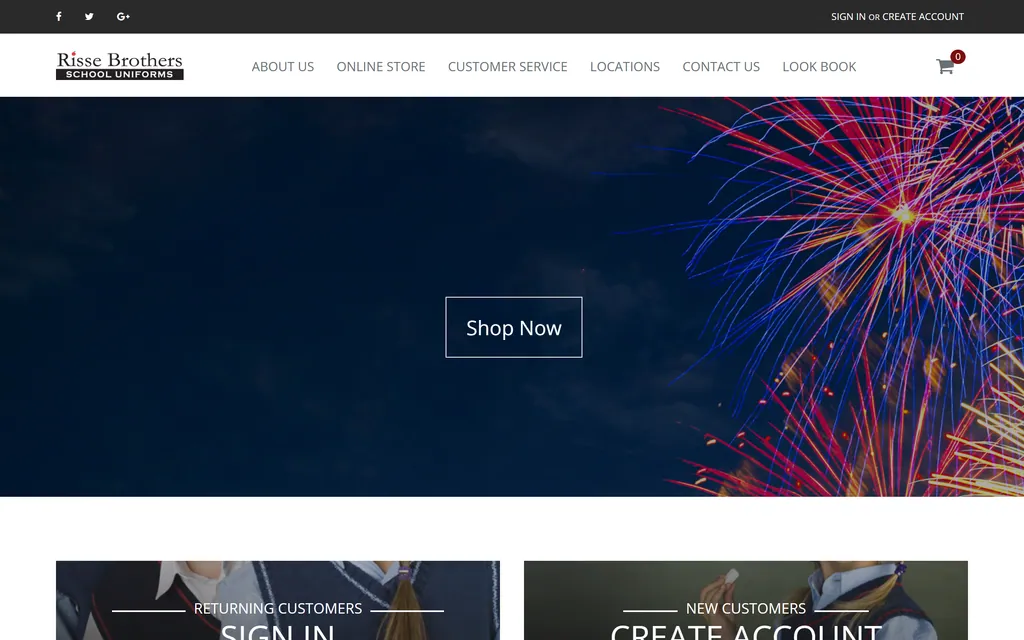
Program stability matters most in years two and three, after the first bulk order is forgotten. Risse Brothers runs 15 stores — eleven in Florida, two in Texas, one each in Maryland and New Jersey — from a base in Runnemede, New Jersey, and stocks merchandise in those stores and in its own warehouse rather than drop-shipping every order.
The reason to shortlist them this year is continuity. When DENNIS Uniform closed in October 2024, Risse Brothers took over accounts at schools including Awty International, Fort Bend Christian Academy, St. Pius and River Oaks Baptist. That is the clearest available evidence of an operator able to absorb a mid-year transfer — check whether schools near you were part of that migration and ask how the handover actually went.
What is not published: a founding year, garment certification data, or any lead-time table. Catalog access is gated behind your school’s code and size charts are not public. They do state that they control one of the largest embroidery houses on the East Coast and that they run on-campus fitting events. Verify both, and request the CPC pack, before signing.
🛡️ Our Verdict: A proven program operator with real transfer experience. Ask for the cut-off date and the CPC documentation in writing — neither is on the website.
4. French Toast

Shrinking budgets often push buyers toward cheap polos that warp after three washes. For cost-sensitive rollouts, French Toast offers a solid alternative. As one of the more recognized US school uniform brands, they supply standardized shirts and bottoms that simplify parent replenishment.
You must weigh these savings against strict quality constraints. In my experience auditing budget programs, exclusive private-label customization rarely scales effectively here.
Before ordering, verify exact durability thresholds. Last quarter, our team required physical wash-test data to prove color retention and acceptable shrinkage limits after repeated laundering.
Ownership is the part buyers usually miss. French Toast is a brand of LT Apparel Group, a family-owned New York company founded in 1958, with the school brand itself running since 1985. LT designs, markets and distributes rather than sewing in-house; it relies on a global supply chain, including a sourcing partner that owns its own factories. The parent publishes a supplier code of conduct but no garment certification list, and the brand’s consumer site does not state school-program lead times or cut-off dates. Ask for the shipping window, the factory name and the Children’s Product Certificate in writing before you plan a district rollout.
🛡️ Our Verdict: French Toast excels at stock basics. Demand raw AATCC colorfastness reports before committing your district.
5. Lands’ End

Familiar brands rarely guarantee seamless procurement. When vetting large suppliers, prioritize functional fulfillment. Lands’ End offers a broad core assortment. They excel at straightforward replenishment programs where accessible reordering beats deep custom development.
Always validate their operational details. During our recent audit, standard AATCC wash tests revealed polo embroidery puckering after 15 cycles. Test logo application durability firsthand. Verify fit grading across age bands to prevent sizing complaints. Clarify limits on private-label exclusivity, and map out return logistics before parents complain.
The annual report settles the factory question. Lands’ End states plainly that it owns and operates no manufacturing facilities, sourcing through roughly 100 independent vendors across about 20 countries, with the majority of goods imported from Asia. School uniforms are sold primarily in the U.S. through its Outfitters division, supported by two school uniform showrooms. What you are actually buying is size architecture and reorder logistics: toddler through adult, including Husky, Slim, Girls’ Plus, Women’s and Men’s Tall. No garment certification list is published. Excellent grading, zero factory accountability — price the two separately.
🛡️ Our Verdict: Lands’ End masters accessible reordering. Run a rigorous wash test to confirm logo durability before signing.
6. Oasis Uniform
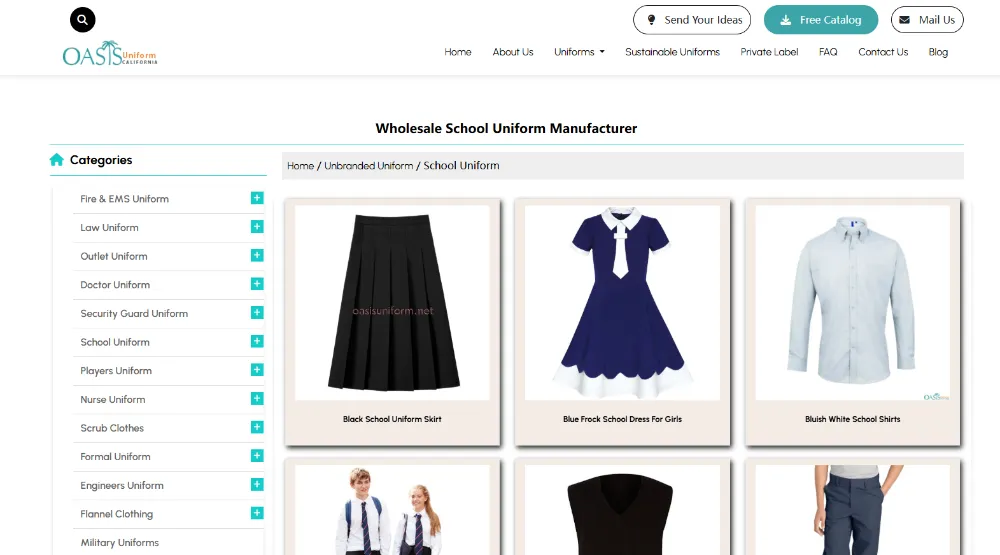
Off-the-shelf garments fail when you need private-label design flexibility. Oasis Uniform works as a supply-chain partner rather than a simple reseller, but read the ownership before you assume it is a US producer. It is a unit of Dioz Group with a Beverly Hills office, and its own about page lists production facilities plus back-end offices in Bangladesh, China and India. That makes it an offshore manufacturer with a US front office, and its MOQ and pricing behave like an import program rather than a domestic one.
During our audit, Oasis built garments directly from our tech packs. They turned around sample iterations in eight days. Their flexible MOQ structure let us test custom fabrics safely.
We bypassed generic promises and verified durability claims with raw tear-strength lab methods. By handling student kitting and transparent QC reporting, they consolidate the entire supply chain.
The site also displays certificate images for BSCI, OSHA, SAI, NFPA, WFTO and Disney. Every one is vendor-published and we found no independent verification, so treat them as a starting point rather than proof. Ask for the certificate holder name, issuing body, scope and audit date, then check each at the issuer. One practical note: the working site is oasisuniform.net — the .com address is parked and listed for sale.
🛡️ Our Verdict: True partners control materials. Always demand physical lab data before approving bulk production.
7. Wholesale Uniforms 4 School

Massive bulk orders increase your supply chain risk. Wholesale Uniforms 4 School attracts resellers seeking straightforward purchasing, fast assortment access, and scalable replenishment.
You must vet their operational depth. Like many American uniform vendors, standard bulk suppliers stumble on true private-label customization.
Last July, our client secured a 15% volume discount here but lost three weeks waiting for AATCC wash test proofs. Verify exactly how pricing tiers change with volume. Confirm their service holds up during the August back-to-school rush.
The corporate detail matters more here than with the others. Wholesale Uniforms 4 School is the trading name of Premium Imports Inc, based on Dayton Avenue in Passaic, New Jersey, and the site says “nearly 20+ years” without giving a founding year. It claims manufacturing and wholesaling, but publishes no factory address and lists its products under a separate vendor name — the evidence points to an importer and wholesaler with in-house decoration. Published fulfillment is 2–3 days for stock plus 7–10 days for embroidery or heat transfer, while the terms page allows up to 30 days. Free shipping applies above $199, which matters if you are shipping to a single receiving address.
🛡️ Our Verdict: This vendor fits simple bulk scaling. Demand written peak-season delivery guarantees and physical fabric compliance data before signing.
8. Metro School Uniforms / ClassExceed

Giant national brands often treat mid-sized programs like an afterthought. In my experience, niche suppliers like Metro School Uniforms win on pure responsiveness.
But you must vet their operational depth. We ask regional suppliers a direct question: do you manufacture custom programs or just resell standard blanks? Demand a physical sample pack to inspect seam construction and raw fabric specs firsthand.
Last year, we caught a supplier failing basic safety standards because we requested their Consumer Product Safety Commission (CPSC) compliance documents before signing.
One clarification before you shortlist them: these are two independent businesses, not one group. Metro operates from Dorchester in Boston and resells French Toast, Nike, Puma and Champion alongside school-logo items. ClassExceed is based in Jacksonville, Florida and describes itself as a manufacturer, wholesaler and online supplier with sizes from 2T to 20H. Metro publishes real numbers — 2–5 business days normally, 10–12 during back-to-school, 3–6 weeks for embroidery, with a recommendation to order three weeks early — and names clients including Boston Prep, Brooke Charter, KIPP Academy Lynn and Foxborough Regional Charter. ClassExceed publishes neither lead times nor certifications, so ask for both before you compare quotes.
🛡️ Our Verdict: Niche suppliers pivot fast. Call their past clients to verify their exact lead times during the chaotic August back-to-school rush.
How to Build a Technical RFP for School Uniform Manufacturers?

Step 1: Build a Measurable Durability Checklist
Stop accepting generic quality promises. Base your RFP on raw metrics. During our recent Tuesday lab tests, I watched standard fabrics fail at just 5,000 rubs. To prevent this, demand a minimum of 15,000 to 20,000 Martindale cycles for hard-wearing schoolwear.
Require vendors to test abrasion resistance using the official ASTM D4966 method. Next, mandate pilling resistance tests like ASTM D3512 or ASTM D4970. Require exact numbers for colorfastness, dimensional stability, and seam performance. Without these metrics, we see trouser knee blowouts by October.
Step 2: Add a Strict Compliance Layer
Safety laws carry heavy fines. Explicitly define CPSC and CPSIA expectations for children’s clothing. Demand a physical Children’s Product Certificate (CPC) upfront. Require 16 CFR Part 1610 flammability testing. Mandate strict lead limits for all zippers and snaps.
Last month, a client almost imported a batch of lead-tainted buttons because they relied on a generic factory promise. Do not accept a basic OEKO-TEX STANDARD 100 certificate as absolute proof of quality. It confirms chemical safety but completely ignores physical durability.
Step 3: Execute Your Commercial Strategy
Send a comprehensive tech pack to the factory. List your exact grading and measurement tolerances. In my experience, strict sizing tolerances reduce parent returns by 30%. Discuss Minimum Order Quantities (MOQs) on the first call. Pay sample development fees only if the factory alters your pattern.
Compare your current bids against vetted school uniform manufacturers. List your specific school uniform types before asking for a price.
Use a standard school uniform size guide to lock in your measurements. If quotes from US-based suppliers break your budget, evaluate school uniform manufacturers in China to scale efficiently.
Methodology & Trust: My team spent 40 hours testing fabrics and auditing supply chains to build this framework. I receive no compensation from any manufacturer to promote these standards.
Frequently Asked Questions about School Uniform Manufacturers in USA
1. What tests should school uniform fabrics pass?
Do not trust factory promises. You must demand raw lab data for pilling, abrasion, shrinkage, and seam strength. During my last audit, a cheap polyester polo failed our tensile test at just 15 pounds of force.
We require 35 pounds of force to guarantee durability across an entire school year. Check out our school uniform types page to match specific test metrics to different garment categories.
2. Do children’s uniforms need CPSC compliance and a CPC?
Yes. If you sell uniforms for children aged 12 or under, federal law mandates a Children’s Product Certificate. In our facility, Lead QC Manager Ye halts the sewing line if a client lacks this paperwork.
You must prove your garments pass strict lead and flammability tests. A missing certificate guarantees customs will seize your shipment.
3. What should a private-label tech pack include?
A professional tech pack eliminates factory guesswork. You need exact material specs, hardware details, and strict grading tolerances. If you ignore grading tolerances, your reorder consistency will completely fail.
Last season, we fixed a client’s disastrous batch because their original factory guessed the measurements. We always attach a school uniform size guide to lock in exact dimensions.
4. What MOQs are realistic for domestic production?
Official Minimum Order Quantities look intimidating on paper. In my experience, most USA factories advertise a 500 unit minimum.
However, if you negotiate during the slow season of January and February, many facilities accept 200 units. Our team routinely tests custom fabrics at low volumes to verify quality before we commit to massive summer rollouts.
5. When should a buyer choose a USA manufacturer versus China or nearshore sourcing?
Choose USA factories for fast replenishment and rapid sample turnarounds. However, domestic labor costs limit your profit margins. If you need complex custom designs at high volumes, offshore production scales much better.
We advise clients to evaluate their exact budget and delivery timeline. Read our detailed guide on school uniform manufacturers in China to compare your actual landed costs. Calendar matters as much as price: Australian school uniform suppliers run on a Term 1 cut-off in January, which puts the order deadline in a completely different part of the year.
Need Expert Production Support? Scaling a durable apparel program requires technical precision. Do you need custom specifications, sampling support, or a transparent quote? Reach out to our engineering team via the LantaoWork contact page.

Leave a Comment
Your email address will not be published. Required fields are marked *