Table of Contents
The short answer Most names on a UK school uniform list are not manufacturers. Of the twelve supplier groups here, only four carry a manufacturer label: Price & Buckland, One+All, Just Schoolwear and Gregory Pollard. The rest are wholesalers, brand-wholesalers or retailers — so qualify the group rather than the brand.
This guide covers school uniform manufacturers of every kind — full-service, wholesale, retail-led — organised around who you would actually contract with. It covers 12 supplier groups and 15 brands, two parent groups owning five of those brands between them.
Three buyer types drive the list — multi-academy trusts needing breadth across many sites, independent schools outsourcing the programme, and retailers topping up staples. It is a weaker fit when the brief is private-label production.
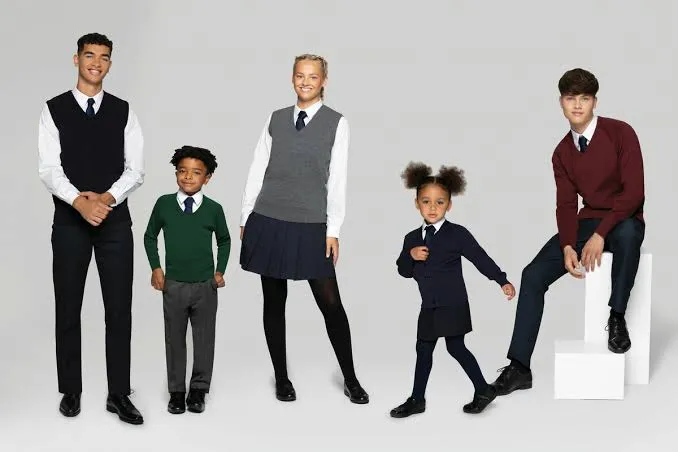
Top 12 UK School Uniform Manufacturers for Procurement Teams
Some entries are retailers or wholesalers rather than manufacturers; the Type column flags which, because that difference decides what is negotiable.
| Supplier group | Type | Core Strength & Best Fit | Required Verification | Key Risks |
|---|---|---|---|---|
| Schoolblazer Group — Trutex · Schoolblazer (ASX: Hancock & Gore) | Brand-wholesaler (Trutex) · Retailer-designer (Schoolblazer) | Two front doors, one owner: Trutex for academy trusts and retail, Schoolblazer for independent-school programmes. | ISO 12945-2 pilling data, Global Recycled Standard (GRS) certificates, sizing-accuracy data, ETI audit records | Neither is factory-direct; Trutex pricing is unpublished |
| Price & Buckland | Manufacturer (est. 1959) | Broad range for multi-academy trust (MAT) rollouts and retailers, with precise custom embroidery. | Physical knitwear strike-offs, acceptable quality limit (AQL) 2.5 reports | Summer account bottlenecks |
| Banner Ltd — Banner · Monkhouse · Beau Brummel (PE: CBPE Capital) | Wholesaler · Retail chain · Bespoke label | UK’s largest schoolwear group: wholesale, national retail and bespoke tailoring. | ISO 3801 GSM weights, batch GRS certificates, bespoke strike-offs, BS EN 14682 certificates | One company, not three — shortlisting two prices the same supplier twice |
| David Luke | Brand-wholesaler (est. 1982) | Recycled polyester, positioned as matching virgin durability. | Full GRS transaction certificates, replenishment capacity verification | Premium eco pricing; rigid small-run costs |
| One+All | Manufacturer (employee-owned) | Consistent knitwear and polo stock for academy trusts. | BS EN 14682 safety data, tear strength reports | Delays for fully bespoke sizing |
| Zeco Schoolwear | Wholesaler-distributor (est. 1976) | Value staples — trousers, shirts, polos — with consistent dye-lot colour. | 50-wash anti-pilling cycle tests | Limited branding and blazer support |
| Gregory Pollard | Outfitter + hosiery manufacturer | Precise embroidery control for strict school brand identity. ISO 9001 certified. | Physical logo strike-offs, stitch density audits | Manual account handling creates summer bottlenecks |
| Schoolwear United | Retailer | Ultra-fast wholesale fulfilment for mid-season restocking. | OEKO-TEX Standard 100 chemical safety reports | No capacity for complex bespoke manufacturing |
| Just Schoolwear | Manufacturer-embellisher + retailer | Streamlined repeat ordering for retail chains. | ISO 105-J03 colour consistency tests, prior August on-time delivery records | Not suited for custom private-label ranges |
| School Uniform Direct | Retailer (est. 1983) | Short supply chain for school shops and wholesale basics. | Raw seam strength data, REACH fabric dye compliance certificates | Limited custom private-label manufacturing |
| Winterbottom’s Schoolwear | Brand-wholesaler (est. 1977) | Fast, attentive service for small regional school networks. | British Standard fabric tear strength data, historical peak delivery rates | Cannot scale to national volume |
| School’s In | Retailer | Parent-facing logistics and school-shop alignment for local programmes. | AZO dye test reports, confirmed mid-season replenishment lead times | No national bulk inventory for enterprise orders |
Disclosure: LantaoWork competes with every supplier listed here — this is a buying guide, not an independent review. Entries come from Companies House filings, certification records and trade press, not product testing; none paid to be included. Ownership is current to September 2026.
1. Schoolblazer Group — Trutex & Schoolblazer
Trutex and Schoolblazer read as two independent options. They are not. Hancock & Gore bought Schoolblazer in 2024 and Trutex in 2025, folding both plus its Mountcastle subsidiary into one Schoolblazer Group.
H&G itself then rebranded to Schoolblazer Limited, so treat this as one supplier with two front doors.
Trutex
Put Trutex first if you supply academy trusts or retail storefronts: brand recognition, core schoolwear coverage, and blazers and trousers built for high-wear daily use. The heritage runs back to 1865 and a UK maker is still attached, though most production is offshore.
Ask for raw ISO 12945-2 pilling test data, shrinkage and colourfastness rates, and Global Recycled Standard certificates for the polyester blends.
Schoolblazer
Schoolblazer is the biggest single force in UK independent-school uniform: founded in 2004, supplying 250+ schools and around 140,000 students — roughly a quarter to a third of the sector’s pupils — from Oundle and Mansfield, with distribution at Sutton-in-Ashfield.
Its pitch is operational: an intelligent sizing system wired into parent-facing ordering, plus free in-house name-tape embroidery.
It is a designer and retailer rather than a factory owner, with around ten suppliers accounting for most of the range — which matters if your brief assumes direct manufacturing control.
🛡️ Our Verdict: One group covering the whole UK market: Trutex for academy trusts, Schoolblazer for independent-school programmes. Neither is factory-direct; benchmark Trutex pricing directly.
2. Price & Buckland
Price & Buckland suits retailers needing broad ranges and dependable replenishment, with managed service built for complex, multi-site programmes.
Logo scaling drifts between sites across a rollout, so the physical strike-off is the gate that matters: approve one before bulk, specify logo dimensions per garment size, and request raw AQL 2.5 inspection reports.
🛡️ Our Verdict: Wide range coverage; account throughput in peak season is the thing to manage.
⚡ Power Move: Force the factory to confirm their annual Back-to-School capacity in writing and demand a dedicated account manager before signing a contract.
3. Banner Ltd — Banner, Monkhouse & Beau Brummel
Banner Ltd is the largest organisation in UK schoolwear and has been private-equity owned since CBPE Capital bought the group in 2021.
Its three brands appear as separate suppliers in almost every other UK list, which makes the market look more competitive than it is: Banner is wholesale, Monkhouse is retail, Beau Brummel is bespoke. All three are one company, and one negotiation.
Banner
Banner is the wholesale side — wide product breadth plus a strong recycled-content narrative, a common choice for large multi-academy trust procurement. Scale alone is not evidence: require exact GSM weights per ISO 3801 and GRS batch certificates for any recycled-content claim.
Monkhouse
Monkhouse is the group’s retail chain and one of the country’s largest schoolwear retailers — a national store network plus on-site school shops. It was founded in 1938, acquired by Banner in 2018, and serves more than 700,000 customers a year by its own figures.
Retail reach is the whole offer, so it is what to test: ask for school-specific service levels, the off-season restocking process, and how parent returns are handled.
Beau Brummel
Beau Brummel is the bespoke label, with tailoring heritage back to 1851 — trading then as John Barran & Sons in Leeds — and schoolwear from the early 1970s.
Expect made-to-order blazers, jackets, skirts, kilts, dresses, pinafores, shirts and trousers, with pattern and cloth development in-house and British mills such as Marton Mills in the chain.
Bespoke is also why to plan ahead: lead times run longer than a catalogue supplier’s, with little off-the-shelf stock behind them. Confirm ISO 3801 GSM figures for your cloth, approve a strike-off, and ask for BS EN 14682 child-safety certificates.
🛡️ Our Verdict: One group, three entry points, one negotiation — shortlisting Banner and Beau Brummel separately prices the same company twice. Book stock allocations by February: allocation, not capacity, runs tight in August.
4. David Luke
David Luke is the strongest eco-storytelling option here, and the benchmark for testing whether recycled polyester really matches virgin tear strength — that depends on the yarn and construction, so ask for the test report, not the marketing line.
Demand Global Recycled Standard transaction certificates for the whole chain, and vet their ability to hold price targets on mid-season private-label replenishment.
🛡️ Our Verdict: David Luke delivers strong sustainable garments, but eco-fabrics carry premium pricing and small runs are the least flexible point in the curve — negotiate restocking early.
5. One+All
Among UK school uniform manufacturers, One+All is a practical option for academy trusts needing broad basics.
They hold deep stock in core knitwear and polos, built around recurring supply programmes rather than custom design — so confirm off-the-shelf depth and replenishment windows directly, and ask for raw BS EN 14682 test data covering drawstrings plus baseline tear strength metrics.
🛡️ Our Verdict: One+All delivers exceptional consistency for standard stock runs; route bespoke sizing to a specialist. Lock in your core replenishment matrix by March to prevent shortages.
6. Zeco Schoolwear
Zeco focuses on value-driven core basics — dependable trousers, shirts and polos. Dye-lot drift is the real risk at volume: pull the same style from three lots, compare in daylight before approving bulk, and check anti-pilling claims against a wash-cycle report rather than the easy-care label.
🛡️ Our Verdict: Zeco excels at staple garments. Complex customisation is not the brief, so buy volume drivers here and route bespoke blazers to a specialist.
7. Gregory Pollard
Gregory Pollard is worth evaluating if your brief demands strict school identity control — managed service support rather than commodity garments.
Stitch density decides whether a logo survives 50 washes or puckers at 20, so require a strike-off per logo, specify stitch density per garment weight, benchmark against AQL parameters, and ask for the scope statement behind the ISO 9001 certificate.
🛡️ Our Verdict: Premium customisation with deliberately manual account handling — lock in turnaround times and named contacts before peak season.
⚡ Power Move: Demand physical sampling and verify exact turnaround times before the peak season begins.
8. Schoolwear United
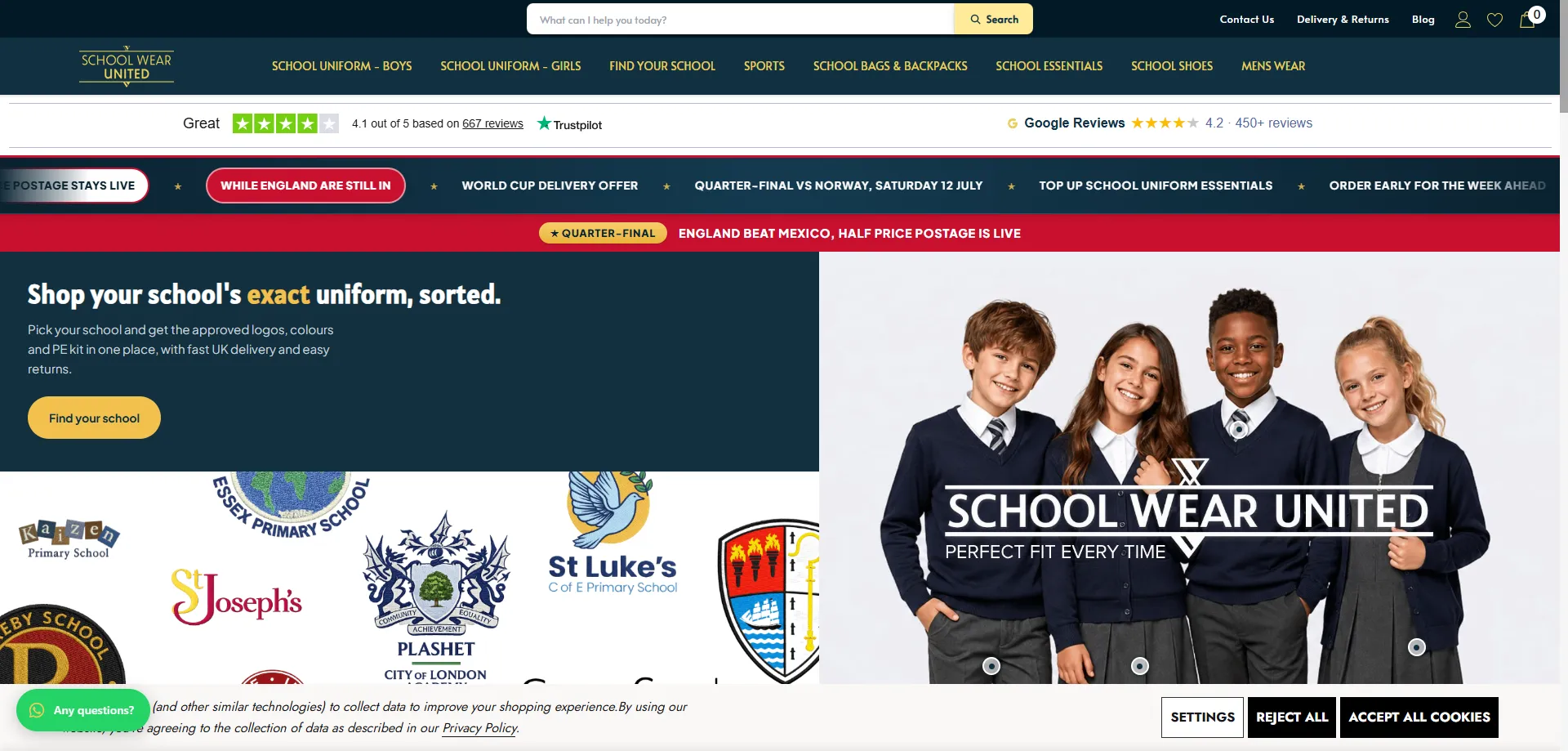
Schoolwear United sells wholesale across all core categories: off-the-shelf depth beats private-label development when you need stock now, which is the entire value.
Get the dispatch SLA and warehouse depth in writing before depending on it mid-season, and request raw OEKO-TEX Standard 100 data to confirm safe chemical limits.
🛡️ Our Verdict: Reliable turnaround for basic stock purchasing. Not a private-label partner — use them to plug inventory gaps, not build custom ranges.
9. Just Schoolwear
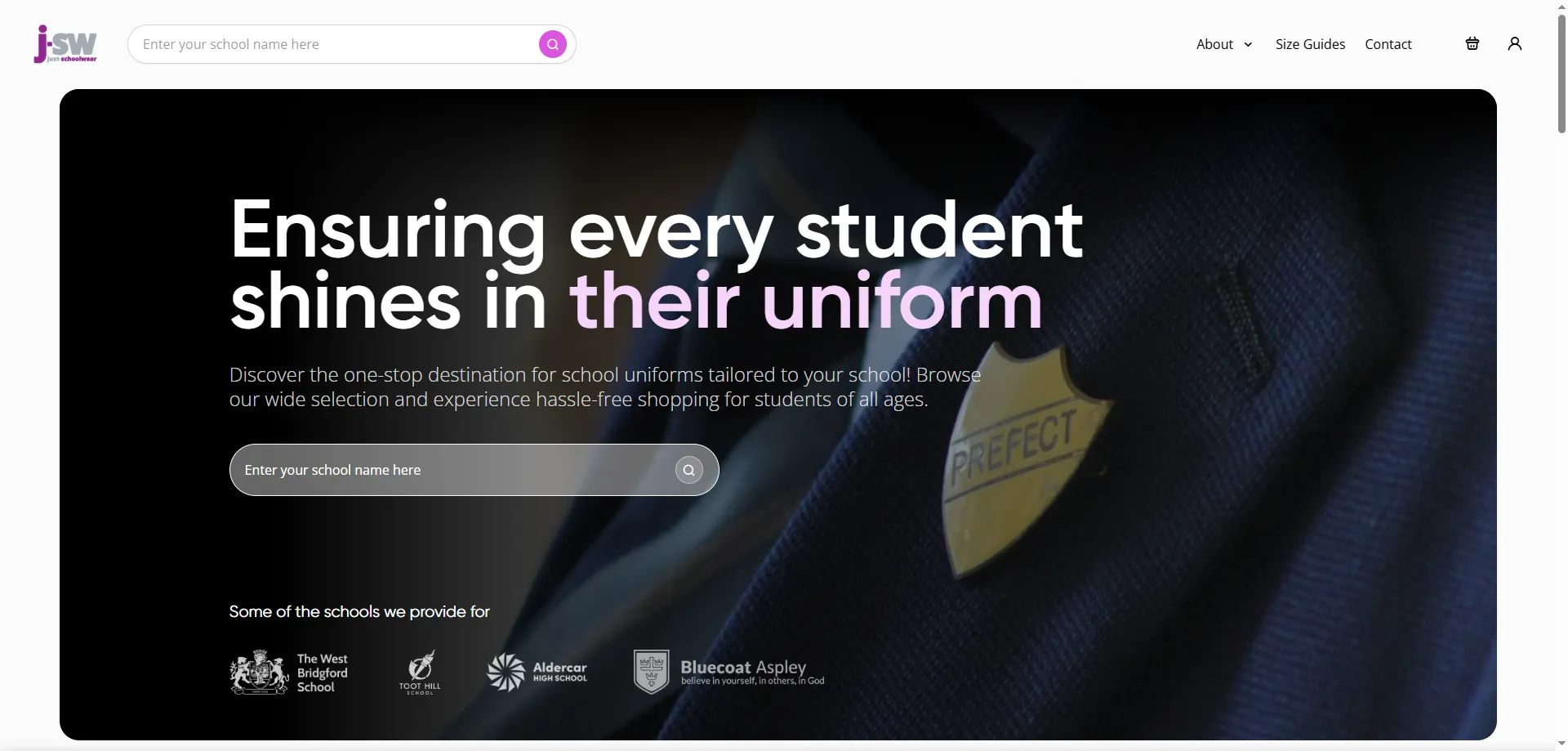
Just Schoolwear is built around steady assortment continuity and straightforward ordering.
Repeat ordering is where retail programmes live or die, so walk the reorder flow in their portal before committing, and confirm it holds through July and August.
Demand hard colour-consistency data across dye batches using ISO 105-J03 testing, and review on-time delivery metrics for the previous August peak.
🛡️ Our Verdict: Excellent operational reliability for standard retail ranges; private-label work is outside their wheelhouse.
10. School Uniform Direct
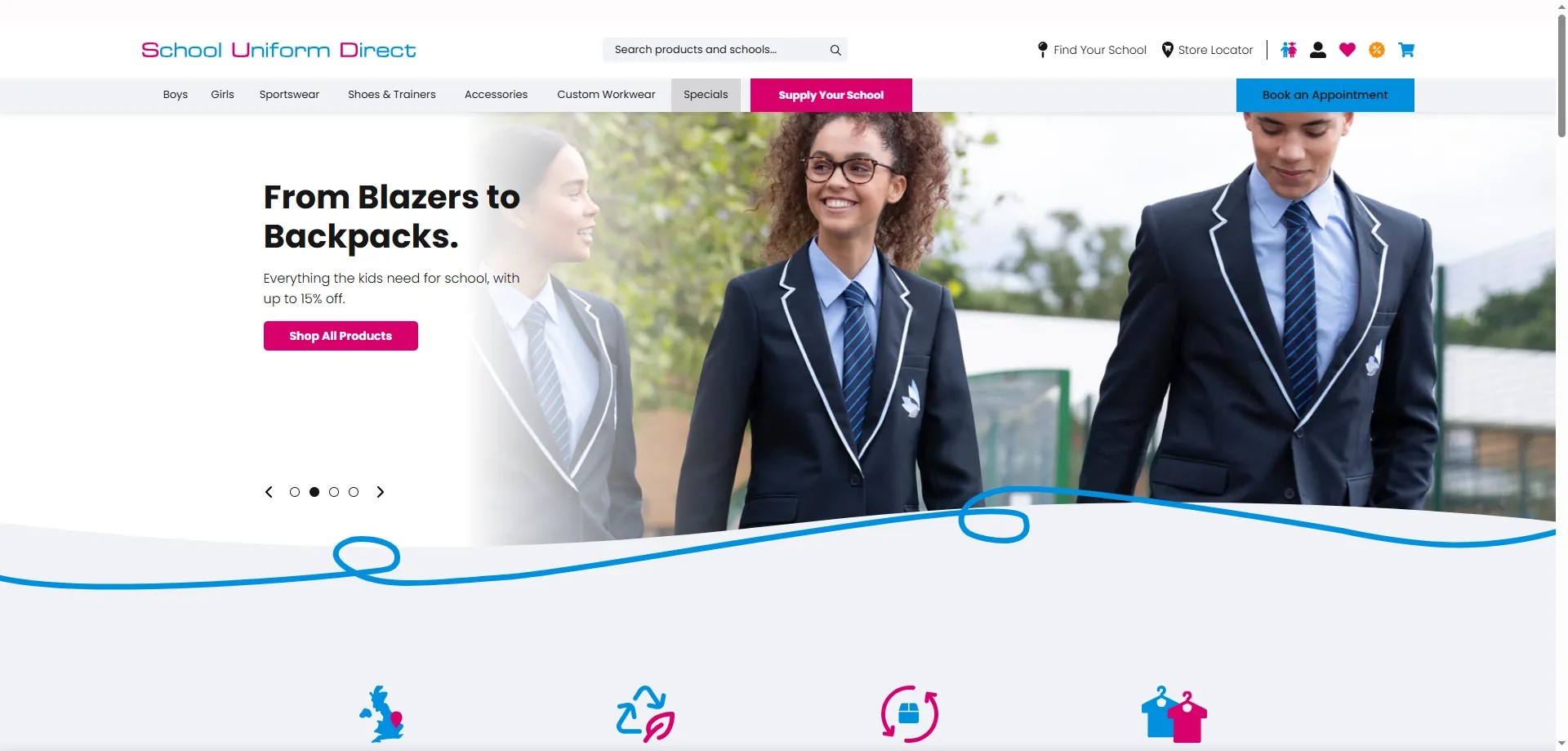
School Uniform Direct offers a shorter supply route, and its broad assortment fits wholesale and school-shop models — but convenience is not quality control. Ask for raw seam strength data, exact REACH compliance certificates for fabric dyes, and physical samples before committing to bulk.
🛡️ Our Verdict: Excellent accessibility for off-the-shelf stock; for private-label development, look to a specialist manufacturer instead.
11. Winterbottom’s Schoolwear
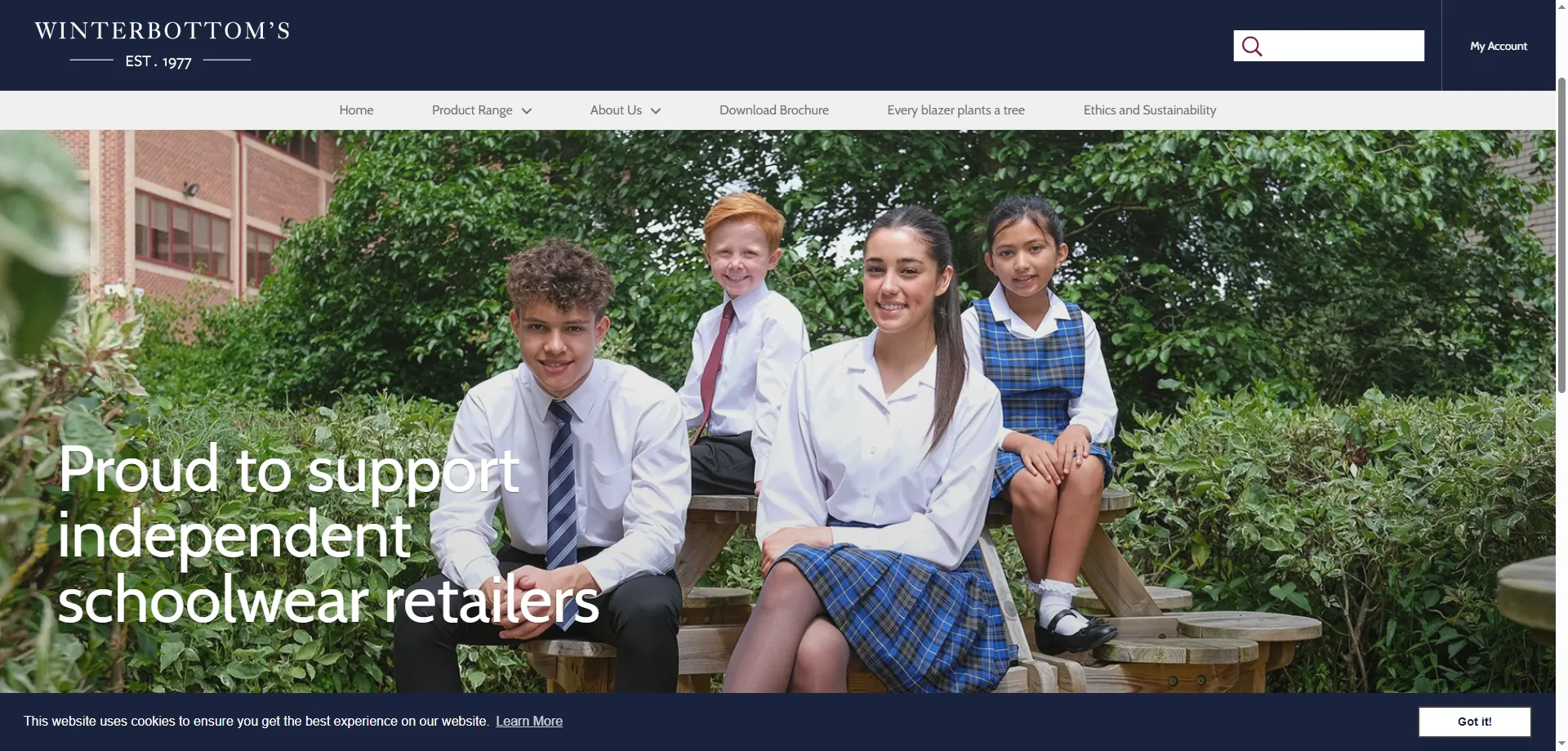
Evaluate Winterbottom’s if local responsiveness matters more than scale: ask for reference accounts of a comparable size, and check August response times rather than the annual average.
Verify durability against British Standards for textiles — raw fabric tear strength data and exact on-time delivery percentages for the previous August peak.
🛡️ Our Verdict: Strong local support, but the model is regional — national-scale volume is not the right brief, and enterprise private-label flexibility sits elsewhere.
12. School’s In
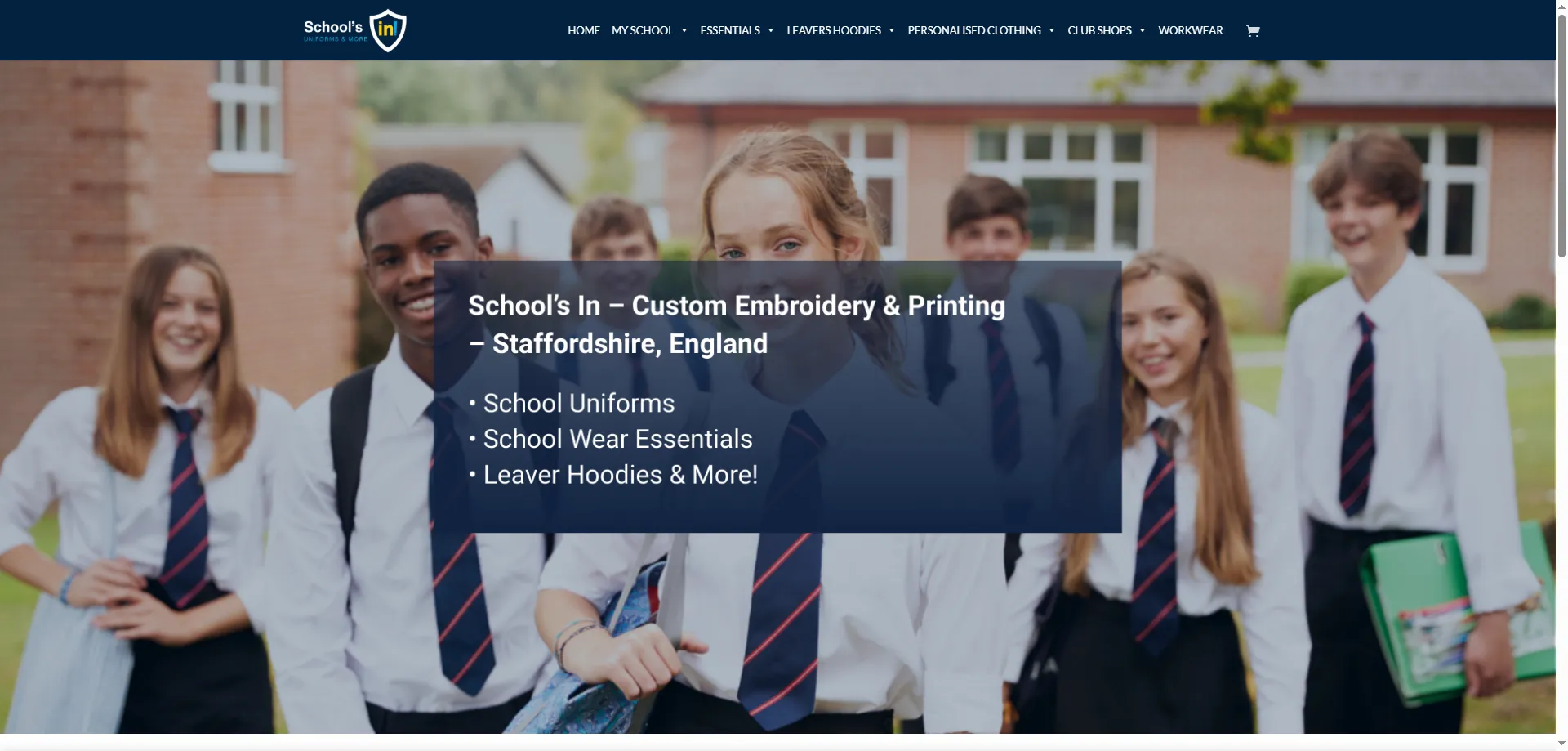
School’s In bridges bulk supply and front-line retail, and is built around parent-facing logistics — but you still own the compliance risk, so demand raw AZO dye test reports and exact mid-season replenishment lead times before signing.
🛡️ Our Verdict: Genuinely accessible for smaller, local school networks; national wholesale buyers need a different tier, because localised inventory is not built to carry enterprise volume.
UK Suppliers or Factory Direct?
These 12 groups get finished uniforms to parents in the UK. Factory-direct private-label is a different route — decide which one the brief needs before shortlisting.
| If the brief is… | The route that fits |
|---|---|
| Parent portals, on-campus fittings, mid-term restocking | A UK retailer or managed supplier from the list above |
| Standard staples at volume, range already designed | A UK manufacturer-wholesaler, such as Price & Buckland or One+All |
| Private-label production, minimum order quantity (MOQ) 100 pieces, DDP (delivered duty paid) to the school | Factory-direct school uniform manufacturing |
How to Qualify Your School Uniform Manufacturing Partners?

Use this 5-point scorecard to vet suppliers. Every step asks for documentation rather than assurances.
Step 1: Audit Product Breadth and Durability
Make sure the school uniform types on offer cover the full programme. A 65/35 poly-cotton blend is the standard workhorse for schoolwear bottoms: demand a 160 GSM floor for basic bottoms, 170–200 GSM for heavier structured fabrics, and roughly 200 GSM for polos to stop the collar curling.
Step 2: Demand the Full Compliance Pack
Never accept verbal claims: dark colourways are where wash fastness fails first, so require ISO 105-C06 data for every navy and black shade rather than a single light-colour sample.
Mandate children’s garment safety checks under BS EN 14682. For cut and sew services, verify audit scores before asking for a price. The rules also changed what can be required — see FAQ 7 on the 2026 branded-item caps.
Step 3: Require Real Sustainability Proof
Force suppliers to prove environmental claims: ask for raw material transaction certificates rather than a summary. Counterfeit certification tags circulate in this market, so check the certificate number against the issuing body’s own register.
Step 4: Map the Sample Approval Workflow
Check their size guide before ordering — missed sizing drives parent returns, the cost that never shows up in the unit price. Approve branded packaging and private-label samples physically before mass production begins.
Step 5: Secure BTS Critical-Path Reliability
Force the factory to guarantee pre-production, bulk production and warehouse arrival dates ahead of the July–August peak. Overseas suppliers work to a different public-holiday calendar, so buffer your timeline by two weeks rather than assuming a same-day reply.
Frequently Asked Questions About School Uniform Manufacturers in the UK
1. What compliance checks do UK school uniform buyers need before raising a PO?
Demand OEKO-TEX certificates for chemical safety and BS EN 14682 test data before sending a purchase order — the standard governing cords and drawstrings on children’s garments, where these audits most often fail.
2. How do I verify durability and sustainability claims for schoolwear?
Broad environmental statements carry zero weight: demand raw transaction certificates for Global Organic Textile Standard (GOTS) and GRS materials, because chain of custody has to be proven, not asserted.
On durability, set 160 GSM as a floor weight and 2% as a maximum shrinkage limit, and require the pilling data behind both.
3. When should I start ordering for the Back-to-School season?
Lock in orders by February. An April order leaves no buffer if a fabric runs out or a sailing gets rolled, and there is no recovery window before August. Wholesalers cover urgent inventory gaps; for logo embroidery and custom sizing, compare factory-direct school uniform manufacturing instead.
4. How do I bypass middleman markups for custom orders?
Trading companies hide their production sources. Work directly with the factory floor for control over your timeline and raw materials — for factory transparency and rapid 3D prototyping, contact us.
5. Should I buy school uniform from a manufacturer or a retailer?
Decide by which half of the problem you own. A manufacturer gives control of fabric, construction and certification at source — sizing and parent distribution become yours.
A retailer or managed supplier absorbs parent logistics: ordering, fittings, bagging, returns. Brand-wholesalers sit between, designing the range while a partner factory makes it — so ask for the factory name with the test report.
6. Who is the largest UK school uniform supplier?
It depends what you measure. By UK schoolwear volume, Banner Ltd — around 6.5 million garments a year, sold to retailers and wholesalers rather than direct to schools.
By group revenue, Schoolblazer Group, assembled by Hancock & Gore at roughly A$181m pro-forma, including Australia and New Zealand. Banner supplies your supplier; Schoolblazer is the programme itself, so the two only compare once the buying layer is clear.
7. What does the Children’s Wellbeing and Schools Act 2026 change for UK school uniform buyers?
From September 2026, schools in England may make no more than three branded items compulsory at primary level, and four at secondary or middle level — one must be a tie. PE kit counts.
The definition is the part most buyers miss: an item is branded not only when it carries the logo, but when its colour, design or fabric means it can only be bought from particular suppliers. A school-specific navy blazer with no logo still counts.
That shifts volume toward generic staples — the plain navy skirt or polo a parent can buy anywhere — so the strongest brief is no longer “match our exclusive uniform exactly” but “make a durable, correctly coloured staple that survives high-street comparison”.
Ask for colourfastness and GSM data on those lines.

Leave a Comment
Your email address will not be published. Required fields are marked *