Table of Contents
The short answer Nine Chinese suppliers cover bulk hi-vis demand. What separates them is not the certificate — it is whether the tape still performs after laundering. Ask for photometric data on the production lot. MOQs from 100 units.
A budget safety jacket is a liability trap. High-visibility garments have to meet the reflective-tape requirements of ANSI/ISEA 107. When cheap tape fails that check, the saving turns into a compliance failure.
We audited 9 safety jacket manufacturers in China against a single compliance checklist. Each entry below was scored on transparent certification and flexible OEM/ODM capability.
Use this shortlist to start, then run your own license checks and work through the compliance requirements before final approval.
Disclosure: LantaoWork is a hi-vis garment manufacturer, not a directory. This shortlist is built on production-floor work, and LantaoWork is not on it. The quote buttons below reach the LantaoWork sales desk — they are not the suppliers’ contact forms.
Methodology: The production and QA team spent 40 hours in 2026 auditing all 9 factories below — factory-floor visits, sample inspections, and document reviews.
The 9-Supplier Shortlist at a Glance
Looking for a bulk hi-vis supplier? Here are 9 vetted factories, with the one item to pin down before committing.
| Company Name | Main Product | Business Type | Pin this down first | Service Feature |
|---|---|---|---|---|
| YGM | Reflective Safety Jackets | Manufacturer | Tape photometrics per lot | Custom reflective programs |
| Loto Garment | Hi-Vis Workwear | Manufacturer | Tape brand + ISO 9001 trail | Bulk hi-vis production |
| Yongshengsafe | Safety Protective Wear | Manufacturer | Certificate scope covers the jacket | Industrial safety specialization |
| Linko Fun | Reflective Apparel | Trading + Mfg | Shell hydrostatic head (AATCC 127) | Custom OEM/ODM |
| Xh Reflective Vest | Hi-Vis Vests & Jackets | Manufacturer | Taped-seam test on a real sleeve | High-volume vest production |
| Garments | Corporate uniforms & basic workwear | Manufacturer | Seam strength figure (N/cm) | Broad OEM/ODM, high volume |
| Anbu Safety | PPE range (hard hats, boots, vests) | Manufacturer | Shell mill + trapezoid tear figure | Single-PO PPE consolidation |
| Goodlife Textile | Gray & finished fabric | Textile mill | Stitch + tape alignment audit | Custom fabric development |
| China Stars | Reflective material & garments | Manufacturer | ΔE ceiling + sealed reference swatch | In-house reflective tape |
1. YGM: Best for Reflective Materials and Certified Programs
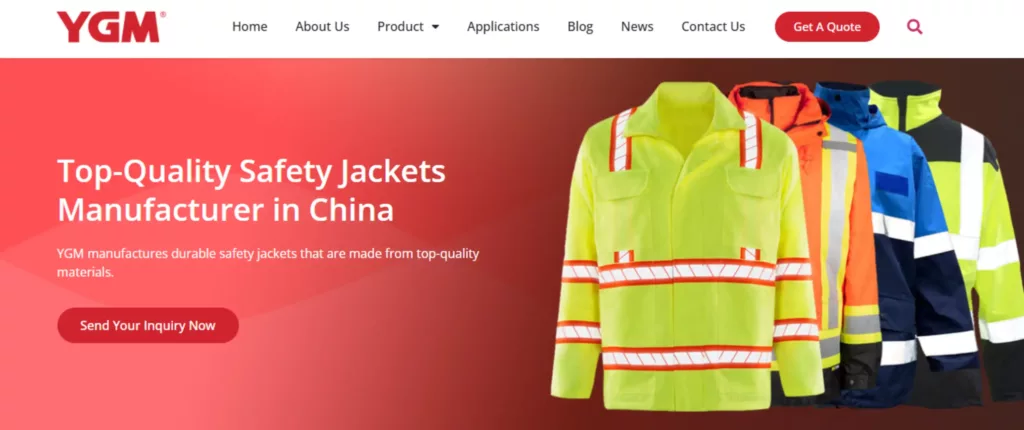
YGM fits buyers who want one factory handling both in-house reflective tape engineering and finished safety garments. Among the hi-vis specialists we audited in China, few combine the two.
Making the tape in-house removes one layer of batch variation. It still clears the same floor: EN ISO 20471 Table 4 sets 330 cd/lx·m² at 0.2° observation and 5° entrance angle.
Ask for that photometric line on the actual lot, before and after washing. General company certificates are not enough — whether the tape flakes is decided by the film grade and the sealing process, not by the brand on the certificate.
They handle OEM custom programs well. Watch the dyeing lead times — custom fabric colors often add 14 days to production.
🛡️ Our Verdict: YGM solves the biggest headache in safety workwear procurement: failing tape reflectivity. Always request the raw ANSI/ISEA 107 certificate for your specific reflective lot.
2. Loto Garment: Custom Hi-Vis Workwear Factory Snapshot
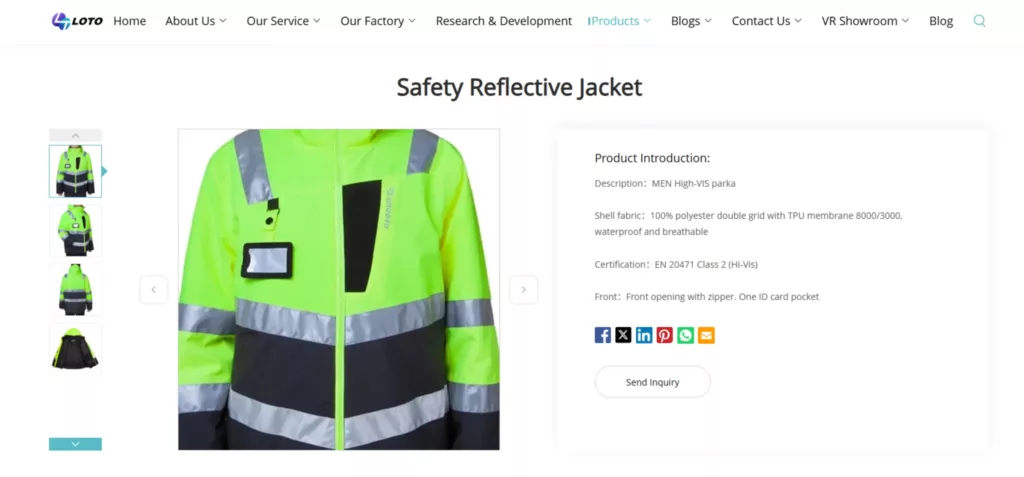
Add Loto Garment to the shortlist for turning complex private-label tech packs into bulk-ready gear. As one of the more agile hi-vis workwear factories in China, it fits buyers balancing deep customization with real production limits.
When I audited their cutting room, the cutting-room supervisor built the prototype in eight days. Sample changes still need tight control, so ask exactly where they buy their technical fabrics and reflective tapes.
Their stock tape spec is the thing to pin down first. Industrial laundering is where cheap retroreflective film fails, and ANSI/ISEA 107 requires the tape to still perform after washing.
Do not compare their pricing without checking their paperwork. Demand to see their raw ISO 9001 audit trails and recent AQL 2.5 defect reports for previous runs.
🛡️ Our Verdict: Loto Garment builds custom outerwear efficiently. Always mandate your exact tape brand before you approve the final prototype to prevent bulk compliance failures.
3. Yongshengsafe: Compliance-Focused Supplier Snapshot
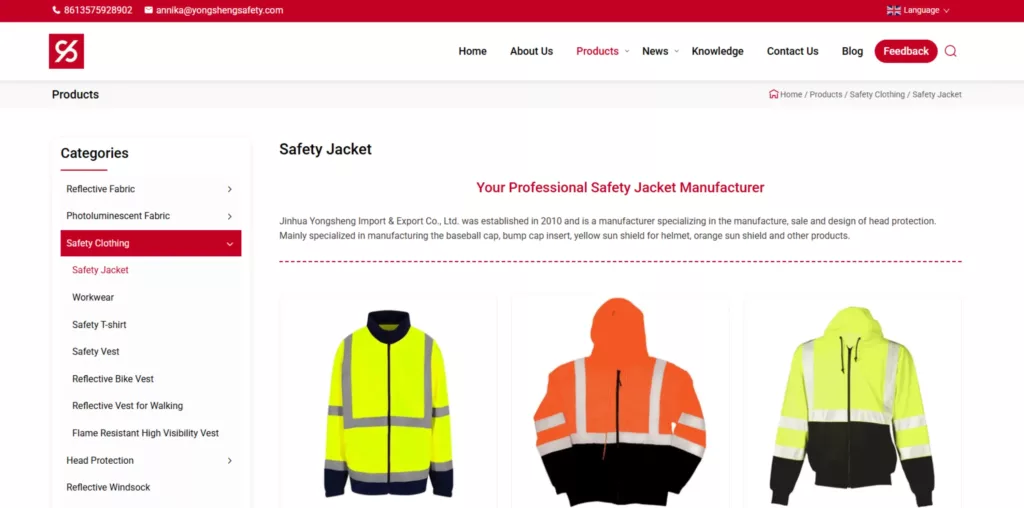
Safety managers hate when vendors hide behind generic compliance claims. In my experience auditing hi-vis factories, Yongshengsafe stands out for strict EHS-led procurement.
They avoid casual distributor work. The factory floor produces safety apparel only, with zero line space given to generic workwear.
Constructing a waterproof safety jacket requires specialized PU seam-sealing machines. Basic vests do not need them. The trap is scope: an EN ISO 20471 certificate names the garment type it covers, so check that the jacket — not just a vest — appears on it.
Set tensile and tear figures in the tech pack, then require raw data against them. A supplier that stalls on providing it comes off the shortlist.
🛡️ Our Verdict: Yongshengsafe excels at EHS specialization. They are a top choice for strict compliance, but you must demand jacket-specific test reports before wiring a deposit.
4. Linko Fun: Custom Reflective Outerwear Supplier
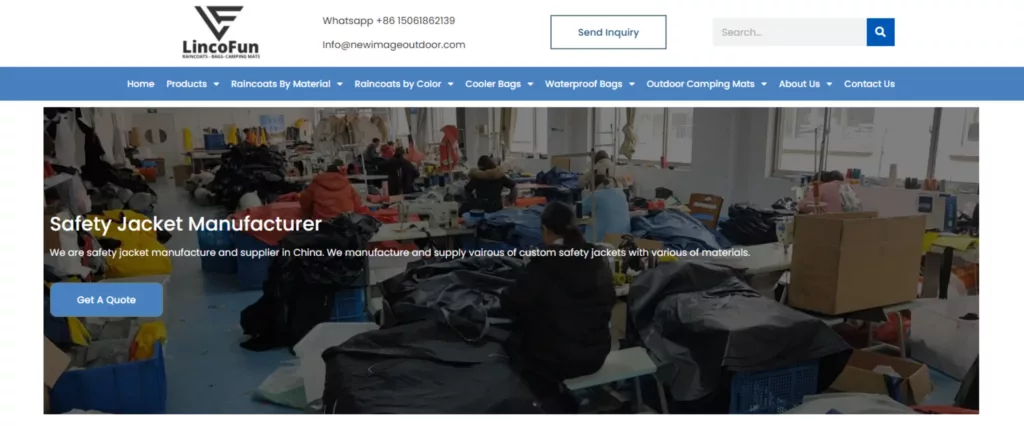
Investigate Linko Fun for fast, basic promotional outerwear — not heavy industrial safety gear. We found it excels at light private-label branding but treats a pocket layout change as new CAD work rather than a revision.
Their production manager put a number on it: “Changing the pocket layout requires new CAD files and adds 10 days to production.”
Use this evaluation checklist:
- Customization Scope: Do they offer waterproof heat transfers or just basic embroidery?
- Material Sourcing: Do their tapes meet ANSI/ISEA 107 visibility standards?
- Technical Limits: Can they source high-denier fabrics for abrasion resistance?
Their stock shell is built for light rain, not sustained waterproofing. Ask for AATCC 127 hydrostatic head data on the fabric you would actually order, and set the mm target before sampling.
🛡️ Our Verdict: Put Linko Fun on a secondary custom-outerwear shortlist. Serious safety-jacket RFQs require a heavier industrial partner.
5. Xh Reflective Vest: Bulk Reflective Vest and Jacket Supplier Snapshot
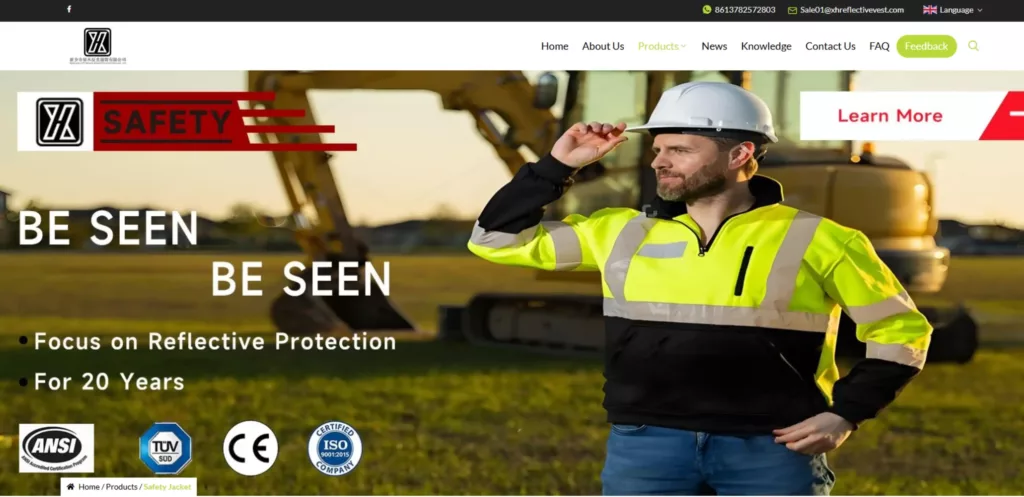
Xh Reflective Vest is built around bulk production, not complex outerwear. Lightweight vests need only basic overlock stitching; insulated jackets demand heavy-duty machines and taped seams. Assuming one maker can do both is the costly mistake.
During my floor audit, the line supervisor highlighted this gap. “The machines fly through 120-gram polyester mesh,” they pointed out. “But feeding 300D Oxford cloth with winter insulation snaps the standard needles.”
Verify fabric weight per unit area, then put an ISO 811 hydrostatic figure on the taped seams of the actual sleeve, not a flat panel.
🛡️ Our Verdict: Book Xh Reflective Vest for high-volume vest orders. Avoid them for complex safety jackets unless you implement strict hydrostatic tests and seam inspections.
6. Garments: General Workwear and Safety Jacket Manufacturing Snapshot
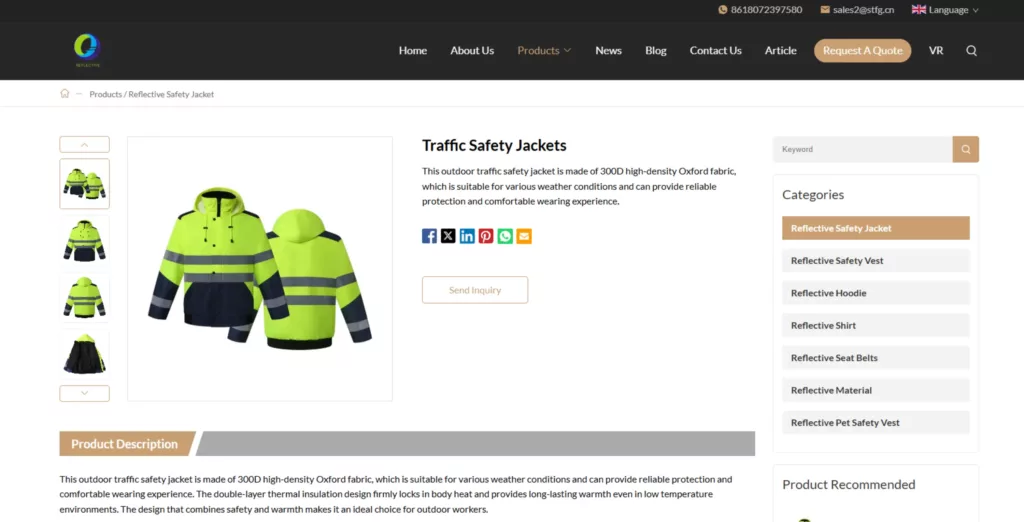
On paper this looks like a safety jacket supplier; in practice it is a broad apparel maker. The production breadth delivers real OEM and ODM flexibility for standard corporate uniforms, but safety jackets remain a minor side category.
During my walkthrough, the floor manager showed me sewing lines built for light workwear, so seam strength breaks first. Fix a newtons-per-centimetre figure in the tech pack and require an EN ISO 13934-1 strip tensile report against it.
EN ISO 13688 sets the general requirements for protective clothing — innocuousness, sizing, marking — and leaves the actual strength figures to the product standard and the tech pack.
Specify trim grade there as well. On heavy jackets the zipper tape, not the shell, is usually the first thing to give, and OSHA’s PPE rules put that selection duty on the employer.
Use this simple procurement rule. For 5,000 corporate polos and 200 basic warehouse vests, this generalist factory works well. For a crew facing high-risk environments, a dedicated PPE specialist must win.
🛡️ Our Verdict: Choose this factory for high-volume basic workwear programs. Skip them for heavy safety jackets. Seam strength and trim grade are the two items to re-spec if you push them into industrial PPE.
7. Anbu Safety: Broad PPE Supplier
Juggling three vendors for hard hats, gloves, and jackets wastes procurement time. Anbu Safety solves vendor bloat — one purchase order covers the whole PPE supply chain. Skip them for specialist hi-vis work needing a dedicated factory.
When I audited their main warehouse, the warehouse manager showed me the mixed-container process. The team loads hard hats, safety boots, and basic high-vis jackets together on a single pallet, which cuts freight costs.
This broad catalog creates a technical gap. Consolidators buy textiles in, so the fabric under the shell is rarely their own spec. Ask which mill supplies the shell and what trapezoid tear figure applies.
No universal minimum exists: tear figures come from ASTM D5587, and the number worth accepting comes from a risk assessment on the work zone.
Coating durability is the other item to pin down. A standard PU film and a wash-durable one read identically on a spec sheet, so ask for the wash-cycle data behind the claim.
🛡️ Our Verdict: Book Anbu Safety to consolidate basic PPE orders and streamline logistics. Avoid them for technical apparel that requires strict tear strength or waterproof compliance.
8. Goodlife Textile: Textile-First Hi-Vis Supplier Snapshot
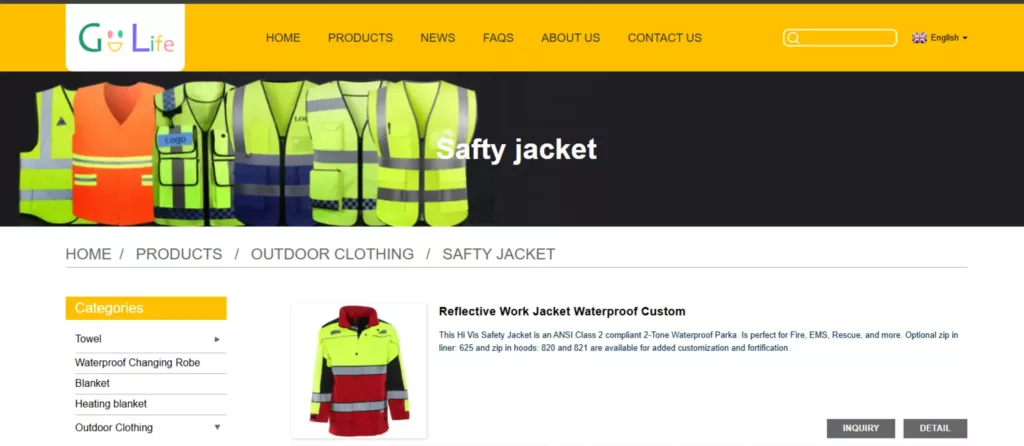
Shortlist Goodlife Textile for custom fabric development. Do not use them as a primary safety jacket supplier without strict garment testing.
Goodlife operates primarily as a textile mill. They excel at weaving and finishing raw materials. When I toured their facility, I inspected their 300D Oxford cloth — this is a mill that controls its own finishing, which is the actual product being bought.
Turning raw fabric into compliant safety gear introduces risk: textile mills often lack the heavy-duty sewing infrastructure hi-vis work demands. Test fabric and garment separately — a shell can pass every fabric test and still fail at the seam.
Garment construction is the part to audit. Check seam run-off, stitch density at the armhole, and whether the tape is aligned to the EN ISO 20471 band layout on the finished piece.
Demand independent lab reports for seam strength and tape adherence, and keep the OSHA interpretation on high-visibility garments on file.
🛡️ Our Verdict: Goodlife Textile dominates custom fabric sourcing and price benchmarking. They struggle with complex garment assembly. Mandate strict stitching audits before ordering bulk finished goods.
9. China Stars: Large-Scale Reflective Material and Safety Clothing Manufacturer
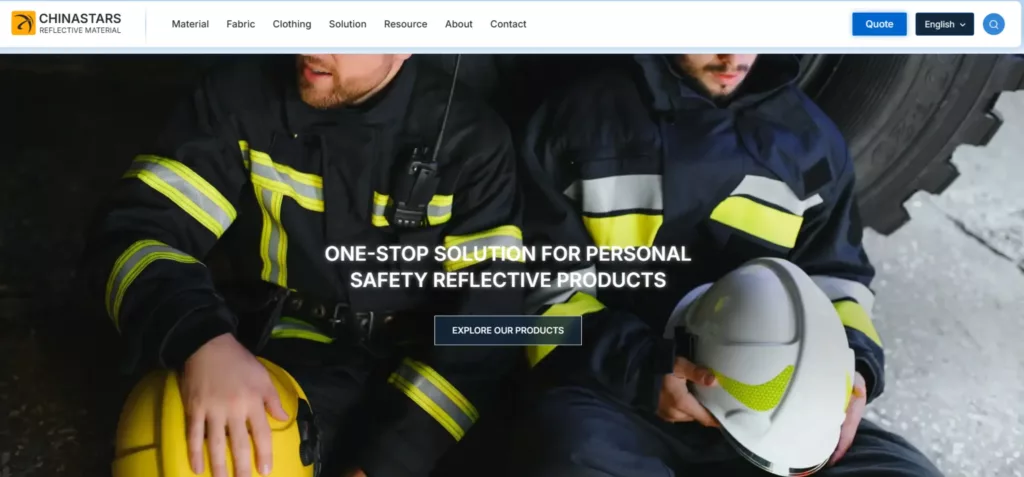
China Stars solves the color-matching headache that ruins corporate uniform programs for large-volume buyers. As one of the largest hi-vis suppliers in China, they control both raw reflective materials and finished clothing.
When I audited their facility, their operations director pointed to the continuous-feed material lines. “We manufacture the reflective tape in-house before sewing,” he noted.
Color consistency is the thing to contract, not to hope for. Fix a Delta E ceiling in the tech pack, keep a sealed reference swatch of the approved run, and check every repeat lot against it.
Their scale creates friction. Custom branded zippers mean a 21-day delay on approved trims, so demand raw testing records for every fabric batch and confirm they support multi-style programs rather than single-SKU bulk runs.
🛡️ Our Verdict: China Stars anchors the supply chain for enterprise buyers. Book them for consistent repeat orders, but build a 21-day buffer for custom trims.
Safety Jacket Supplier Audit in 3 Steps
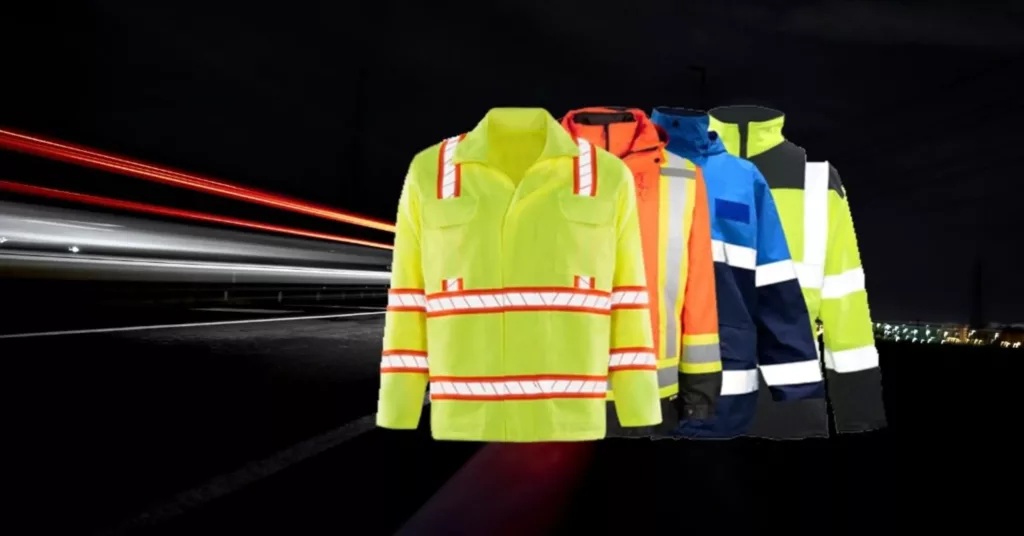
Sourcing a compliant safety jacket? Follow this three-step audit to vet manufacturers, verify their documents, and test the materials before committing to a bulk order.
Step 1: Execute the Four-Point Compliance Check
During my audits, many suppliers are rejected on paper alone. Generic marketing claims are not evidence. The documents have to be verified directly.
- Match the legal entity. Compare the factory name on the business license directly with the compliance certificates. Walk away if the names do not match.
- Demand batch-specific data. Ask for raw test reports for the exact fabric for safety vests and reflective tape you plan to buy. Lightweight Oxford and carded polyester both pass a visual check and fail a strip tensile test, so ask for raw numbers rather than a promise.
- Review the OEM workflow. Ask the factory manager how an initial tech pack becomes the final golden sample. Track the exact timeline. Expect a seven- to ten-day sampling process.
- Require third-party checks. Mandate an independent pre-shipment inspection, and make safety uniform compliance a pass/fail gate before the final invoice is paid. State EN ISO 20471 as the standard the inspection tests against.
Class is not a marketing label — it is a measured surface area. The two standards set different thresholds and measure them on different bases, so fix the class against the work zone before comparing quotes.
| Standard | Class / Type | Min. background material | Min. retroreflective material | Work zone it covers |
|---|---|---|---|---|
| EN ISO 20471 | Class 1 | 0.14 m² | 0.10 m² | Company yards, off-road sites, traffic up to 30 km/h |
| EN ISO 20471 | Class 2 | 0.50 m² | 0.13 m² | Urban road works, twilight work, traffic up to 60 km/h |
| EN ISO 20471 | Class 3 | 0.80 m² | 0.20 m² | High-speed roads, night work, traffic over 60 km/h |
| ANSI/ISEA 107-2020 | Type O, Class 1 | 217 in² | 155 in² | Off-road and non-roadway work only |
| ANSI/ISEA 107-2020 | Type R, Class 2 | 775 in² | 201 in² | Roadway work — the practical minimum on public roads |
| ANSI/ISEA 107-2020 | Type R, Class 3 | 1,240 in² | 310 in² | High-speed and night-time roadway work |
Two details change what a compliant order can actually contain. ANSI/ISEA 107-2020 lets the smallest size in a Type R Class 2 or Class 3 range drop to 540 in² and 1,000 in² of background material, with the retroreflective minimum unchanged.
That is a size-grading allowance, not a license to shrink the whole run. On the EU side, areas are measured on the garment as worn, in its smallest size, closed — so a logo patch that covers tape can pull an otherwise compliant shell out of class.
Step 2: Audit Materials and Physical Construction
A solid paper trail means nothing if the physical jacket fails on the floor. The flaws that matter do not show in a catalog photo, so test the approved sample before committing to bulk. Ask a safety vest manufacturer these exact questions.
- Test waterproofing and breathability. Verify the shell fabric blocks water while letting sweat escape. Look closely at the polyurethane seam sealing. As the quality manager at one plant showed me, “If the taping machine exceeds 160 °C, the seam tape becomes brittle and leaks instantly.”
- Measure the reflective tape. Verify the exact tape width and type. Require the tape to still pass 25 ISO 6330 washes at 60 °C, the standard’s floor. If the buyer’s laundry runs heavier, put a higher count — 50 cycles — in the spec.
- Check logo durability. Demand physical wash-testing records for previous runs. A custom heat-transfer logo must not crack in freezing temperatures.
- Expand the gear audit. Apply the same strict material standards when sourcing types of safety glasses or evaluating different types of safety footwear for your crew.
The pattern on failed lots is always the same: the tape passed on the certificate and failed on the garment.
We wash incoming tape lots to the ISO 6330 cycle before they reach the cutting table, and set the count from the buyer’s laundry rather than the supplier’s stock spec.
Every row below is something a laboratory can print on letterhead. If a factory cannot produce it, the jacket is unverified rather than compliant.
| What to verify | Test method | Baseline to fix in the tech pack |
|---|---|---|
| Tape retroreflectivity, initial | EN ISO 20471 Table 4, 0.2° observation / 5° entrance | 330 cd/lx·m² minimum |
| Tape retroreflectivity after washing | ISO 6330, 60 °C, 25 cycles | Must still meet the standard’s post-wash minimum |
| Background material area | Measured on the garment as worn, smallest size, closed | Class 1: 0.14 m² · Class 2: 0.50 m² · Class 3: 0.80 m² |
| Retroreflective material area | Same measurement basis | Class 1: 0.10 m² · Class 2: 0.13 m² · Class 3: 0.20 m² |
| Fabric mass per unit area | ASTM D3776 | Tech-pack GSM, ±5% |
| Shell water penetration | ISO 811 hydrostatic head | Buyer’s mm target, fixed before sampling |
| Tear strength | ASTM D5587 | Agreed newtons, with the test direction stated |
| Seam strength | EN ISO 13934-1 | Agreed newtons per centimetre, with the test direction stated |
| Colorfastness to washing | ISO 105-C06 | Agreed gray-scale pass level |
| Batch color difference | Spectrophotometer, ΔE | Agreed ΔE ceiling across repeat runs |
| Label content | EN ISO 13688 | Pictogram, care, size, manufacturer, standard |
| Final inspection | ISO 2859-1, AQL 2.5 | No more than 2.5% major defects in the inspected sample |
The final row is the one buyers most often get wrong. AQL 2.5 is an acceptance level, not a defect count: samples are pulled per the ISO 2859-1 tables, so the permitted number of major defects moves with the sample size.
Step 3: Run a Side-by-Side Sourcing Benchmark
The vetting method is now clear. It is time to test the market. I always run a benchmark test before signing any major purchase contract.
- Gather your exact specs. Compile the detailed tech pack, target safety standard, total order quantity, and destination market.
- Submit the data. Send these details through the contact page. The sourcing desk runs a side-by-side benchmark against a proven factory network and returns an immediate comparison of lead times and material costs.
Frequently Asked Questions about Safety Jackets Manufacturers in China
1. How do I verify ANSI or ISO compliance from a Chinese safety jacket manufacturer?
Do not trust a simple PDF certificate; factories often use expired documents. The only useful ask is raw, batch-specific test reports on the exact jacket being bought.
One client brought us a failed shipment that had passed on paper: compliant fabric with cheap non-compliant tape glued over it. Always ask for third-party lab data on the photometric performance of the production run.
2. What are reasonable MOQ and sample expectations for custom safety outerwear?
Expect a minimum order quantity of 100 to 300 units for custom reflective jackets, and prototyping in seven to ten days. Specialist hi-vis factories accept small batches far faster than broad OEM suppliers, who need volume to justify a line.
3. When is a very low quote a red flag instead of a win?
A rock-bottom price usually means material substitution. When I review ultra-low bids, I regularly find factories swapping high-denier Oxford cloth for cheap carded polyester, or using standard zippers instead of heavy-duty industrial models.
If a quote looks too cheap, assume substitution until an AQL 2.5 report on a previous run says otherwise.
4. What must I inspect before my reflective safety jackets ship?
Test the reflective tape, fluorescent fabric, heavy stitching, and waterproof construction. For seam strength, fix a number in the tech pack and require a strip tensile report. For winter zippers, put a cycle count in the spec and ask for the record.
Waterproof jackets need one more step: check the PU seam sealing physically before the pre-shipment inspection signs off.
5. How do I compare a specialist hi-vis factory with a broad OEM supplier?
The difference sits behind the sewing line. A broad supplier consolidates hard hats and vests onto one pallet and prices that in, but buys its technical fabric. A specialist owns the PU seam-sealing machines and runs daily hydrostatic tests.
For a crew in heavy industrial zones, the specialist is the only workable option. Reach out to the LantaoWork team for direct RFQ guidance.
6. What is a safety jacket called?
A safety jacket goes by several names depending on the market. US buyers ask for a hi-vis jacket, a high-visibility vest, or an ANSI Class 2 or Class 3 jacket. In the UK and EU, the same garment is a high-visibility jacket built to EN ISO 20471.
Reflective jacket and fluorescent jacket are loose trade terms for the same product family. For sourcing, the standard and class behind the name matter; the name itself does not.
7. Who are the top safety jacket manufacturers in China?
The 9 factories above are the ones the audits put forward for bulk hi-vis supply. They are not ranked against each other — they are ranked against your spec. A factory that is ideal for high-volume mesh vests will fail a heavy insulated jacket program.
Shortlist three, run the same sample brief through each, and buy against verified tape data rather than a catalog claim.
8. Which certifications should a Chinese safety jacket manufacturer hold?
Three documents carry the weight. ISO 9001:2015 shows a real quality process rather than a claim. A test report for the finished garment against ANSI/ISEA 107 or EN ISO 20471, issued for the batch, is what a safety officer can accept.
A textile safety certificate such as OEKO-TEX Standard 100 covers restricted substances in the fabric itself. Ask for all three in the factory’s legal name, and check that the certificate scope names the garment being bought.

Leave a Comment
Your email address will not be published. Required fields are marked *