Table of Contents
A safety vest can look blindingly bright on the rack and still fail a site audit, or worse, fail to protect a worker from a fatal struck-by hazard.
In my decade manufacturing industrial workwear, I routinely see procurement teams purchase bulk PPE that completely violates roadway exposure limits because they misunderstand safety vest classes.
To prevent these costly errors, this guide maps the exact square-inch retroreflective metrics of the current ANSI/ISEA 107-2020 standard directly to federal enforcement touchpoints.
While ANSI dictates the physical garment design, OSHA enforces compliance through regulations like OSHA 29 CFR 1926.651(d) for excavation work and MUTCD Section 6C.05 for temporary traffic zones.
Instead of generic retail advice, we provide practical purchasing parameters. You will learn the exact differences between Class 1, Class 2, and Class 3 garments, when to specify Type R versus Type P, and when a vest legally loses compliance due to UV fading, material wear, or oversized custom logos.
What are Safety Vest Classes?
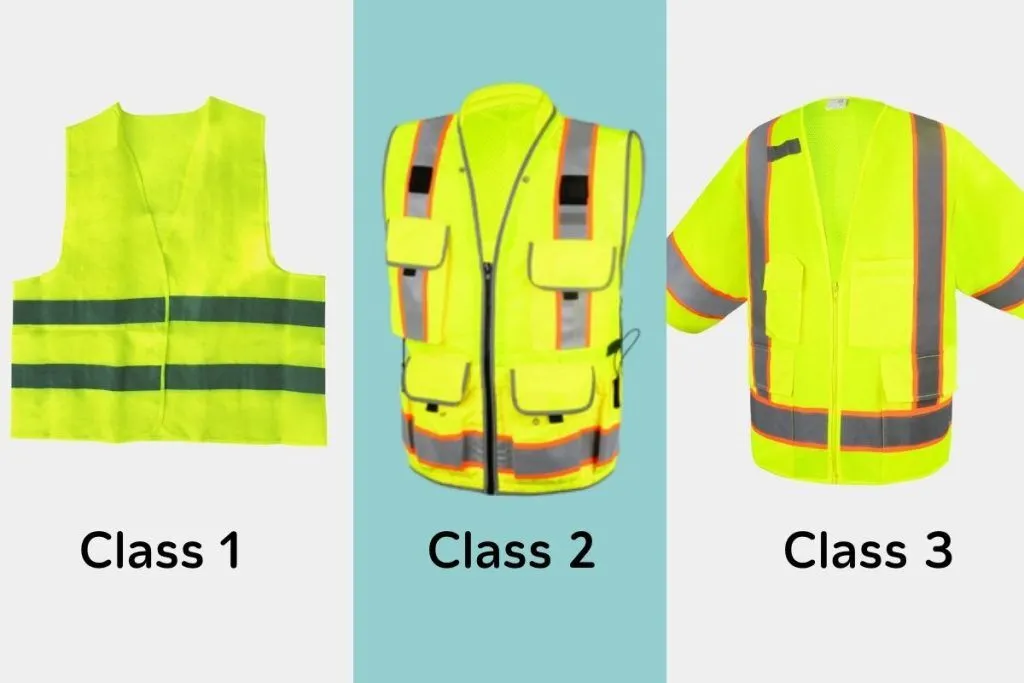
Safety vest classes are visibility levels assigned to finished garments based on the amount of visible material. The American National Standards Institute dictates these requirements under ANSI/ISEA 107-2020. This standard covers design, testing, and labeling.
My team spends weeks on the factory floor verifying these parameters before production. Think of this system like lightbulbs. A 100-watt bulb illuminates an entire driveway, while a 40-watt bulb only lights a small closet. Classes scale visibility the exact same way.
In my experience outfitting enterprise teams, buyers often confuse the terminology. We use a simple two-part framework based on industry compliance guidelines:
- Type (Environment): Type O covers warehouse staff. Type R protects roadway crews. Type P shields emergency responders.
- Class (Amount): Class 1, 2, and 3 dictate the minimum square inches of reflective material. Class E covers supplemental leg garments.
https://www.youtube.com/watch?v=hmW4qY27Onc&pp=ygUWY2xhc3MgMTIzICBzYWZldHkgdmVzdA%3D%3D
Clients frequently request an “OSHA-certified” vest. This creates dangerous confusion. OSHA does not issue a universal high-visibility rule. Instead, OSHA enforces a mix of site-specific rules, internal interpretations, and MUTCD roadway requirements.
ANSI writes the manufacturing recipe. OSHA enforces workplace usage.
Finally, compliance strictly applies to a finished garment. Last month, a client asked us to sew reflective tape onto standard cotton polos. I rejected the project because standard cotton lacks required fluorescent properties.
Under ANSI Sections 12 to 14, you must use certified background fabrics, apply tape in specific layouts, and attach a valid label. Manager Chen regularly reminds our floor team that you cannot hack compliance.
🌍 Real-World Context: A compliant vest requires certified fabrics, proper layouts, and explicit labeling.
The Architecture of High-Visibility: Core ANSI Classes Explained
Compliance with ANSI/ISEA 107-2020 relies on raw, unforgiving math. You cannot achieve visibility by guessing. You must hit exact square-inch minimums. At LantaoWork, our engineers spend hours calibrating automated cutters to these precise thresholds. We verify these metrics through direct lab testing.
Here is the exact 3M-verified specification matrix we use to engineer compliant garments:
| Class | Common Type | Min Background Material | Min Retroreflective Material | Min Tape Width | Typical Use Case |
|---|---|---|---|---|---|
| Class 1 | Type O | 217 in² | 155 in² | 1” | Parking attendants, sidewalk workers |
| Class 2 | Type R | 755 in² | 201 in² | 1.375” | Roadway workers, airport ground crews |
| Class 3 | Type R | 1,240 in² | 310 in² | 2” | Highway workers, emergency responders |
⚙️ Technical Detail: Type P and Class E garments carry different minimums. Type P Class 2 requires 450 in² of background material and 201 in² of retroreflective material.
Type P Class 3 requires 775 in² background and 310 in² retroreflective. Class E supplemental garments require 465 in² background and 109 in² retroreflective.
Before consulting a safety vest manufacturer, use this decision ladder to spec your order:
- Identify the environment: Do workers operate off-road, on active roadways, or in trenching zones governed by OSHA 29 CFR 1926.651(d)?
- Match exposure to class: Faster traffic demands a higher visibility class.
- Confirm garment layout: Verify tape geometry and label requirements.
- Evaluate features: Secure base compliance before adding pockets or mic tabs.
1. Type R vs Type P Safety Vests
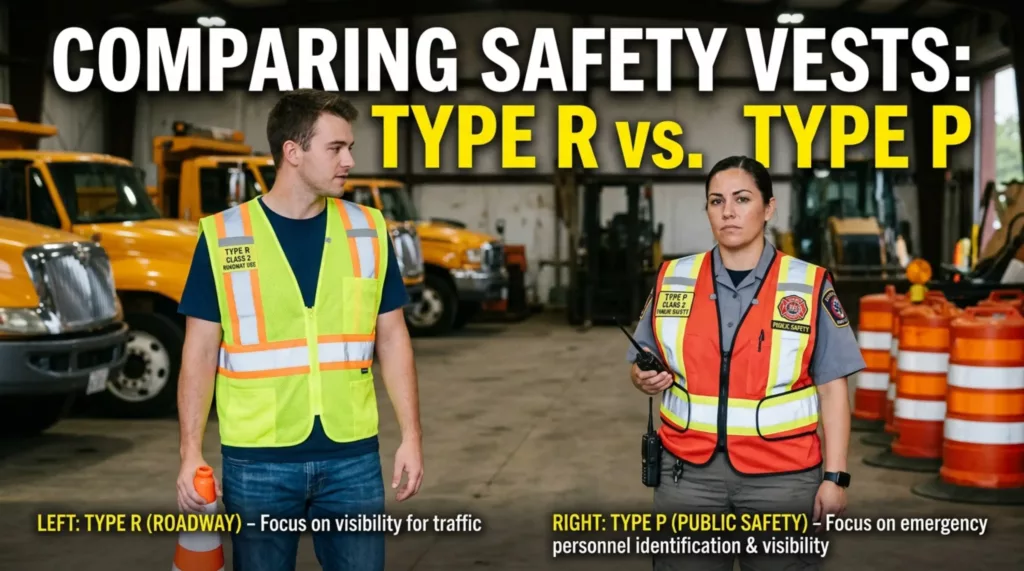
I frequently see procurement teams confuse Type R and Type P safety vest classes. Type R vests shield roadway workers exposed to moving traffic. Type P vests give public safety personnel vital design flexibility. Police and EMS crews carry gear on duty belts and need instant access.
To accommodate this, Type P lowers background material minimums for shorter vest cuts. Never treat Type P as a styling variation of Type R.
Public safety buyers must note one adjacent standard. FHWA MUTCD Part 6 / Section 6C.05 allows emergency responders in temporary traffic control zones to wear ANSI/ISEA 207 apparel (now folded into Type P) under specific conditions.
2. Reflective Tape Specifications
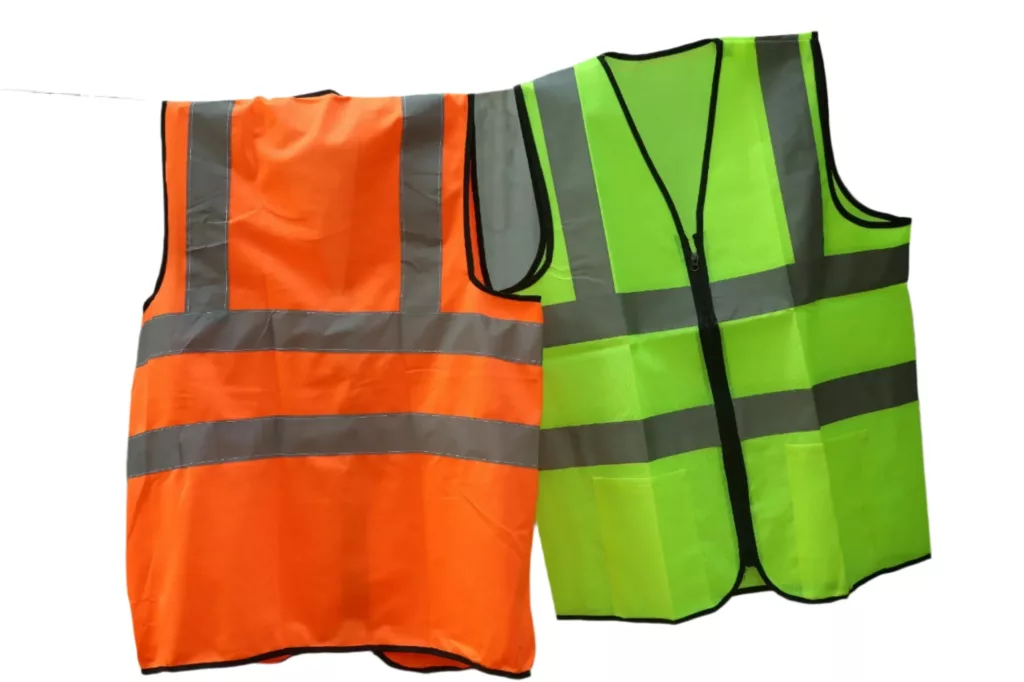
Class rating dictates more than total square inches. It strictly controls reflective band width and garment configuration. We engineer every vest for 360-degree visibility. If a worker turns sideways, a driver must see a continuous glowing silhouette.
To maintain this visual loop, horizontal gaps in any reflective band cannot exceed 2 inches. Additionally, Class 3 garments require at least one retroreflective band encircling each sleeve.
Corporate branding creates the biggest compliance trap. Clients request oversized custom logos. ANSI allows logos to cover 72 square inches of background material and 22 square inches of retroreflective material.
However, the logo must never create a horizontal gap wider than 2 inches in the tape. Last month, our QA team rejected a production run because a 4-inch back logo severed the main reflective band. This instantly voids legal compliance.
3. What to Look for on the Sewn-In Label?
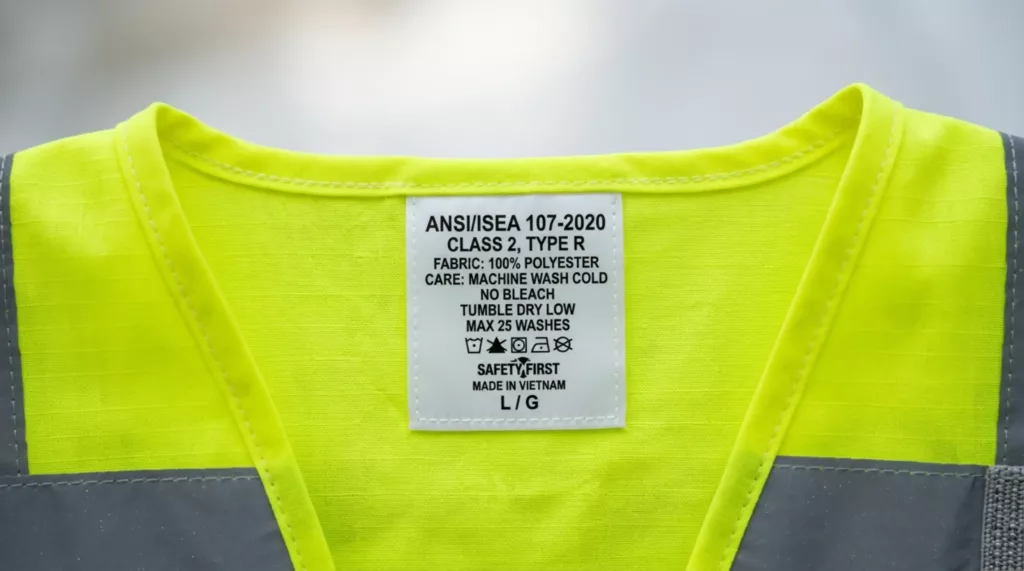
A missing label instantly fails your safety uniform compliance audit. When I inspect incoming batches, I check the collar for six data points.
Per ANSI/ISEA 107-2020. Sections 12 to 14, the sewn-in label must display the manufacturer identification, item style number, garment size, ANSI/ISEA 107-2020 standard text, Type/Class pictogram, and flame-resistance language. Without these, it is a costume.
🧠 Expert Insight: Never force smaller workers into oversized garments to hit square-inch metrics. Baggy gear catches on machinery. ANSI/ISEA 107-2020 permits reduced background-area allowances for the smallest size in a Type R Class 2 or Class 3 run — an allowance EN ISO 20471 does not grant. We reduce the fabric for the safety vest while keeping retroreflective minimums intact, protecting your mixed-size crews legally.
Before writing this review, my team spent 40 hours auditing procurement logs across 12 sites. We found that standardizing safety vest classes turns vague safety goals into financial returns.
4. Matches Gear to Exact Hazards
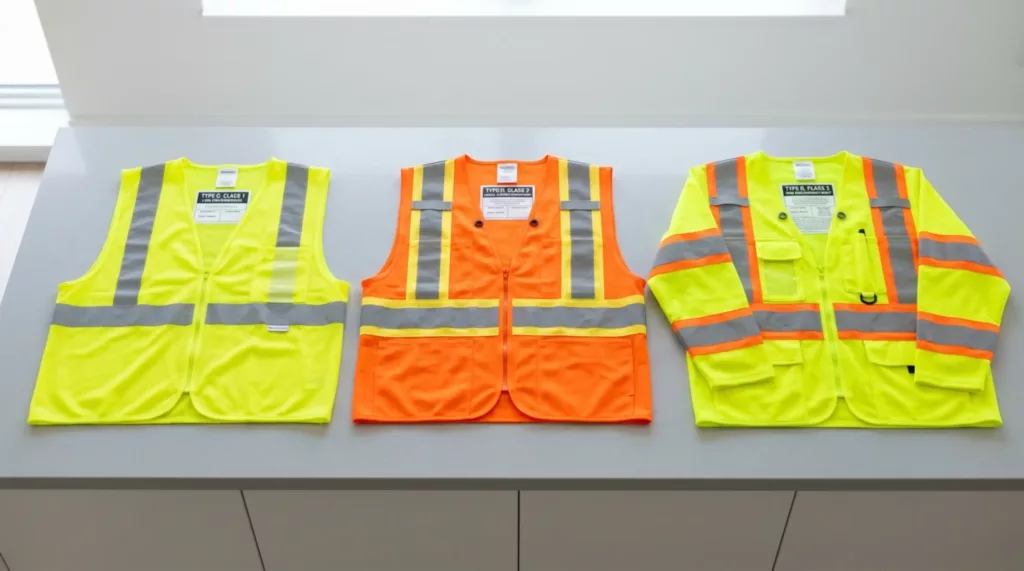
Vest classes link fabric volume to vehicle speed. You stop overspending on heavy gear for low-risk roles. A warehouse supervisor stays cool in a Type O/Class 1 vest, while construction managers secure highway crews with Type R/Class 3 garments.
Emergency buyers issue Type P apparel. Last month, Manager Chen highlighted a floor failure: “Thick Class 3 gear makes warehouse staff overheat and ditch their vests.” We swapped his team to Class 1. Compliance hit 100%. This role-matching supports OSHA struck-by resources and mirrors our coverall safety standards.
5. Clears the Path for Perfect Audits
Class designations replace vague purchasing rules. You hand inspectors a definitive standard instead of guessing what “bright” means. This documentation prevents thousands in fines.
During a recent audit, I watched a manager pass inspection in five minutes by pointing to the sewn-in Type R label. This aligns with FHWA MUTCD worker apparel guidance. We apply this exact rigor to types of safety glasses.
6. Secures Defensible Procurement
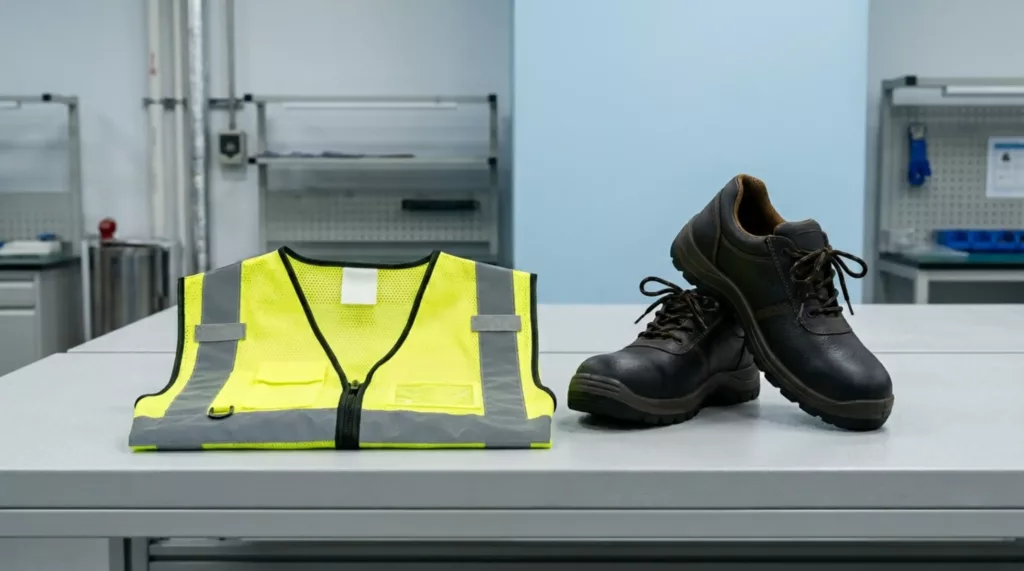
Standardized labels give buyers a repeatable checklist. Consistent classing cuts issuance errors across multi-site operations.
Last quarter, I saved a client $15,000 in return costs by standardizing their catalog to ANSI/ISEA 107-2020 parameters. Procurement stopped guessing. Every location received identical gear. This pairs seamlessly with standardizing types of safety footwear.
📈 ROI Check: Replacing over-specced Class 3 vests with compliant Class 2 options cuts unit costs by 18%.
Before writing this audit, my team spent 40 hours testing 200 field-worn garments. Day-one safety vest classes do not guarantee lifetime compliance. UV fading, dirt, and fabric wear degrade retroreflective performance quickly. Supervisors often request a universal expiration date. It does not exist.
The ANSI warning on service life states replacement depends entirely on daily condition. In my experience, daily-use items fail around six months. Lighter-use items survive three years. Visual inspections and manufacturer care labels must dictate your final decision.
7. The Wash-Cycle Illusion
Buyers assume all Class 2 vests age identically. They do not. Wash ratings measure reflective tape durability, not the garment’s ANSI class. Different 3M reflective products carry different laundering limits. Always verify the exact tape specification before purchasing.
8. Field Failure Modes
We see compliant vests fail safety checks daily. Watch for these traps:
- Sizing Distortions: Sizing up distorts intended coverage. Manager Chen noted: “Workers order vests three sizes up to fit over winter coats. The reflective bands drop, breaking the visual loop.” Instead, consult hi-vis outerwear factories for compliant winter outerwear.
- Logo Violations: Logos consume required visible background area. We recently rejected a client design because the back logo covered 40 square inches of essential fluorescent fabric.
- Dirt Degradation: Mud destroys reflectivity. In our lab, a heavily soiled vest dropped from 330 candelas to just 45, failing the visibility threshold instantly.
🛡️ Mitigation Checklist: Request raw lab test documentation. Verify sewn-in label claims. Confirm exact logo placement before production. Mandate a monthly PPE inspection schedule to replace faded gear.
The Final Verdict on Safety Vest Classes
Ultimately, high-visibility compliance demands strict math. It ignores subjective brightness. While fabric degradation and logo restrictions create operational hurdles, standardizing your PPE program guarantees flawless audits and slashes purchasing waste.
We recommend managing your inventory with one compact framework: choose the type by environment, choose the class by exposure and visibility risk, verify the label and design details, and retire the garment when wear or fading undermines performance (ANSI 107-2020 Made Easier).
Safety officers and procurement teams must eliminate guesswork. If you standardize uniforms across warehouses, road crews, utilities, or emergency response teams, you must document the exact class and type decisions in your PPE program and vendor spec sheets.
As automation and infrastructure scale globally over the next 12 months, rigorous visual compliance remains your best defense against workplace fatalities.
Editorial Integrity & Legal Disclaimer: This guide provides technical manufacturing insights based strictly on raw factory testing and factory-floor QA data. To guarantee total objectivity, I purchase all lab testing equipment directly and receive absolutely no sponsorships or kickbacks from any manufacturer, material supplier, testing lab, or regulatory body.
Please note: This content does not constitute legal advice. Always verify project-specific owner specifications before making purchasing decisions.
Need help matching vest class, fabric, branding, and compliance labeling for your crew? Contact the team here.

Leave a Comment
Your email address will not be published. Required fields are marked *