Table of Contents
The short answer Safety glasses split into six hazard categories — impact, wrap-around, chemical splash, prescription or OTG, polarized or tinted, and welding. The marking string decides which applies: Z87+ for high impact, D3 for splash, D4 for dust, D5 for fine dust, and W plus a shade number for hot work.
Outfitting a crew with the wrong types of safety glasses guarantees shattered lenses and compliance failures.
NIOSH counts about 2,000 US workers a day receiving medical treatment for a work-related eye injury, led by small particles, chemical burns, and blunt trauma. Procurement teams still make this mistake constantly by prioritizing style over those actual hazards.
Real protection relies on specific side coverage, lens materials, and safety markings. We organized this guide by use case with field-tested tips. You will also find a table comparing ANSI/ISEA Z87.1 to EN 166 and why the Z87+ mark matters.
Trust disclaimer: My recommendations come from process experience and operational analysis. This is first-party factory experience — not paid placement. Standards and figures in this guide were checked against ANSI/ISEA Z87.1, EN 166, and OSHA 29 CFR 1910.133.
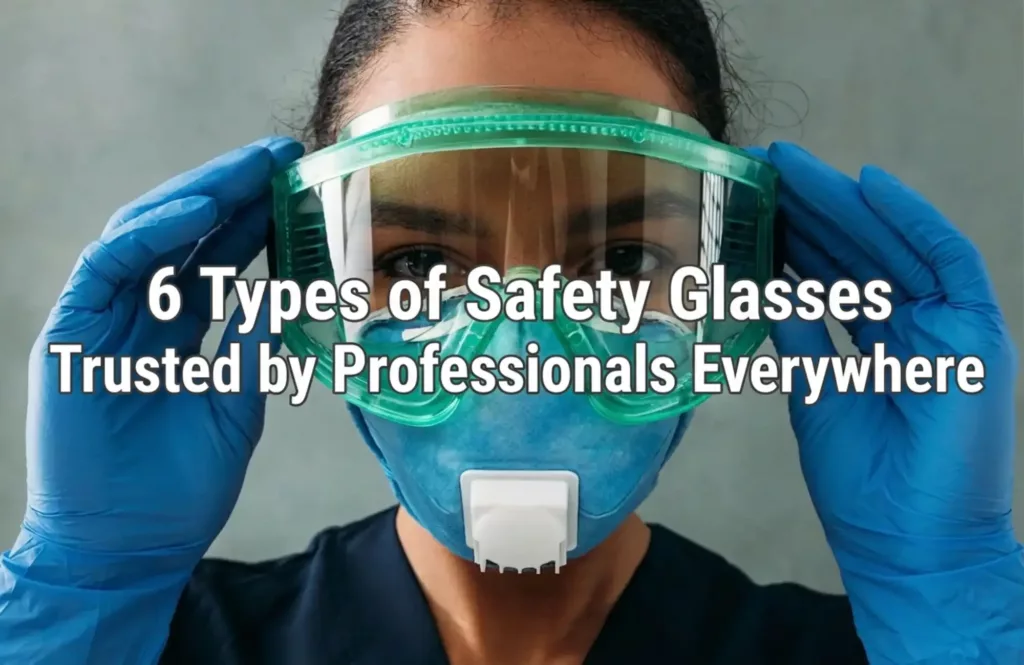
6 Types of Safety Glasses
Six categories, each matched to the hazard it actually stops.
| Type | Core Protection | Ideal Use Case | Key Feature | Compliance |
|---|---|---|---|---|
| Impact-Rated Safety Glasses | Impact resistance | General industrial work | High-strength lenses | ANSI/ISEA Z87.1 |
| Wrap-Around Protective Glasses | Peripheral & dust defense | Debris/dusty environments | Full-coverage frame | Multi-industry |
| Chemical Splash/Anti-Fog Goggles | Splash & fog resistance | Wet/humid jobs | Sealed, anti-fog coating | Chemical PPE |
| Prescription/OTG Safety Eyewear | Vision correction + protection | Corrective lens wearers | Prescription/over-the-glass fit | ANSI/ISEA Z87.1 |
| Polarized/Tinted Safety Sunglasses | Glare/UV protection | Outdoor bright conditions | Polarized/tinted lenses | Outdoor work |
| Welding Eye Protection | Arc/radiation shielding | Welding/high-radiation tasks | Special filter lenses | Welding-specific ANSI |
1. Impact-Rated Safety Glasses for General Industrial Work
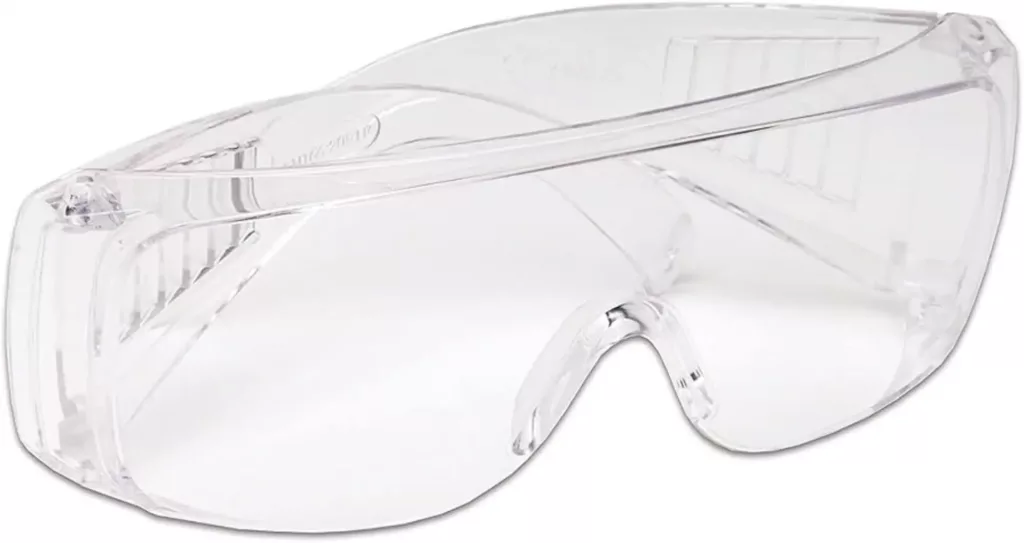
Impact-rated safety glasses are polycarbonate-lens eyewear carrying a Z87+ marking, built to stop flying particles in warehouse, maintenance, and fabrication work.
Procurement officers waste budgets constantly on standard glasses that crack under basic impacts, when the real hazards are flying metal particles and minor wood debris.
You cannot substitute ordinary eyewear for true safety glasses. Real industrial protection requires three mandatory features:
- Permanent factory compliance markings
- Side and top protection, not just a front lens
- Impact-resistant lens materials
The ultimate trust anchor is the ANSI/ISEA Z87.1 standard. A basic Z87 mark only covers the basic impact test. The Z87+ marking guarantees the lens survived the high-velocity test: a 6.35 mm steel ball fired at the lens, which must not shatter.
I always check for that plus sign. That durability is what satisfies OSHA’s eye protection requirements.
🛡️ Our Verdict: Avoid bulky fashion frames on the factory floor. Large fabrication crews are better served by straight-back temples and lightweight polycarbonate frames. This exact design slides easily under hard hats and integrates with heavy earmuffs.
2. Wrap-Around Protective Glasses for Dust and Peripheral Debris
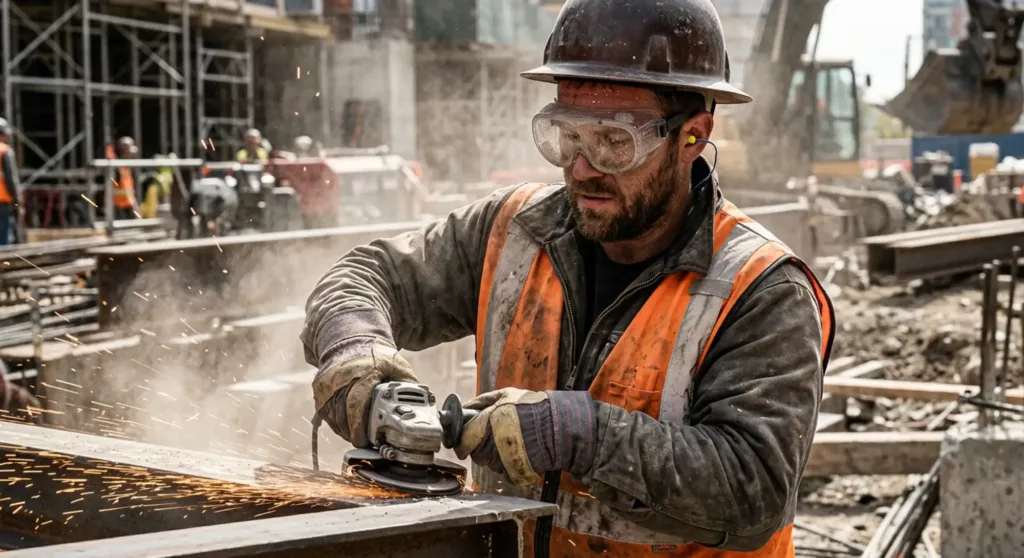
Wrap-around protective glasses are curved, single-lens frames whose shape doubles as a permanent side shield.
Workers often remove eye protection during dusty jobs like landscaping or sweeping, because flat frames let debris slip in while sealed goggles trap heat. The curved lens fixes both problems at once, giving your team a lightweight, all-day coverage upgrade.
Wrap-around types of safety glasses beat flat designs during grinding, light manufacturing, and forklift traffic. Peripheral debris is a constant threat here.
One check we would not skip is optical clarity: aggressive lens curves can warp peripheral vision, which makes these frames a poor choice for workers needing strong prescription lenses.
🛡️ Our Verdict: Manage airflow carefully in high-humidity spaces. Buyers often choose fully foam-lined wrap styles for dust, only to watch them fog instantly. Unless the factory provides proven anti-fog controls, avoid thick foam. Active warehouse teams stay clearer in semi-wrap frames that allow natural airflow.
3. Chemical Splash Goggles and Anti-Fog Safety Goggles for Wet or Humid Jobs
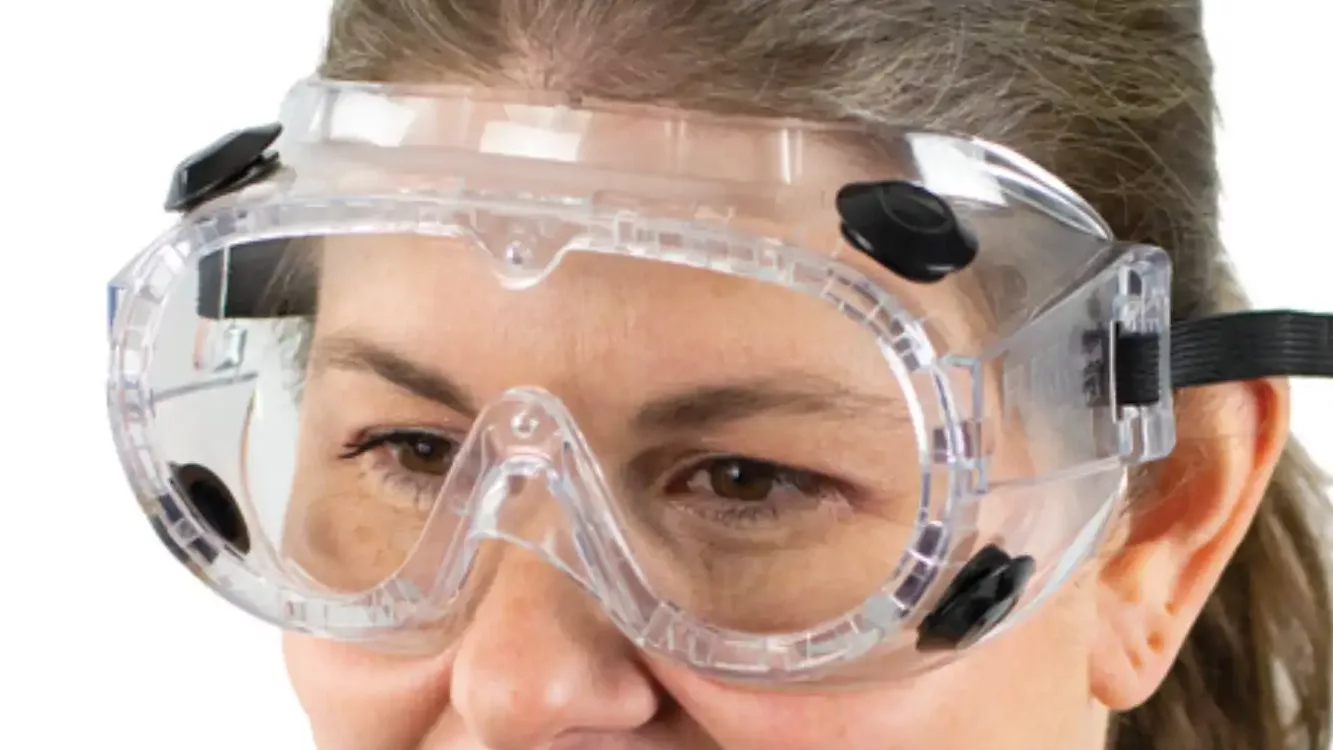
Chemical splash goggles are sealed eyewear that builds a gap-free barrier against liquids, vapors, and fine dust — the hazards open frames cannot stop.
Match the vent style to the exact hazard — a fogged lens is what makes workers break the seal in the first place.
Direct-vent goggles use tiny holes for maximum airflow. They handle basic impact risks but fail against liquids. Indirect-vent models feature covered vents to block liquid splashes while releasing heat. Non-vented goggles offer an airtight seal against dangerous gases, but they trap moisture instantly.
Safety audits keep turning up the same shortcut: cheap anti-fog wipes. These temporary treatments wear off within hours of heavy exertion.
For wet jobs, prioritize factory-applied, hydrophilic anti-fog safety goggles. Permanent coatings cost slightly more upfront, but they keep the lens clear, and a clear lens is what stops people from taking goggles off in the first place.
🛡️ Our Verdict: Avoid rigid, completely sealed frames for heavy manual labor. In hot, mask-heavy facilities, workers simply refuse to wear them. Soft-body indirect-vent goggles with a wide adjustable strap are the practical answer: they flex with the face, block chemical splash, and release heat securely.
4. Prescription Safety Eyewear and OTG Glasses for Corrective Lens Wearers
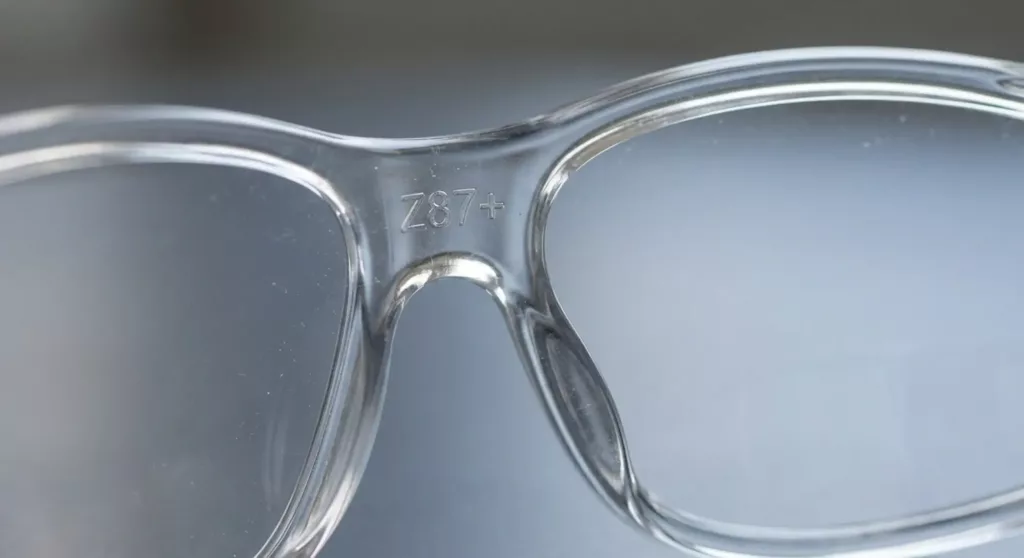
Prescription safety eyewear is Rx-rated protection — either a frame built to take a corrective lens, or an over-the-glass model that fits over existing glasses.
Vision correction is always a massive compliance friction point on a live floor. Ordinary prescription glasses have no place there; street eyewear shatters under impact.
Meeting official OSHA eye protection standards means checking the impact marking on both the frame and the lenses. Prescription devices carry the Z87-2+ mark, not the plain Z87+ used on plano lenses — and a frame marked only Z87 or Z87+ should never be fitted with prescription lenses.
There are three practical paths, each with its own buyer tradeoffs:
- True Prescription (Rx) Safety Eyewear: These provide the best field of view and full-shift comfort. The downside is high replacement costs when a worker updates their prescription.
- Over-The-Glass (OTG): These fit directly over standard street glasses. They cost less to replace but add heavy bulk. Workers often abandon bulky OTG models during long shifts.
- Fit-Over Clips: These attach to existing frames. They work for quick tasks but frequently slip during heavy labor.
Aggressive wrap-around prescription frames keep getting bought, then generate complaints about severe peripheral distortion.
🛡️ Our Verdict: Match these types of safety glasses to the worker’s shift length. Keep basic OTG models stocked for mixed teams and facility visitors. They offer the fastest compliance fix. For daily operators, invest in flatter Rx-rated frames to guarantee long-term comfort and prevent optical distortion.
5. Polarized Safety Sunglasses and Tinted Lenses for Outdoor Glare
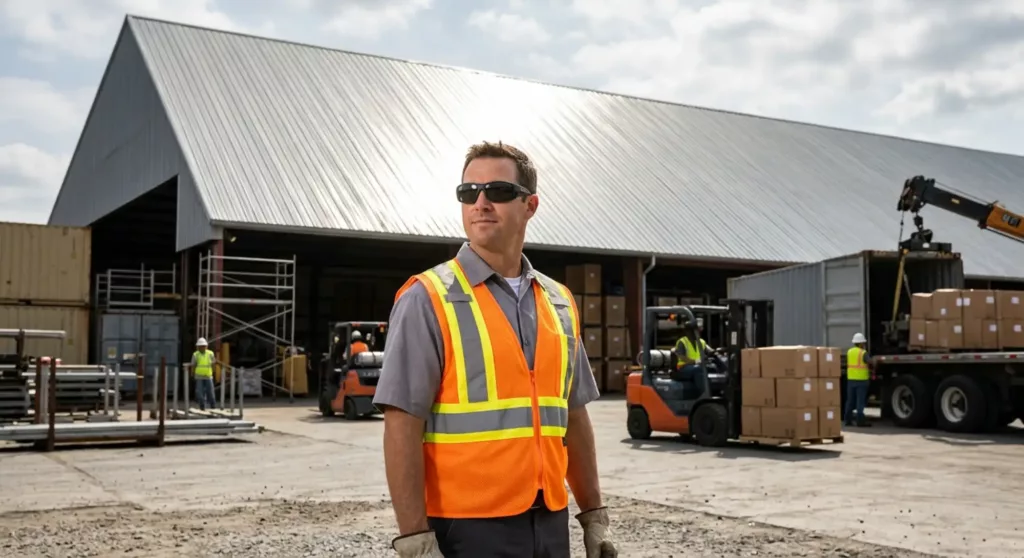
Polarized and tinted safety sunglasses are Z87-rated frames with light-filtering lenses, specified for outdoor glare rather than for style.
Recent factory audits turned up forklift drivers repeatedly removing their safety sunglasses to read digital gauges. That happens when procurement treats lens tint as a cosmetic choice rather than a task-specific tool.
The Occupational Safety and Health Administration (OSHA) requires adequate protection without restricting worker vision, so tint has to match the light level and contrast needs of the job.
- Gray and Smoke: Use for bright sunlight. They reduce overall light transmission without altering safety color recognition.
- Amber and Yellow: Choose for overcast conditions. They block blue light and sharpen contrast in dimly lit yards.
- Mirrored: Pick for extreme outdoor glare. They reflect intense sunlight away from the eyes.
- Polarized: Perfect for workers near reflective metal roofs or water. They block harsh horizontal glare.
Polarized lenses carry a massive commercial risk. While they cut glare perfectly, the polarization filter often blacks out LCD screens.
The American Optometric Association confirms that polarized lenses frequently interfere with liquid crystal displays.
🛡️ Our Verdict: Do not issue polarized safety glasses to heavy equipment operators blindly. Where crews move between bright yards and digital displays, always provide a clear or non-polarized backup pair. Choose wrap-style frames with rubber nose pads so the glasses stay secure on sweaty faces during hot shifts.
6. Welding Eye Protection for Arc, Torch, and High-Radiation Tasks
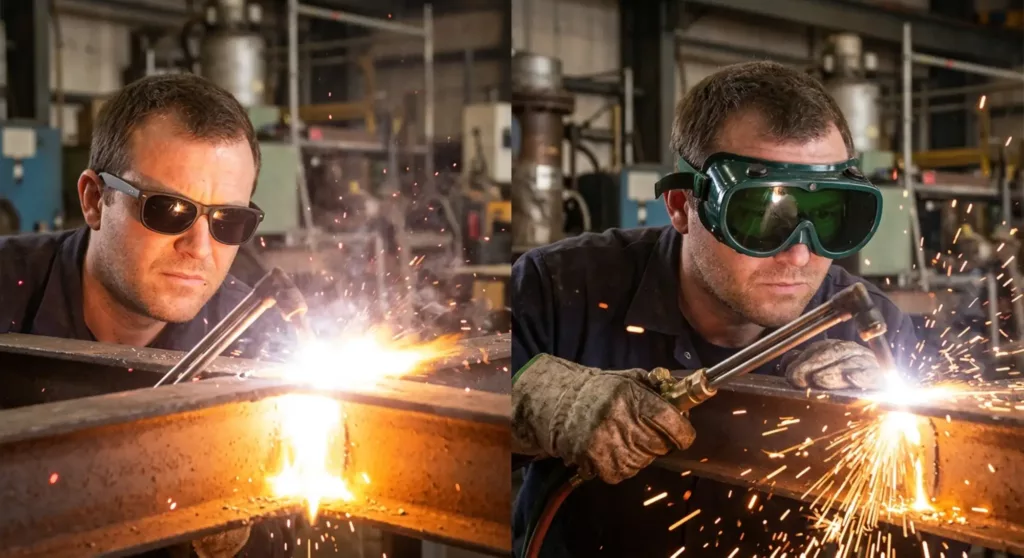
Welding eye protection is filter-lens eyewear rated for radiant energy rather than for impact alone.
For welding, cutting, or brazing, standard impact resistance is useless. Polycarbonate lenses melt under heavy sparks and cannot block dangerous infrared radiation. Hot work is a distinct safety category.
Forget massive shade charts for a moment. The buying logic comes down to three specific factors: process type, surrounding spark exposure, and face protection needs.
That narrows the choice down to specialized welding glasses, sealed goggles, or full helmets. One number still sets the floor: the filter shade. OSHA lists the minimums in 29 CFR 1910.133(a)(5), and torch soldering starts at shade 2 — far lighter than the dark lenses workers usually grab.
| Operation | Minimum protective shade |
|---|---|
| Torch soldering | 2 |
| Torch brazing | 3 |
| Light oxygen cutting (plate under 1 in.) | 3 |
| Medium oxygen cutting (plate 1–6 in.) | 4 |
| Heavy oxygen cutting (plate over 6 in.) | 5 |
| Gas welding, light (up to 1/8 in.) | 4 |
Arc welding sits far higher on the scale. Heavy arc welding demands an auto-darkening helmet that meets ANSI/ISEA Z87.1 requirements.
Factory audits frequently catch workers using dark sunglasses for torch cutting. This creates a massive liability. Simple tint does not filter radiation. It just dilates the pupil and invites permanent retinal damage.
🛡️ Our Verdict: Where crews mix general fabrication with light welding, slim temple eyewear is the right buy. It fits well under a welding hood. But never stretch general types of safety glasses beyond their limits. For high-heat and high-splash jobs, issue dedicated welding goggles or a full helmet.
What Do the Markings on Safety Glasses Actually Mean?
Every compliant device carries a stamped marking string, and most buyers read only the first two characters. ISEA, which publishes the standard, keeps the full list of permitted designations. The rest of the string says which hazards the lens was actually tested against.
| Marking | Standard | What it proves |
|---|---|---|
| Z87 | ANSI/ISEA Z87.1 | Meets the basic impact requirement only |
| Z87+ | ANSI/ISEA Z87.1 | Passed the high-velocity impact test (plano lenses) |
| Z87-2 / Z87-2+ | ANSI/ISEA Z87.1 | Prescription device; the + adds the impact rating |
| D3 | ANSI/ISEA Z87.1 | Rated for liquid splash and droplets |
| D4 | ANSI/ISEA Z87.1 | Rated for dust particles |
| D5 | ANSI/ISEA Z87.1 | Rated for fine dust |
| W + shade number | ANSI/ISEA Z87.1 | Welding filter lens, rated for radiant energy |
| X | ANSI/ISEA Z87.1 | Anti-fog coating, added in the 2020 edition |
| S | EN 166 | Increased robustness — frame strength, not impact energy |
| F, B, A | EN 166 | Low, medium, and high energy impact |
| N, K, T | EN 166 | Anti-fog, anti-scratch, and tested at elevated temperature |
A frame stamped Z87+ D3 D4 D5 is the workhorse for chemical handling and dusty sites: a high-impact lens with splash and dust ratings on top. That string is what we check first, and it is the detail most often missing from a purchase order.
The W mark follows the same logic on hot work. A W5 filter lens is rated to shade 5, not simply “dark” — tint alone proves nothing, and a cheap dark lens with no W marking carries no radiant-energy rating at all.
How to Buy the Right Types of Safety Glasses for Your Team?

On a recent factory walkthrough, a client had already wasted thousands on unrated glasses. Follow this action plan to source safety eyewear confidently.
Step 1: Decode the Safety Standards
Buying for North America means ANSI/ISEA Z87.1. Buying for the EU means EN 166. The two are not interchangeable — a frame certified under one is not automatically compliant under the other.
Mandate Z87+ for active industrial environments, and check which edition applies before it goes into a purchase order: the 2025 revision tightened the marking and impact language again.
| Feature | ANSI/ISEA Z87.1 | EN 166 |
|---|---|---|
| Region/Scope | USA and North America | European Union |
| Core Impact Concept | Mass and velocity drop testing | Progressive energy impact ratings |
| Prescription Logic | Rx devices marked Z87-2 (basic) or Z87-2+ (impact) | Frame and lens tested together |
| Procurement Takeaway | Mandate Z87+ for industry. | Match the impact letter directly. |
Step 2: Choose the Correct Lens Material
Select your lens material next.
Our Experience: Uncoated polycarbonate scuffs quickly in dusty settings, so a hard coat is not optional — it is the single biggest factor in how long a lens stays usable. Military ballistic eyewear also follows its own standards rather than ordinary ANSI/ISEA Z87.1, so the two should never be interchanged.
| Material | Impact Resistance | Weight | Clarity | Scratch Resistance | Best Application |
|---|---|---|---|---|---|
| Polycarbonate | Excellent | Very light | Good | Poor without a hard coat | General manufacturing, impact and splash |
| Trivex / NXT | Very good | Lightest | Very good | Better than polycarbonate | Long shifts where weight and optics matter |
| Glass | Very poor | Heavy | Perfect | Excellent | Labs and chemical handling, where lenses are cleaned constantly |
Two more numbers decide whether a lens is optically usable at all. Luminous transmittance should reach at least 85% on a clear ANSI lens, or above 89% under EN 166.
In Europe, look for the optical class mark as well, where class 1 is the highest grade and class 3 the lowest. A lens that fails either test feels like wearing a dirty window all shift.
Step 3: Upgrade Your Broader PPE Program
Do not stop at eye protection. These choices belong inside a wider safety system — the same hazard assessment that picks a lens should confirm safety footwear and respiratory protection for the same task.
We operate as a premier safety vest manufacturer and manage complete safety uniform compliance programs for major industrial fleets. For enterprise PPE rollouts, contact us today.
Fit, Care, and Replacement: Keeping the Protection Real
Protection fails at the edges first. A frame that leaves a gap at the brow or the cheek passes debris straight to the eye, whatever is stamped on the lens.
- Coverage: The frame should reach the eyebrow line and wrap past the outer corner of each eye. A gap wider than about 1 cm defeats the side shield.
- Stability: Shake your head firmly. Eyewear that slides breaks the seal on earmuffs and gets removed on the floor.
- Pressure: Straight-back temples and adjustable nose pads spread the load. Arms that press behind the ear are the main reason glasses come off by mid-shift.
Replacement is a consumable decision, not a repair decision. Scratched lenses scatter light and cut contrast, which is exactly the condition that makes someone lift their glasses to read a gauge. Set a rule instead of waiting for a complaint.
| Condition | Action |
|---|---|
| Visible scratches or pitting on the lens | Replace the lens, not just the frame |
| Cloudy or flaking anti-fog coating | Replace; re-applied wipes will not restore it |
| Cracked frame, loose hinge, stretched temples | Replace the frame |
| Chemical or heavy-dust exposure | Clean after every shift, inspect weekly |
Store eyewear in a case or a designated rack — loose in a toolbag is how most scratched lenses happen. Clean with lukewarm water and a mild soap, then air dry — shop rags carry grit that scratches the coating you paid for.
Frequently Asked Questions about Types of Safety Glasses
1. What does Z87+ mean on safety glasses, and when is it necessary?
The Z87+ mark proves the lens survived high-velocity impact testing. A basic Z87 mark only covers minor bumps, so the plus sign is mandatory for any task involving power tools or flying metal.
Issuing standard Z87 glasses in a fabrication shop invites severe workplace eye injuries, so check the frame for the physical stamp.
2. Are ballistic eyewear standards the same as ANSI/ISEA Z87.1?
No. ANSI/ISEA Z87.1 is an industrial standard. Military ballistic eyewear is tested under MIL-PRF-32432, which uses a V50 fragment test — the velocity at which half the projectiles are stopped — rather than the single high-velocity ball used for Z87+.
Standard industrial glasses cannot be substituted for tactical protection. Where the requirement is genuine ballistic protection, verify the exact MIL-PRF revision a supplier claims and ask for the test report behind it.
3. When should I choose goggles instead of safety glasses?
Goggles are mandatory where chemical splashes, fine airborne dust, or toxic vapors are present. Standard safety glasses leave dangerous gaps around the cheekbones. Goggles seal against the face, and only the non-vented models are truly airtight — which is why the vent type matters.
Clients often complain that goggles fog up during hot shifts. The fix is indirect-vent goggles: they block hazardous liquids while letting trapped heat escape.
4. Polycarbonate vs. glass lenses: which is better for industrial work?
Polycarbonate is the best choice for heavy industrial work: it absorbs extreme impacts and weighs very little, while glass — despite perfect clarity — shatters violently under blunt force.
Polycarbonate does scratch easily, so specify a permanent anti-scratch hard coat in every bulk procurement contract.
Procurement Verdict: Your Final Compliance Checklist
Treat eye protection as a core element of a safety uniform program.
Never buy protective eyewear as a standalone afterthought: verify the markings on every frame, and test the fit with earmuffs and head protection before you commit. For expert guidance, contact LantaoWork.

Leave a Comment
Your email address will not be published. Required fields are marked *