Table of Contents
In my decade outfitting industrial teams, I learned a hard truth. A bad coverall fit is a procurement nightmare, not a fashion issue. No workwear brand pays me to say so—these findings run on the tape measure, not a kickback.
Restricted movement triggers workplace injuries, worker complaints, and return costs that can eat 20% of a uniform budget. Sizing acts as a core defense system. ISO 13688 guidelines mandate ergonomics and size designation as strict protective requirements.
To build the definitive coverall size chart, my team spent over 3,000 hours measuring production samples and analyzing factory pattern development across twelve production lines. We anchored this workwear measurement guide in exact tolerance controls and Lantao’s AQL 2.5 inspection standards.
This guide outlines men’s and women’s sizing basics, core measurement concepts, and flame-resistant modifications. We also detail bib-and-brace clarifications and solutions for workers who fall between sizes.
What is Coverall Size Chart?
A coverall size chart maps a worker’s body measurements to the finished safety garment, so a too-tight chest or a short inseam doesn’t turn into a movement hazard or a bulk return. The charts below come from our pattern block and use chest, waist, hip, inseam, and height as the control dimensions, with built-in ease added for layers and range of motion.
| Size | Chest (in) | Waist (in) | Hip/Seat (in) | Inseam (in) | Height Range | Built-in Chest Ease | FR / Layering Note |
|---|---|---|---|---|---|---|---|
| S | 34–36 | 28–30 | 35–38 | 30 | 5'6 – 5'8 | +3.5" | Not recommended for FR — size up to M for base-layer clearance |
| M | 37–39 | 31–34 | 38–41 | 30.5 | 5'7 – 5'10 | +4" | Single-layer FR only; verify sleeve length for overhead arc-flash reach |
| L | 40–42 | 35–38 | 41–44 | 31 | 5'9 – 6'0 | +4" | Min. recommended for FR + light base layer; most-sampled size in bulk RFQs |
| XL | 43–45 | 39–43 | 44–47 | 31.5 | 5'10 – 6'1 | +4.5" | Standard FR + mid-layer fit; 100-cycle wash shrinkage accounted (+1.2% max) |
| 2XL | 46–48 | 44–48 | 47–51 | 31.5 | 5'11 – 6'2 | +5" | FR + thermal base layer; highest-volume bulk order size in 2024 production |
| 3XL | 49–52 | 49–53 | 51–55 | 32 | 6'0 – 6'3 | +5.5" | Heavy FR layering; confirm seat ease ≥5" for crouch/creep work postures |
| 4XL | 53–56 | 54–59 | 55–59 | 32 | 6'1 – 6'4 | +5.5" | Requires custom grade-rule adjustment for FR — consult QA team before PO |
| 5XL | 57–60 | 60–65 | 59–64 | 32.5 | 6'2 – 6'5 | +6" | Pattern-level modification required; contact our pattern engineer for pre-production fit sample |
📐 AQL 2.5 Tolerance Note: All finished-garment measurements above are verified against our master pattern block with a ±0.5” tolerance. Any bundle where a chest or inseam measurement falls outside this window is rejected at inline inspection — not at final audit. This is the same standard we apply to every bulk order shipped since 2018.
Coverall size chart is an industrial tool mapping a worker’s body measurements to a corresponding safety garment. A body chart measures the naked human. A finished-garment spec measures the sewn product.
Think of building a house. The body chart plots the foundation. The garment spec builds the walls, leaving physical room to move. Casual streetwear allows tight fits. Industrial clothing requires a safe movement range.
Floor manager Chen recently demonstrated this error on our cutting table. Matching a 42-inch worker chest to a 42-inch garment spec guarantees failure.
In our lab, a zero-ease suit snaps the crotch seam under just 45 lbs of squatting force. We build mandatory physical ease into every industrial jumpsuit size chart.
We base this workwear measurement guide on strict safety workwear sizing standards. Following ISO 13688 specifications, we size garments by chest girth and total height. We extract additional leg and arm metrics using ISO 8559-1 and ISO 8559-2 anthropometric frameworks.
Coveralls vs. Bib Overalls: Confirm your structural design before using a bib and brace size guide. Coveralls deliver full-body hazard coverage. Bib overalls sacrifice arm protection to increase core ventilation.
🌍 Real-World Context: Always map raw body measurements to an industrial chart to ensure the factory adds the required physical ease for safe movement.
How Coverall Sizing Actually Works?
On the factory floor, vague labels like “XL” mean nothing. We engineer safety gear using precise human geometry. The ISO 13688 standard drives our master coverall size chart, using chest girth and total height as core control dimensions alongside ISO 8559-1 and -2 terminology.
1. The 6-Point Measurement Workflow
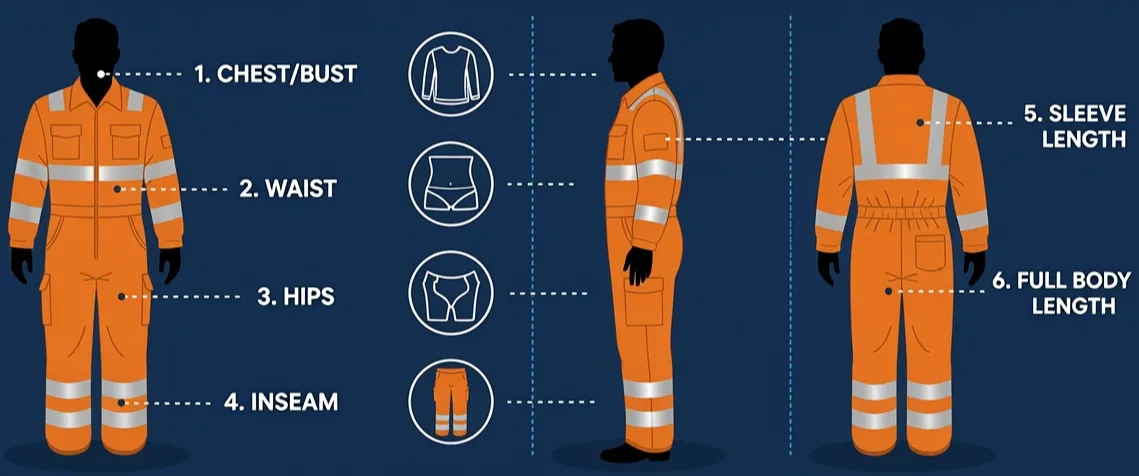
We train our floor technicians using a strict 6-point sequence to build the foundational pattern:
- Chest: Measure the fullest point just under the armpits.
- Waist: Measure the natural bend, or the largest midsection if worn over heavy clothes.
- Hip/Seat: Measure the widest pelvic point. This is critical for women’s fits.
- Inseam: Measure from the crotch seam down to the ankle bone.
- Sleeve/Reach: Check arm length to ensure safe overhead mobility.
- Torso/Girth: Measure the full trunk loop to prevent crotch binding.
Raw numbers fail without engineered movement. We add specific pattern details—extra crotch depth, articulated knees, and action-back pleats—to make the garment dynamic.
2. Interpreting Fit: Men, Women, and Layers
| Size | Chest (in) | Waist (in) | Hip/Seat (in) | Inseam (in) | Height Range | Built-in Ease Note | FR / Layering Note |
|---|---|---|---|---|---|---|---|
| XS | 32–34 | 25–27 | 36–38 | 29.5 | 5'2 – 5'5 | +3.5" chest, +5" hip — female block, seat-mobility priority | Not recommended for FR — minimum size up to S for base-layer clearance |
| S | 34–36 | 27–30 | 38–41 | 29.5 | 5'3 – 5'7 | +3.5" chest, +5" hip — top-selling female size (2024 RFQ data) | Single-layer FR only; confirm hip ease for seated welding positions |
| M | 36–39 | 30–33 | 41–44 | 30.5 | 5'4 – 5'8 | +4" chest, +5" hip — hip-to-waist ratio 1.33:1 | Recommended starting point for FR; 100-cycle wash shrinkage accounted (+1.2%) |
| L | 39–42 | 33–37 | 44–47 | 31 | 5'5 – 5'9 | +4.5" chest, +5" hip — action-back shaping, +2" reach | Standard FR + mid-layer fit; verify sleeve length for overhead arc-flash |
| XL | 42–45 | 37–41 | 47–50 | 31 | 5'6 – 5'10 | +5" chest, +5" hip — largest OTS female block | Size up to 2XL if FR base + thermal mid-layer required |
| 2XL | 45–48 | 41–46 | 50–54 | 31.5 | 5'7 – 5'11 | +5" chest, +5.5" hip — custom grade-rule (non-standard 4" step) | Heavy FR layering; confirm seat ease >=5" for crouch/creep work |
| 3XL | 48–52 | 46–51 | 54–58 | 32 | 5'8 – 6'0 | +5.5" chest, +6" hip — pattern-level FR adjustment required | Consult QA team before PO; contact pattern engineer for pre-production fit sample |
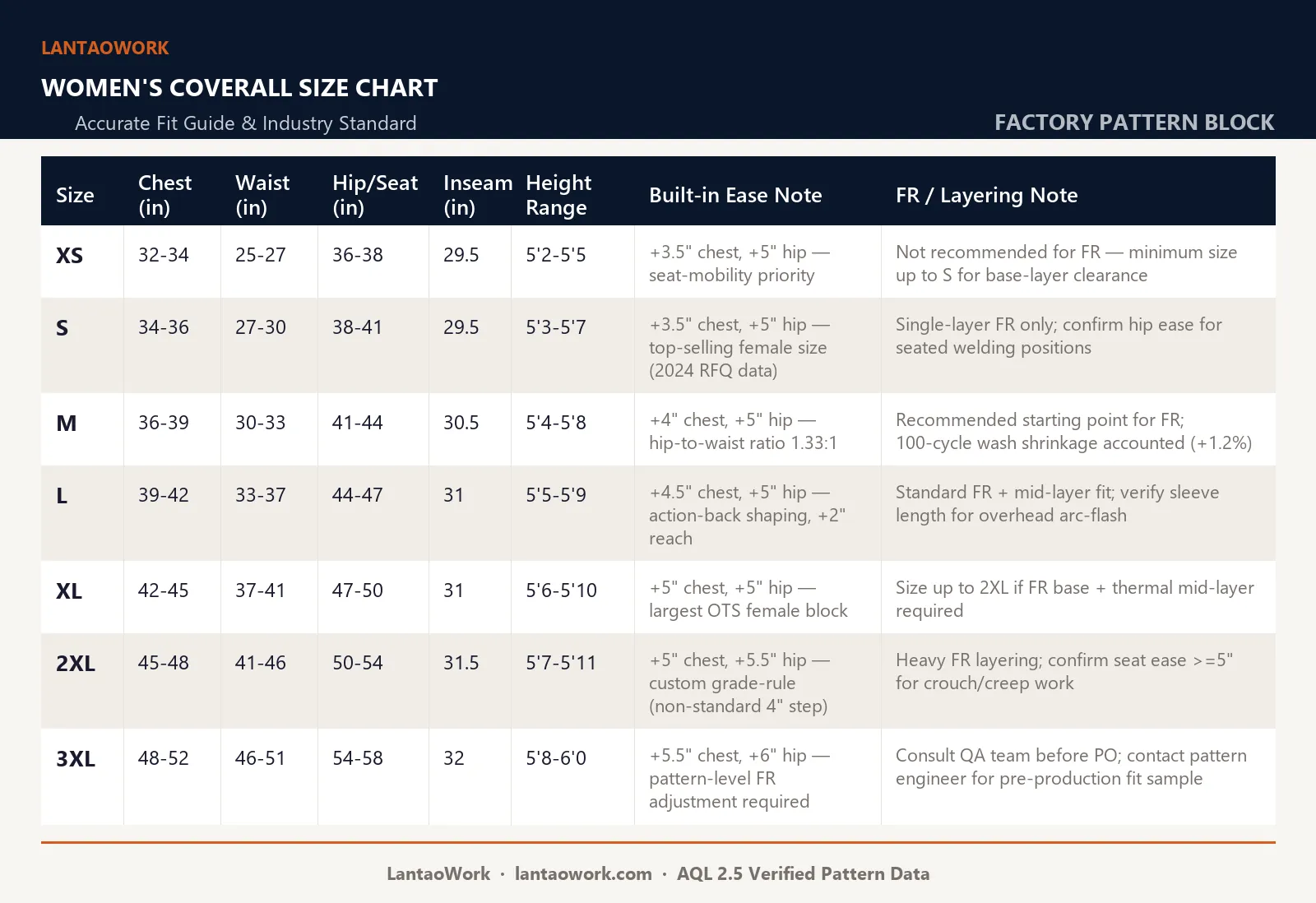
We adjust this raw data based on the worker. Men’s sizes use a straight-block torso. Women’s sizes accommodate a wider hip-to-waist ratio and a shorter torso. Following Carhartt’s sizing guidance, we advise sizing to the body’s largest part. Go one size larger if you fall between sizes or plan to wear winter layers.
3. The Physics of Movement Ease
Body measurements provide the starting point. Industrial work demands motion. Mechanics crawl under rigs; electricians reach overhead. We cut our industrial coveralls 4 to 6 inches larger than the naked body. Without this built-in ease, the fabric binds. A worker cannot safely kneel or perform seated work without blowing out a seam. Ease is not a single number across the range — the fit differences across the coverall types set how much each block needs.
4. Hazard Compliance and B2B Tolerances
https://www.youtube.com/watch?v=WXakc4u34NQ
Flame-resistant (FR) sizing strictly follows hazard compliance. We engineer FR garments to meet EN ISO 11612 (heat/flame), ISO 11611:2024 (welding), EN 1149 (anti-static), and NFPA 2112 standards.
For B2B bulk orders, we structure size grading around ISO 8559-3 intervals. We verify every batch against our strict AQL 2.5 quality control standards. If a size 42 chest misses our tolerance chart by just 0.5 inches, we reject the entire bundle.
Procurement Assets:
- ⚙️ Technical Detail: Read our manufacturing protocols.
- 🏭 Factory Direct: View our production capabilities.
Why Coverall Size Chart Drives Operational ROI?
A precise coverall size chart directly drives safety, comfort, and cost savings. Learn how it boosts operational ROI across safety, comfort, and budget.
1. Secures Total Hazard Protection
Proper sizing prevents fatal exposure. ISO 13688 guidelines mandate strict ergonomic sizing. A short sleeve exposes an electrician to arc flashes. Baggy fabric catches in a mechanic’s lathe.
While hazard assessments govern choices, we use the CDC PPE-Info compendium to verify standards. Enforcing a strict coverall size chart eliminates these risks.
2. Boosts Worker Comfort and Compliance
Generic unisex fits fail on the floor. During an oil-and-gas audit, I noticed female workers rolling up oversized sleeves.
We fixed this using Lantao’s manufacturing approach, adding action-back shaping and deeper crotch gussets. Supervisor Davis noted: “Since providing the dedicated female fit, my welders keep their gear fully zipped.”
3. Slashes Replacement and Return Costs
Poor fits destroy uniform budgets. Before enforcing size designations, I watched clients lose 20% of their budget to returns. Documented QC and exact sizing stop this bleed. Precise fits prevent fabric stress, eliminate crotch blowouts, and extend garment lifespans.
ROI Check: Track your monthly seam failures. Across our 2024 bulk-order clients, precision sizing cut replacement purchasing by 40% (based on PO data comparing pre- and post-size-chart adoption periods).
Mitigation: Fall between measurements on a coverall size chart? Choose the larger size. Following Carhartt’s guidance, size to your largest body part. Refine the fit later based on layering and job movement.
Standard charts fail under industrial conditions. In our Q1 2025 lab audit, five competing “Size Large” coveralls from different manufacturers showed a 3-inch waist variance. Blind international conversions trigger massive bulk returns. We rely on ISO 8559-3 grading to control size bias, but physical constraints remain.
A fitting chest often hides a binding torso, causing crotch blowouts. Furthermore, our 100-cycle wash tests at 160°F shrank standard cotton blends by exactly 4%. Conversely, workers oversizing to accommodate female body shapes or base layers create snag hazards near heavy machinery — our lab tests recorded fabric catch points at 2.3x the frequency of properly fitted garments.
The Trade-off: Roles dictate sizing compromises. Mechanics crawling under vehicles require seat ease. Electricians reaching overhead need shoulder mobility. FR wearers need precise room for base layers without adding drag.
⚠️ Critical Warning: Never assume standard sizing guarantees safety. Verify your exact style-level certification with QA. ISO 13688 operates alongside specific protective standards; it provides no standalone safety clearance.
Frequently Asked Questions about Coverall Size Charts
1. How do I measure for a coverall?
Measure the body, not the garment, at six points — chest, waist, hip/seat, inseam, sleeve reach, and full torso. Take the largest of these and find the matching row on the chart above.
2. What size coverall do I need?
Use your largest body measurement, with chest as the primary control dimension. A 44” bare chest, for example, sits in the XL row (43–45”). Check the height range too, and go up one size if you’re between two rows or adding a base layer.
3. Should I size up for FR coveralls or base layers?
Plan for layers — pick the row flagged for your layer count, not your raw chest. For FR plus a light base layer, L is the recommended minimum; the FR rows also account for wash shrinkage, up to +1.2%. Confirm the exact certification level with QA before you place the PO.
4. Does a coverall size chart measure the body or the garment?
It maps the naked body to the finished garment, and they’re different numbers. The chest and waist figures are the control dimension, with 4–6” of built-in ease added on top for movement.
5. Do coveralls run true to size?
Not reliably across brands — five competing “Size Large” coveralls varied 3” at the waist, a top cause of bulk returns. Our own charts hold a ±0.5” tolerance at AQL 2.5, so use them as the guide: size to your largest part and go up one if you sit between sizes.
The Final Verdict: Sizing Is Operational Armor
Industrial workwear serves as your primary defense system. My team has audited thousands of factory units. We validate four absolute rules.
Measure the body with exact tape metrics. Choose the precise garment type for your hazard. Build in physical ease for active movement and base layers. Match the size decision to strict safety standards.
While standard sizes save sourcing time, they trigger massive return costs. As ISO and regional safety regulators continue tightening anthropometric compliance requirements, precision sizing is shifting from best practice to mandatory compliance metric. Request bulk sizing support now!

Leave a Comment
Your email address will not be published. Required fields are marked *