Table of Contents
The short answer Bib overalls are sleeveless and leave the arms exposed. Coveralls cover arms, torso, and legs in one piece. The trade-off is full-body protection versus freedom of movement: pick coveralls where hazards reach the arms, bibs where airflow and mobility matter more.
For safety-critical industrial work, coveralls are the safer default. For lower-risk, movement-heavy jobs, bib overalls win. Every comparison below turns on that single trade-off.
Beyond that basic split, coveralls themselves divide by hazard — the full range of coverall types covers FR, chemical, arc flash, hi-vis, thermal, and disposable or reusable work.
Put the same worker in a coverall and then in bib overalls on a pipe-fitting job, and the trade-off is immediate. The coveralls block heavy grease completely. The bib overalls let the shoulders breathe for easy overhead lifting. Buyers often stumble on the confusing names — dungarees, bib and brace, boiler suits.
Always base the choice on a hazard assessment, never on a label. Not every garment acts as true PPE. Uncertified materials trap heat and fail under stress.
Judge the garment against specific compliance ratings such as EN ISO 11612, NFPA 2112, or ASTM F1506. The spec table below narrows the decision to coverage, compliance, and mobility.
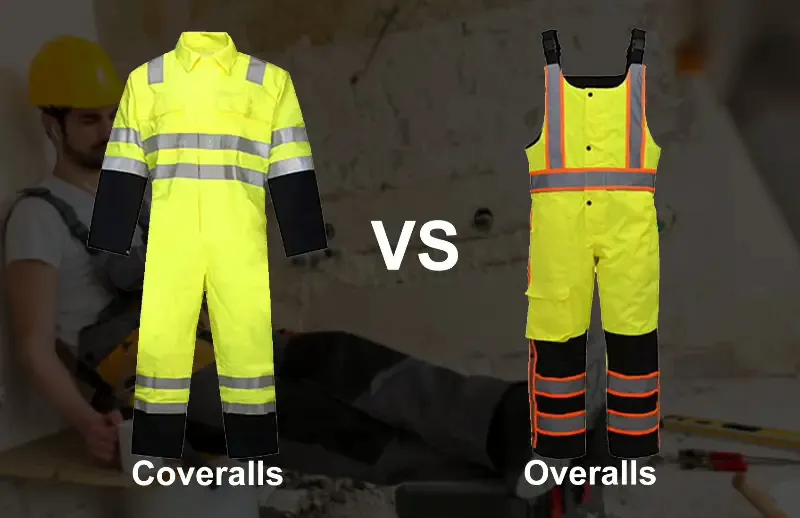
Overalls, Coveralls, and Boiler Suits: Sorting Out the Names
The confusion is not about the garments. It is about the words. A buyer in the United States and a buyer in the United Kingdom can both order “overalls” and receive two different things.
| Term | US meaning | UK and AU meaning |
|---|---|---|
| Overalls | Sleeveless bib overalls | The one-piece garment (US “coveralls”) |
| Coveralls | One-piece, full body | One-piece, full body |
| Boiler suit | Rare | The one-piece garment |
| Dungarees | Rare, dated term for jeans | Bib overalls |
| Bib and brace | Rare | Bib overalls |
Across most of the world, coveralls means the same thing: a one-piece garment with sleeves. The word overalls is the unstable one. In the United States it means sleeveless bib overalls. In the United Kingdom and Australia it usually means the one-piece garment that North Americans call coveralls.
This matters at the specification stage. A line item that reads “bib overalls, no sleeves, shoulder straps” is unambiguous. A purchase order that says only “overalls” is not. Write coverage, sleeve length, and the standard number into the document, and the naming problem disappears.
Difference Between Overalls and Coveralls: A Direct Spec Comparison
Here is the direct spec comparison:
| Feature | Bib Overalls | Coveralls |
|---|---|---|
| Body coverage | Torso, Legs | Full Body (Arms, Torso, Legs) |
| Typical exposure | Abrasion, dirt, snag | Chemical splash, flash fire, molten metal |
| Arm protection | None | Wrist-to-Shoulder |
| Ventilation and heat buildup | Open upper body, passive venting | Enclosed layer, traps body heat |
| Layering flexibility | High (Unrestricted over jackets) | Low (Single fixed layer) |
| Common fabrics/blends | Cotton denim, 10–14 oz (340–475 GSM) | Poly-cotton 65/35, 250–300 GSM |
| Typical closures | Double-stitched, Suspender Buckles | Triple-stitched, Covered Storm Flaps |
| Waterproof options | Yes (EN 343) | Yes (EN 343) |
| FR-certified options | Yes (ASTM F1506) | Yes (EN ISO 11612, NFPA 2112) |
| Best-fit industries | Agriculture, Carpentry, Warehousing | Petrochemical, Welding (EN ISO 11611) |
| Typical drawbacks | Exposed arms, Snag-prone straps | Restrictive overhead reach, Heat stress |
| When procurement should choose it | High upper-body mobility required | Strict OSHA/ISO compliance required |
1. Coverage and protection level
When comparing bib and brace vs coveralls, coverage dictates safety. Coveralls shield the arms, torso, and legs in one unbroken layer. Bib overalls protect the legs and core, leaving the arms exposed to whatever shirt sits underneath.
In a heavy-dust machining shop the gap shows up fast. Sleeveless bibs leave the forearms open, so fine metal shavings settle on bare skin by mid-shift. The coverall’s unified shell keeps debris off the whole body. That continuous barrier directly defines workwear protection levels.
In dirty, splash-prone, or spark-heavy zones, exposed sleeves are a serious vulnerability. Procurement teams prefer coveralls for these hazards because one sealed garment removes the risk of a worker breaking the protective envelope with the wrong undershirt.
Winner: Coveralls for environments with dust, sparks, or chemical splash risks.
2. Compliance and safety standards
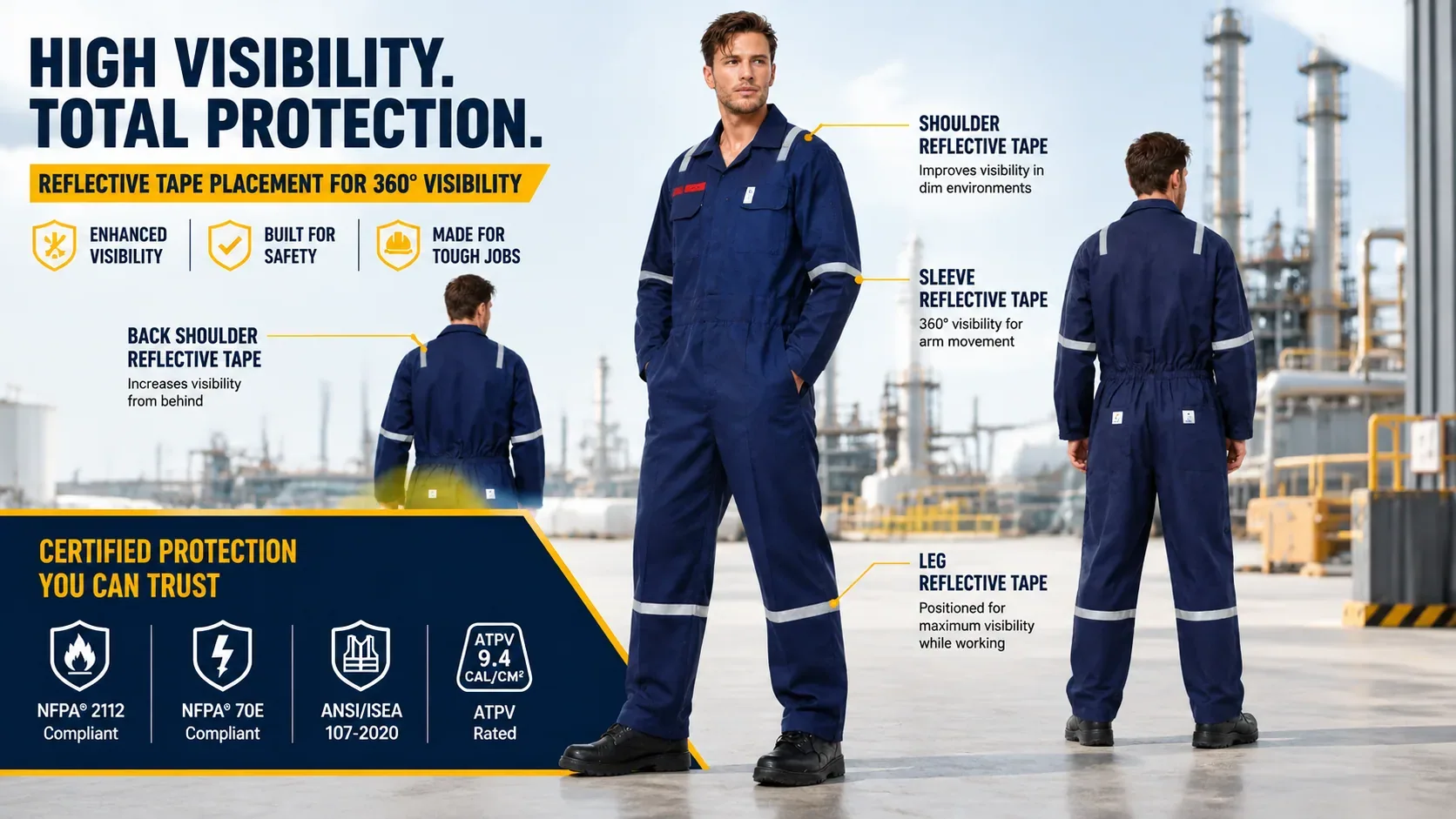
Garment shape alone does not guarantee safety. Buyers often make this mistake when debating boiler suits vs overalls. You must check certifications.
In our factory, we verify the fabric before cutting. If your hazard assessment demands flame resistance, an uncertified bib fails the audit. You need a full-body coverall certified to EN ISO 11612 for heat and flame or NFPA 2112 for flash fires. Welding crews require EN ISO 11611.
Roadwork demands ANSI/ISEA 107 high-visibility ratings. ASTM F1506 applies to arc-rated gear. If site policy requires arm coverage, a full-body coverall is mandatory. Never guess on compliance.
⚠️ Safety First: Always request the manufacturer’s laboratory test reports. A generic “FR-treated” tag means nothing during an OSHA audit if it lacks specific ISO or NFPA certification numbers.
Winner: Coveralls for strict, full-body OSHA/ISO compliance.
3. Mobility, ventilation, and heat stress
Protection trades off with comfort. Bib overalls vent around the torso, so the body stays cooler and the garment moves with the wearer. Heavy coveralls seal heat in and stiffen every overhead reach.
Side-by-Side: Range of Motion vs. Dust Ingress
- Overhead Reach: Bibs allow free arm movement. Coveralls pull at the crotch and shoulders.
- Ladder Climbing: Bib straps stay secure and knees flex easily. Coveralls feel heavier and more restrictive.
- Kneeling & Bending: Both perform well, but bibs vent lower-back sweat much faster.
- End-of-Shift Cleanliness: The coverall keeps the undershirt clean. The bib leaves sleeves and upper back coated in shop dust.
Winner: Bib overalls for high-mobility, high-heat tasks.
https://www.youtube.com/watch?v=ZdqOXjBlQuQ
4. Weather resistance and specialized performance options
Both garment types offer advanced protective treatments, but their protective envelopes function differently. The split matters most for waterproof work overalls and flame resistant coveralls.
Waterproof bibs dominate wet outdoor work. The EN 343 lower half keeps the legs dry, while the open top lets the chest vent sweat.
In oil, gas, or heavy industrial environments, FR coveralls take the lead. They simplify safety protocols by protecting the entire upper body from sudden thermal threats. An FR bib overall is never a substitute for an FR coverall. If the job requires protected sleeves, the bib leaves a dangerous gap.
🧠 Expert Take: Waterproofing traps sweat just as effectively as it blocks rain. If your crew does heavy manual labor in the rain, a waterproof bib prevents heat exhaustion better than a fully sealed waterproof coverall.
Winner: Bib overalls for heavy manual labor in wet environments.
5. Buying specs, fabric build, and sourcing practicality
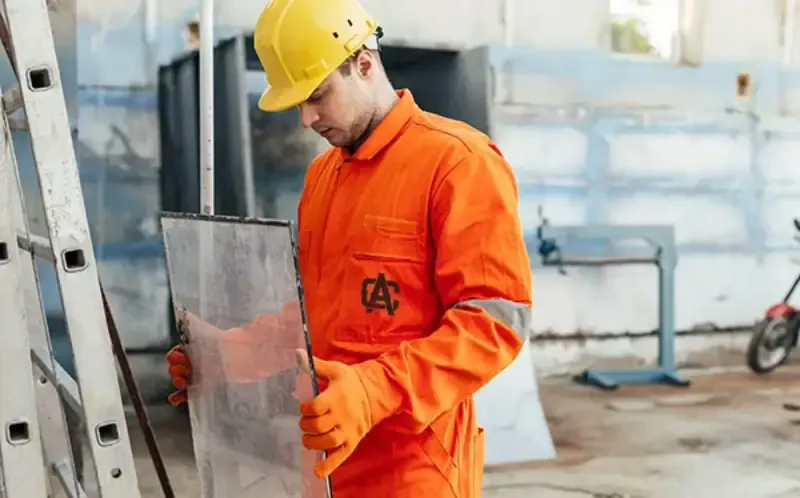
When outfitting a 500-person crew, marketing labels stop mattering. Comparing dungarees vs coveralls in a catalog means nothing without the technical spec sheet. Judge both strictly on material logic.
For high-movement roles, a lighter 240 GSM poly-cotton blend is the better pick. It washes easily and flexes with the body. For heavy abrasion, step up to 300 GSM cotton duck or twill.
A durable garment needs the right ripstop or twill construction, plus reinforced knees, elastic action backs, ankle-to-thigh zips, and covered zipper flaps to stop snags. Cheap crotch seams blow out after three industrial washes.
The Procurement Micro-Checklist: Demand data on these specific points before signing a purchase order:
- Fabric weight and blend
- Certified test reports
- Wash durability and shrinkage tolerance
- QC points: Zipper strength, crotch-seam reinforcement, and colorfastness post-laundering.
Catalogs group industrial safety apparel by end-use rather than garment type, and industrial uniform manufacturers sort their ranges the same way. Always read the specs. Complex rollouts are usually better served by a custom coverall manufacturer than an off-the-shelf line.
Sourcing reality: Neither garment survives a weak spec sheet. Fabric weight, seam construction, and certified test reports decide how long an order lasts — all fixed in how the garment is made, not at purchase.
To grade a large crew by region, read the coverall size chart with measured chest, waist, and inseam ranges rather than relying on letter sizes alone.
When a spec sheet is ready and a factory-direct quote is the next step, contact us for pricing on bib overalls or coveralls. We accept no kickbacks from mills, trim suppliers, or testing labs.
Hazard-to-Garment: A Procurement Decision Matrix
Match the garment to the exposure before matching it to a budget. The table below maps common industrial hazards to the garment that covers them and the standard that proves it.
| Task or exposure | Garment | Standard that applies |
|---|---|---|
| Farming, carpentry, warehousing | Bib overalls | None; abrasion and dirt resistance only |
| General construction, painting | Bib overalls | None, unless sparks are present; then add FR sleeves |
| Welding | Coveralls | EN ISO 11611 |
| Flash fire, oil and gas | Coveralls | NFPA 2112 or EN ISO 11612 |
| Arc flash, electrical work | Coveralls | ASTM F1506, arc-rated |
| Chemical splash, liquid handling | Coveralls | EN 13034 or EN 14605 |
| Roadwork, plant traffic | Coveralls, or a hi-vis vest over bibs | ANSI/ISEA 107 |
| Wet outdoor work | Waterproof bibs or waterproof coveralls | EN 343 |
| Medical, food handling | Coveralls | Task-specific hygiene standard |
The pattern is consistent. Whenever the hazard reaches above the waist and below the shoulder, the sleeveless bib stops short and a coverall takes over.
Bib overalls stay the better choice where the arms stay clear of the hazard and mobility or heat load matters more than coverage — general construction is the clearest case.
Pros and Cons: Which Garment Fits Which Job?
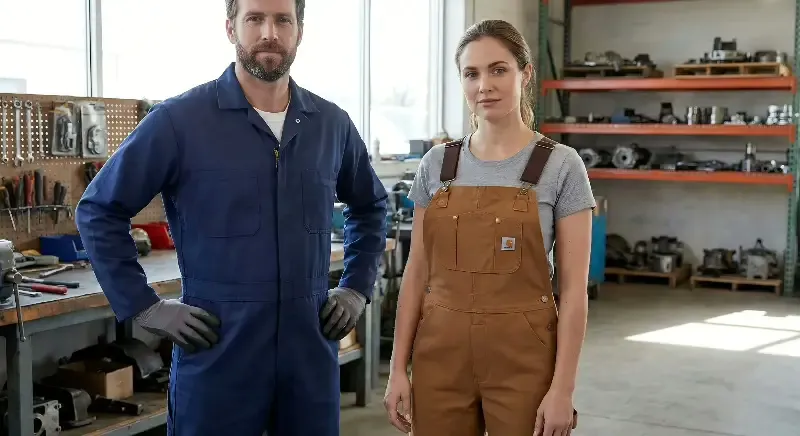
Bib Overalls
Pros:
- Maximum Airflow: The open chest design keeps the wearer cool through a long summer shift.
- Zero Waist Strain: Shoulder straps move the load off the belt line, which matters when lifting heavy material all day.
- Winter Versatility: Heavy thermal layers fit underneath without restricting shoulder or arm movement.
Cons:
- Exposed Arms: Stray metal shavings and shop dust reach unprotected forearms during angle grinding.
- Site Bans: Many site rules require continuous full-body hazard coverage, which bibs cannot satisfy on their own.
- Mismatched Gear: Sleeveless tops mean buying separate Westex FR shirts to match lower-body protection levels.
Coveralls
Pros:
- Total Shielding: The continuous unified garment keeps underclothes clean even in severe dust.
- Simplified Procurement: One protective garment per worker standardizes site safety from day one.
- Continuous Coverage: One unbroken layer closes the side and back gaps that a bib and a separate shirt leave open.
Cons:
- Severe Heat Buildup: Thick unified fabric traps heat, so base layers soak through on summer shifts.
- Restricted Reach: Stiff one-piece fabric pulls tight across the shoulders during repetitive overhead work.
🚀 Actionable Insight: To manage the key difference between overalls and coveralls regarding core heat, order coveralls equipped with two-way zippered vents for rapid cooldowns.
FAQs About Overalls and Coveralls
1. Are overalls and coveralls the same thing?
No. Coveralls protect your arms, torso, and legs, while bib overalls only cover your legs and lower torso. Coveralls provide a complete one-piece protective envelope. Bib overalls use shoulder straps to maximize upper-body mobility. See the Coverage and protection level section above for full details.
2. Should you wear clothes under coveralls and bib overalls?
Yes. You must wear base layers under both garments. Wearing moisture-wicking shirts underneath prevents chafing and manages sweat. For bib overalls, your shirt acts as your only line of upper-body protection.
3. Can I use FR bib overalls instead of FR coveralls?
No, not if your hazard assessment requires full upper-body protection. Exposed arms on bib wearers fail flash-fire compliance. You must use full-body FR coveralls to meet NFPA 2112 Standards if the environment poses spark or flame risks.
4. Is a boiler suit the same as a coverall?
Yes. A boiler suit and a coverall are the same one-piece garment. “Boiler suit” is the common term in the United Kingdom, while “coverall” is the usual term in North America. In workwear catalogs the two names are interchangeable.
5. What do UK and Australian workers call overalls?
In the United Kingdom and Australia the word “overalls” points to the one-piece garment, while North Americans reserve “coveralls” for it. The sleeveless bib garment is more often called dungarees or bib-and-brace. A spec sheet that reads only “overalls” can therefore be filled two different ways.
6. Are overalls or coveralls better in hot weather?
Bib overalls are cooler. The open chest and sleeveless design move air across the torso. Coveralls enclose the whole body, so heat builds up unless the fabric is light or the garment has vents. In high-heat work with no arm hazard, bib overalls are the more comfortable choice.
7. Which garment should procurement teams standardize on?
Standardize on coveralls when the site requires unbroken arm-to-ankle coverage, when the hazard reaches the arms, or when one garment per worker simplifies sizing and replacement.
Standardize on bib overalls when the work is mobile, the hazard is limited to the lower body, and crews need to layer for changing conditions.

Leave a Comment
Your email address will not be published. Required fields are marked *