Table of Contents
The short answer Full OEM cut-and-sew workwear runs 45–60 days between approved sample and in-hand. Stock-blank decoration finishes in 10–14 days. The gap is approvals, fabric reservation, and finish-line buffers, not the sewing line.
Late uniforms break launches, onboarding, and compliance credibility. Poor custom workwear production time planning causes that. I’ve seen it on the factory floor. A clean LantaoWork production board shows three staged cards: cutting, sewing, QC. An overloaded board is a wall of red tags.
Full OEM cut-and-sew workwear runs on a multi-stage schedule, unlike decoration on stock blanks. This guide turns a vague supplier lead-time quote into a schedule you can control.
It draws on LantaoWork production records, floor observations, and an interview with our Head of Production Operations. Scope runs through supplier vetting criteria, then spec freeze, approvals, textile sourcing, factory execution, and finish-line buffers.
Prerequisites: Assemble the Planning Inputs First

I vetted this checklist across LantaoWork FR, hi-vis, security, and hospitality rollouts.
- Target in-hand date, SKU count, and order volume by size. Missing size curves force recuts.
- Approved tech pack and BOM packet on one screen or sample-room table. It reads as one stack: fabric, trims, stitch callouts, branding method, label art, and signed approval sheet.
- Destination country and Incoterms. These shift labeling and testing timing.
- MOQ assumptions and job type. Confirm pilot run or full rollout.
- Full OEM or stock-base customization. This changes fabric sourcing and sample lead time.
- Approver list with one final owner and a 48-hour approval SLA. Samples often sit untouched for 10 days, yet the schedule blames the factory.
Compliance check: Do not release bulk on FR, hi-vis, or anti-static garments until material testing and label requirements are confirmed. Verify hi-vis garments against ANSI/ISEA 107, confirm color fastness to the buyer’s named test method, and inspect the first bulk run to AQL 2.5.
The same schedule shape runs through corporate and hospitality uniform programs.
⚠️ Safety First: Lock the compliance check before the factory cuts bulk.
How to Control Custom Workwear Production Time in 5 Steps?
Each step leaves you with one working document: a backward-planning sheet, an approval tracker, a release rule, a control board, and a dispatch gate. Work them in order, since slippage at the front spends the slack at the back.
Step 1: Plan Backward from the In-Hand Date
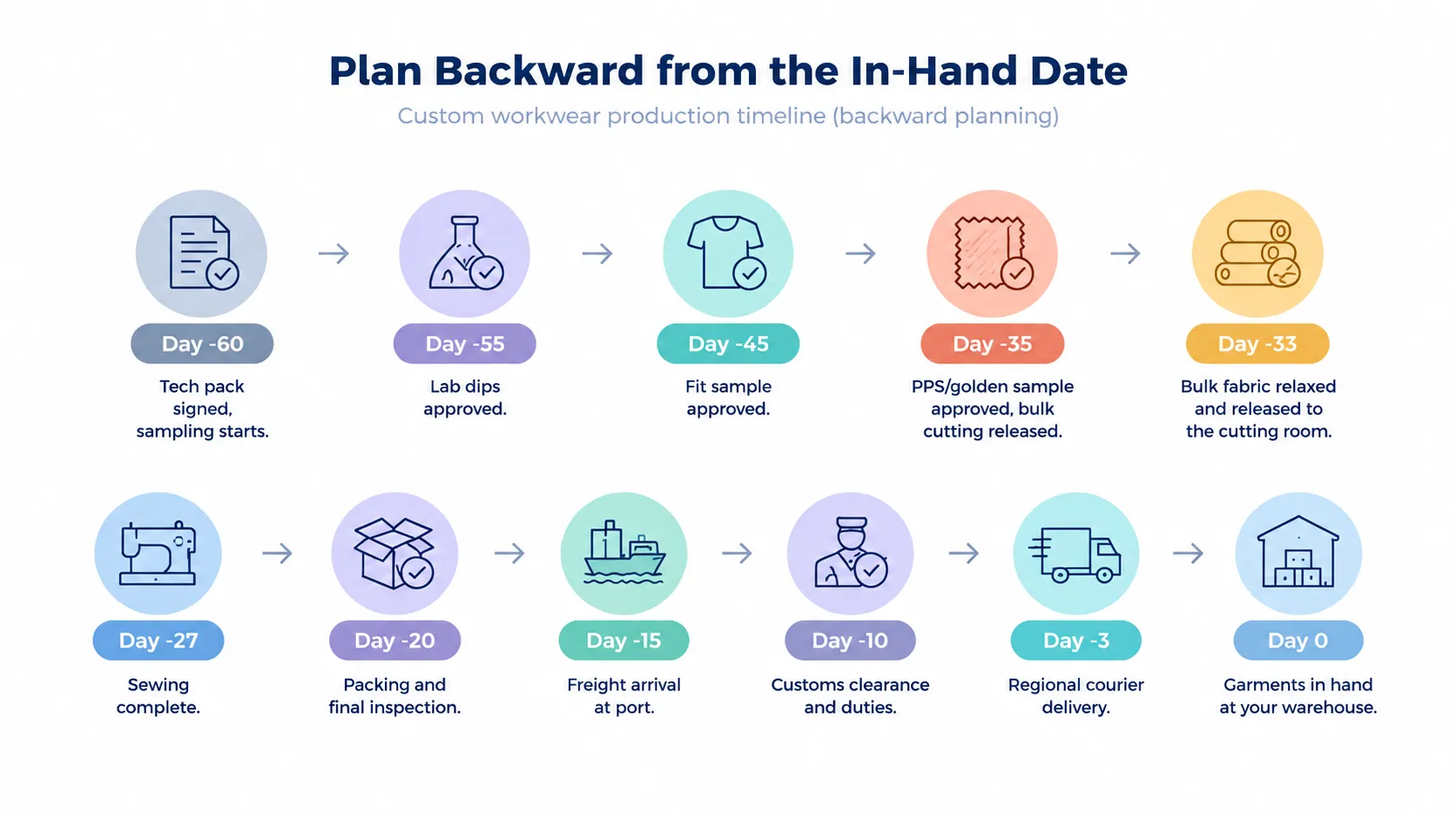
Start with the date garments must be usable: warehouse, branch, or employee-level in-hand date. Not the ex-factory date. Vendor quotes hide transit. Our Head of Production Operations said: “Start from in-hand. Ship date is where problems hide.”
Open a backward-planning sheet. Walk back from the in-hand date through four approval gates: the tech pack signs at Day -60 and sampling starts, lab dips clear at -55, the fit sample is approved at -45, and the PPS at -35 releases bulk cutting.
Material release and production sit between the PPS and the finish line: bulk fabric is relaxed and released to the cutting room at -33, and sewing completes at -27.
The final stretch is finishing and freight: packing and final inspection at -20, port arrival at -15, customs at -10, the regional courier at -3, and garments in hand at Day 0.
This chain is the buyer’s clock, anchored to in-hand. The factory’s 14-day floor cycle in Step 4 runs on a different clock: its Day 1 is Day -35 here.
Freight mode: the five days between final inspection and port assume air, matching the 5–9 day transit window on our freight comparison. Sea runs 28–42 days, which stretches the same plan by roughly a month.
Choose your path now. Full OEM canvas trousers or hi-vis parkas need the full chain. Compressed deadlines can start with stock garments plus embroidery, DTF, or heat transfer.
Do not let a three-day embroidery job benchmark a 60-day custom trouser program. I watched that mistake inflate a security uniform schedule by three weeks.
Validation: A realistic plan shows where its slack sits. Day -20 to Day -15 holds the rework buffer, and Day -3 to Day 0 absorbs courier slippage. If no stage has visible slack, compress one stage, not the whole plan.
⚡ Speed Verification: In our last FR rollout, rebuilding the schedule backward took 45 minutes. It surfaced seven days the factory quote had hidden: five days of transit and two days of customs.
Step 2: Break Pre-Production Into Owned Milestones
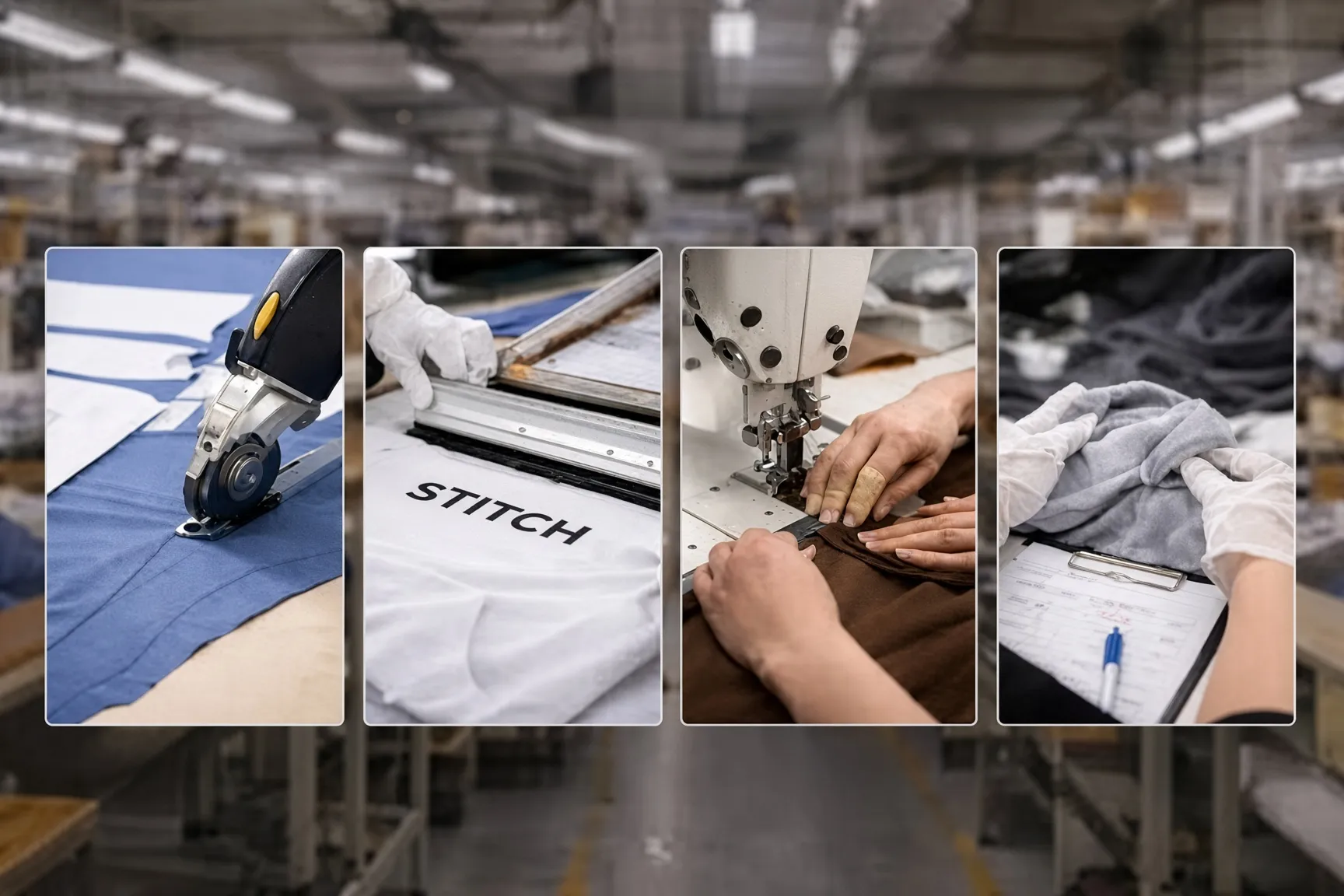
The backward map from Step 1 gives finish dates. Now assign an owner to each wait. In our floor reviews, approvals fail when no one owns the clock.
Open your approval tracker. Create rows for tech pack/design prep, lab dips, prototype/fit sample, and PPS (pre-production sample). Set the gap between gates: lab dips 5 days after sign-off, fit sample 10 days later, PPS 10 days after that.
Each revision resets that row, and scattered feedback across procurement, operations, brand, and EHS adds about two extra rounds. Use one consolidated feedback file instead.
Sensory checks I use: Check lab dips in a D65 light box: approved dips hold color under cool and warm light, while rejected ones look flat or shift green. Confirm the match against the buyer’s named color-difference method, then qualify the dye lot under ISO 105-B02 before bulk dyeing.
On fit samples, feel the seat, knee, and shoulder seams; a good fit moves without puckering. Approved embroidery strike-offs show dense, even stitches and flat backing, and rejected ones show gaps, curling, or an off-center logo.
| Milestone | Owner | Approval deadline | What is being checked | What happens if late |
|---|---|---|---|---|
| Tech pack/design prep | Brand lead | Day -60 | Fabric, trims, stitch callouts, label art | Pattern work and sourcing stall |
| Lab dips | Fabric manager | Day -55 | Light-box color and color fastness | Bulk dyeing waits |
| Prototype/fit sample | Operations plus EHS | Day -45 | Fit feel, seam strength, mobility | Recuts force delays |
| PPS/golden sample | Single final owner | Day -35 | Trim, embroidery strike-off, measurements | Bulk cutting blocks |
Primary route: courier the fit sample and PPS to one named approver. Some buyers approve digitally; keep courier as the fallback for color and touch. A 300-unit pilot protects a 3,000-unit rollout.
Validation: Every row has one owner and one deadline. No “TBD.” If an owner is missing, the schedule is already late.
🧠 Author’s Take: I do not maximize margin on first-run workwear. A validation order that we can inspect and correct beats a “profitable” order that returns 15% of units and breaks trust.
Step 3: Route Raw Materials and Lock the Release Rule
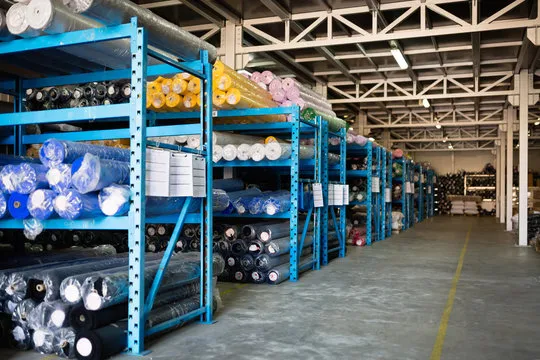
I have watched a cutting table sit empty because coated polyester was still at the dye house. Sewing speed did not matter. Raw material timing decided delivery.
Separate three material paths before you book the line:
- Stock fabric/trim route: Fastest. Ready fabric sits in the warehouse or on the mill shelf. Typical ready-to-cut lead time: 6 days. I inspect roll condition under D65 light.
- Custom dye or custom mill route: Slower. Lab dips add 7–10 days. Bulk dyeing adds 10–20 days. If the mill has minimums, delays compound. Reserve the dye lot slot first.
- Technical textile route: Slowest. FR, anti-static, water-repellent, and hi-vis finishes add 15–30 days. Certifications and batch tests stretch this further.
These lead times come from LantaoWork order records, not supplier marketing. “Ready-to-cut” means the fabric has been inspected, relaxed, and released to the cutting room.
| Material family | Median ready-to-cut time | Variance |
|---|---|---|
| Stock poly-cotton | 6 days | ±3 days |
| Custom dye cotton twill | 18 days | ±9 days |
| Coated PU/nylon | 22 days | ±12 days |
| Hi-vis FR treated | 28 days | ±16 days |
Hi-vis FR widens the most. I watch that spread hardest.
Release rule: No bulk cutting until material approvals and compliance checks are complete. Reflective tape feels stiff but smooth. Coated fabric feels waxy and heavier. Custom dye is not approved until the second lab dip matches the standard.
For hi-vis or similar performance claims, test the material package before bulk sewing, not after the run ends. Ask every name on your manufacturer shortlist the same question before you book a line.
⚠️ Experience Warning: I once saw a 600-piece security jacket line wait nine days for missing reflective tape. The fabric was approved, but the trim was not. The line was booked, cut, and stalled. Lock trims alongside fabric.
Step 4: Execute the Day-by-Day Factory Workflow
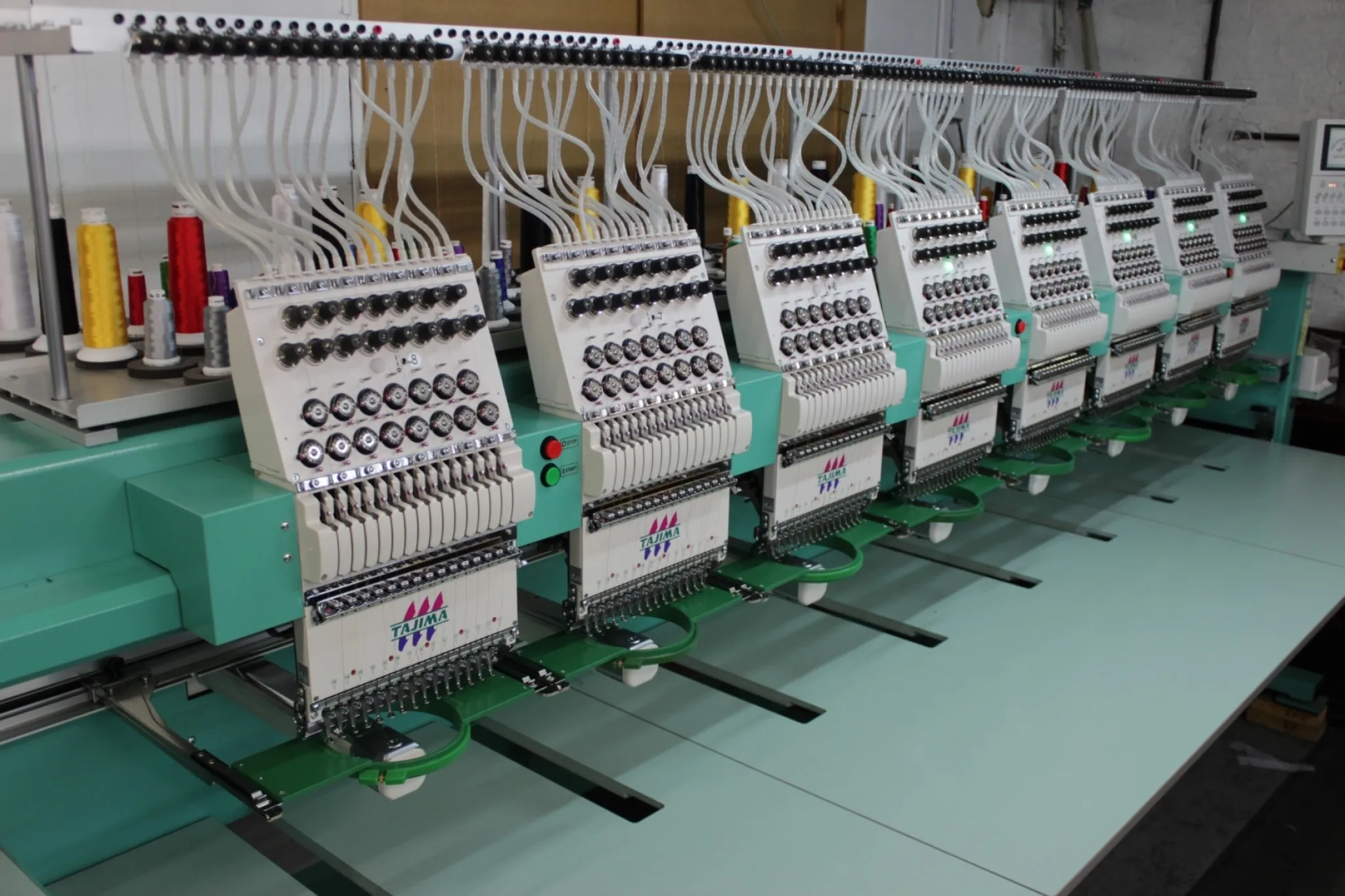
Raw materials are locked. Now follow the floor sequence day by day. I walked the LantaoWork floor last quarter: the cutting room’s rhythmic thud, operators calling bundle numbers on the sewing line, the faster click of the logo area. Use this table as your control board.
Factory day 1 below is the day bulk cutting is released, which is Day -35 on the in-hand clock in Step 1.
| Factory day | Factory Action | Dependency | Buyer Decision Needed | Typical Delay Risk | Control Metric |
|---|---|---|---|---|---|
| Day 1 | Bulk release, cutting order issued | Approved BOM | Final label art approval | Missing logo file | Sign-off timestamp |
| Day 1-2 | Pattern and marker prep | Sample-room tech | Pattern grade rule | Grading errors | Marker efficiency |
| Day 2-3 | Bulk fabric arrival and relaxation | Fabric release | None | Late trims | Relaxation hours |
| Day 3-4 | Cutting | Marker and spreader | None | Dull blade | Cut layer count |
| Day 4-5 | Bundling | Cut parts | Size curve confirm | Mismatched sizes | Bundle accuracy |
| Day 5-8 | Stitching | Sewing line balance | None | Missing operator skill | Daily output vs target |
| Day 8-9 | Logo application | Embroidery lead | Logo placement | Thread breakage | Rejection rate |
| Day 9-10 | Inline QC | Stitched parts | None | Seam puckering | AQL pass rate |
| Day 10-11 | Finishing | Washed parts | None | Snags | Defect count |
| Day 11-12 | Pressing | Finished garments | None | Heat damage | Pressed count |
| Day 12-13 | Packing readiness | QC passed | Packing spec | Wrong carton | Packing list |
| Day 13-14 | Final QC | Packed units | None | Hidden stains | AQL 2.5 |
Daily line output shifts by garment complexity. Basic trousers run 800 to 1,200 pieces per line per day. Multi-pocket cargo trousers drop to 500 to 700. Seam-sealed outerwear falls to 150 to 250. Use SMV (Standard Minute Value) to level load, not guesswork.
Stage variance in the same order records: custom embroidery adds 1.2 days on average, DTF adds 0.4 days, FR seam sealing adds 2.5 days, and stock blank decoration adds 0.3 days.
Head of Production Operations, LantaoWork: “The real bottlenecks hide outside the sewing line. Seasonal fabric milling constraints hit after Chinese New Year: mills shut for two weeks, and raw material shortages delay dye lots.
Compliance testing cycles also stall: FR tests can take 10 days. Embroidery queue congestion triples in Q4. Reserve these slots early.”
Kitting and white-label distribution add packing steps that belong in the schedule from day one.
🧠 Author’s Take: I always walk the cutting room before releasing bulk. The sound tells me if the line is balanced. If the cutting table is quiet, fabric is late. If the sewing line has no pile-up, the SMV is off.
Step 5: Run the Final Control Gate Before Dispatch
Schedule inline checkpoints during sewing and finishing. Book the final AQL inspection only after most cartons are sealed. I have seen inspectors arrive while the packing line still ran. That wastes a QC day and resets trust.
Do sensory checks. Pull a random carton from the middle pallet and run your hand along the tape seal: no lifted edges, no exposed garment corners. Check carton labels against the packing list: product code, size run, destination mark, carton weight.
If branded packaging or EU PPWR packaging specs apply, they have to be visible on that label. A clean lot stacks uniformly, labels facing one direction, no mixed SKUs. If you see handwritten labels or torn tape, stop dispatch.
Packing is a lead-time lever, not an afterthought. Assortment packing, employee kitting, branded packaging, and destination labeling all add time before freight, so confirm them before final QC. Enterprise buyers often ship to one DC; distributors may need split shipments or white-label fulfillment.
Leave a three-day rework buffer after final AQL. In our last FR lot, replacement zipper tapes arrived after the inspector left. Use the buffer for rework, trim replacement, and packing list fixes.
Freight decision: choose air when missing a rollout costs more than the freight premium, and sea when schedule slack exists and landed cost matters more.
Validation: The inspector signs off on packed cartons, not loose garments. Dispatch only when labels, seals, and carton count match the packing list.
AQL 2.5 means no more than 2.5% major defects in the inspected sample. AQL 4.0 allows 4%. Lower is stricter.
🧠 Author’s Take: Middle pallet, bottom carton. Packing crews know which boxes get opened, and they stack accordingly.
Troubleshooting Common Production Schedule Delays
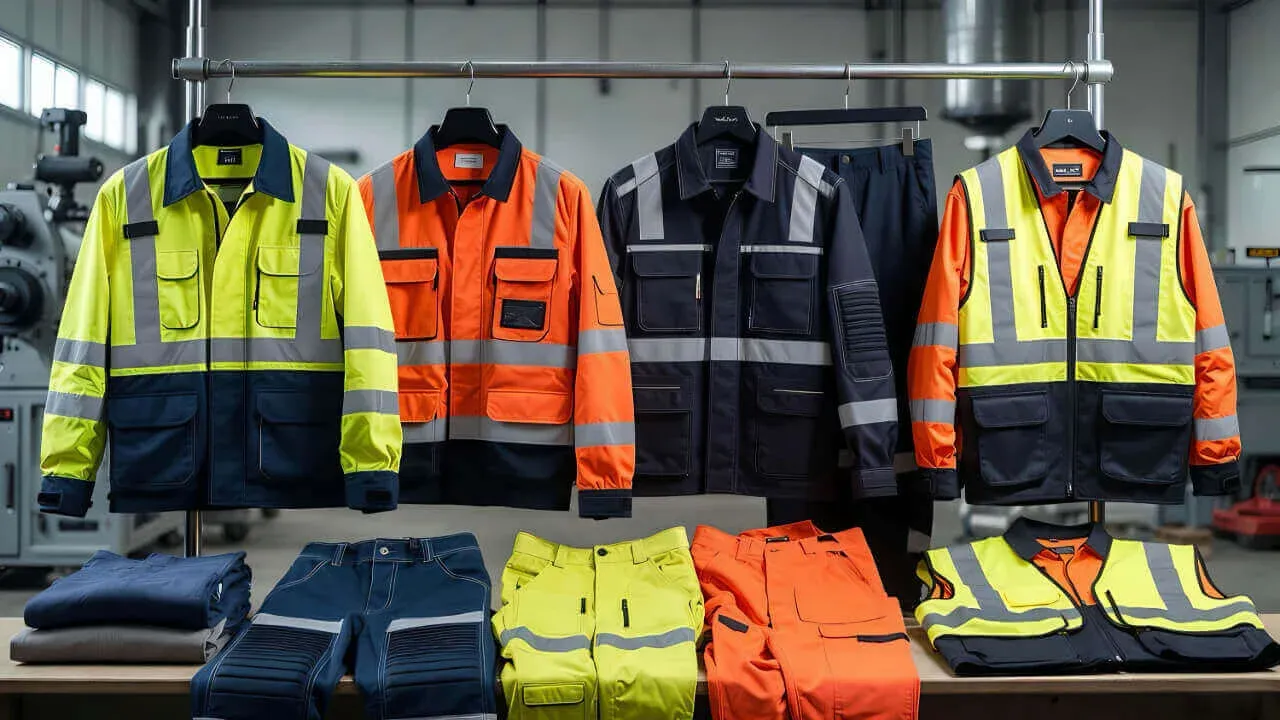
Five delays account for most late custom workwear orders, and they sit at the gates on either end of the schedule, not in the middle. Each entry below pairs a symptom with the field diagnosis and the fix.
1. Approvals keep cycling or sit untouched
Field diagnosis: In my LantaoWork log, six rollouts lost 8–11 days here, not at the factory.
Fix: Enforce one approver and a 48-hour SLA. Escalate to silent approval once the deadline passes.
🛡️ Prevention: Name one final owner before sampling. “Reply all” chains kill schedules.
2. Materials quoted but not reserved
Field diagnosis: The quote assumed a mill slot that was never actually booked. The dye lot then queued behind other orders.
Fix: Require fabric booking confirmation. Rank substitute fabrics and colors in advance. Set a switch deadline. We swapped to a local stock substitute in 24 hours and recovered five days.
3. Order shows “in production” but is waiting in queue
Field diagnosis: “In production” often means fabric matched but line not cut.
Fix: Ask for line booking date, cutting completion date, and daily output targets. Track these, not generic status language.
🧠 Author’s Take: Red-flag any row where the cut date passes with zero daily output.
4. Compliance testing runs late
Field diagnosis: Post-holiday capacity crunch and testing-lab backlogs hit hardest in Q1. Peak replenishment windows make this worse.
Fix: Move lab submissions forward. Block bulk release until reports land.
5. Final inspection fails or packing is incomplete
Field diagnosis: The AQL report only covers what was on the floor that day. Cartons packed after the inspector left ship uninspected unless the count is reconciled.
Fix: Pre-book rework days after AQL. Hold freight space that tolerates a short shift.
Head of Production Operations, LantaoWork: “Buyers underestimate final QC rework the most. They plan cut and sew tightly, but rework after AQL failure always steals a week.”
⚡ Quick Fix: The 80/20 recovery: lock fabric reservation and line booking first.
🛡️ Our Verdict: We reproduced these failures across three seasonal cycles. Late material reservations and hidden queue waits cause the most pain.
FAQs About Custom Workwear Production Time
1. What is a realistic custom workwear production lead time?
Full OEM cut-and-sew workwear takes 45 to 60 days from approved sample to in-hand on expedited freight, or about a month longer by sea. Stock blank decoration can finish in 10 to 14 days. In my LantaoWork log, hi-vis FR outerwear hit 58 days because coated fabric, FR tests, and trims added 15 to 30 days.
2. What is the biggest delay most buyers miss?
Missing trims. Fabric approval alone is not enough. Lock trims, labels, and zippers at the same time as fabric, or a single missing tape roll will idle a cut line for a week.
3. Can I shorten custom workwear lead time after order placement?
Yes, but only if you compress the correct stage. Asking for a faster quote does not move cutting or sewing. Move approvals, reserve materials, and set a switch deadline for substitutions.
4. How much buffer should I add after final inspection?
Add at least three days for rework. I plan twenty days between final QC and in-hand: three days of rework buffer, then port, customs, and the final courier leg. Lose that buffer and dispatch slips by exactly those three days.
5. What should a controllable production schedule include?
It must include an owner, a deadline, and a dependency for each gate. I use a backward plan from the in-hand date: Day -60 sampling, Day -55 lab dips, Day -45 fit sample, Day -35 PPS, Day -20 packing, Day 0 in-hand. If any row shows “TBD,” the schedule is already late.
Conclusion: Control the Gates, Not the Quote
The result is simple. Buyers who control approvals, materials, and finish-line buffers control production time. Buyers who only push for a faster quote do not.
Assign one owner and one deadline to every gate, then reuse the Step 2 approval tracker and the Step 4 control board on every custom workwear PO.
Releasing a PO feels calm only when every gate, buffer, and owner is already defined. The schedule sits quiet. No chase calls.
Start your next schedule with LantaoWork.
Transparency note: This article is first-party factory experience on LantaoWork’s own production floor, not an independent review. It draws on our production records and interview-based floor observations.

Leave a Comment
Your email address will not be published. Required fields are marked *