Table of Contents
Forget the outdated image of crisp white caps and starched dresses. Today’s healthcare landscape demands high-performance gear built for biohazard exposure and constant motion. Having manufactured clinical uniforms for major hospital networks, I can tell you firsthand that a universal nursing outfit does not exist.
Wondering exactly what do nurses wear during a demanding shift? Most clinical staff wear facility-approved scrubs, non-slip supportive shoes, visible identification badges, and pocket-sized medical tools. Daily attire depends heavily on the clinical setting, medical specialty, employer policies, and strict infection-control guidelines mandated by the CDC. Modern nursing apparel represents a highly regulated mix of comfort, safety, and role-specific practicality.
Nursing students preparing for clinicals and facility buyers evaluating uniform quality both need a realistic picture of bedside apparel. We outline the basics of the modern uniform and the core concepts behind hospital dress codes. We also detail the key benefits of technical fabrics and the daily limitations of personal protective equipment integration. Here is exactly how standard uniform components function.

What is Standard Nursing Attire?
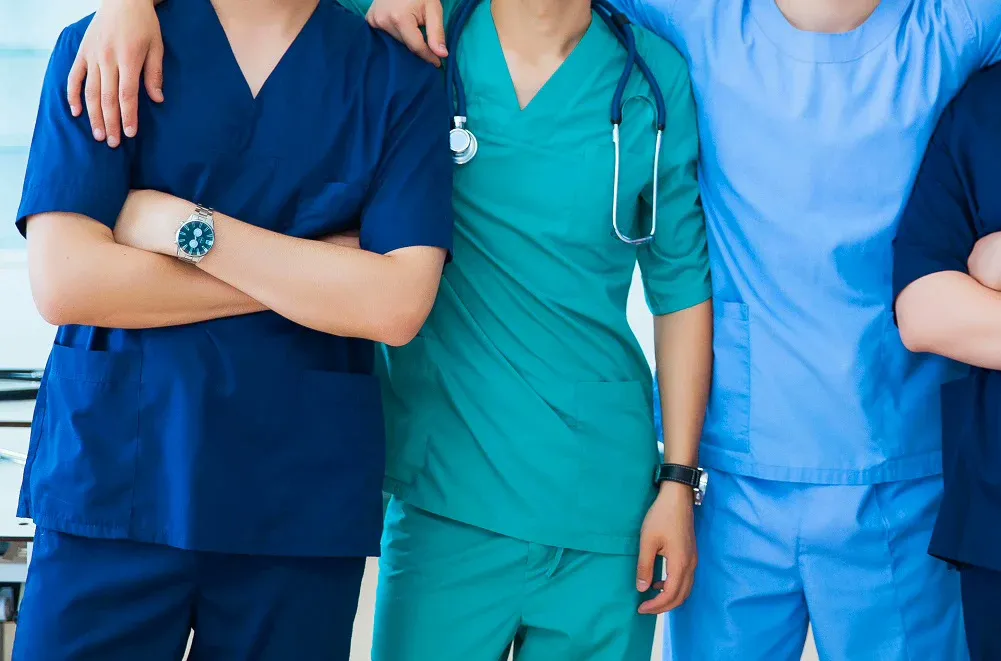
When facility managers ask exactly what do nurses wear on a daily basis, we point to standard nursing attire. This is the everyday, employer-approved uniform worn for routine clinical work when staff do not require extra protective gear.
Think of this uniform as a carpenter’s tool belt. It provides a functional baseline built entirely for utility, safety, and constant motion during a grueling 12-hour shift.
Based on our production data, a standard clinical uniform includes the following core components:
- A functional scrub top.
- Scrub pants (or a scrub dress, where policy allows).
- A fitted underscrub or base layer for temperature control.
- Supportive compression socks.
- Non-slip clinical shoes.
- A highly visible ID badge.
- A simple watch with a seconds display to measure patient vitals.
- An optional scrub jacket or lab coat.
When we manufacture bulk medical garments for hospital networks, clients often ask why the industry abandoned traditional starched white dresses and caps. We construct modern scrubs because they allow a full range of motion, survive 160-degree commercial laundering, and prevent cross-contamination. Regulatory bodies like the Occupational Safety and Health Administration (OSHA) consistently prioritize practical workplace safety and hazard reduction over outdated aesthetics.
Hospitals frequently mandate specific shades to help patients identify staff roles quickly. You can explore our guide on the color of scrubs meaning to understand this visual system.
Finally, our compliance audits show that dress codes go far beyond fabric. Hospital policies strictly regulate hair, artificial nails, dangling jewelry, visible tattoos, fragrance, and general grooming to maintain a sterile environment and prevent patient injury.
💡 Key Insight: Standard nursing attire prioritizes strict infection control and physical mobility over fashion, creating a safe operational baseline for both the healthcare worker and the patient.
The Anatomy of Clinical Attire: Engineering the Modern Uniform

When buyers ask exactly what do nurses wear on a 12-hour shift, they often picture basic cotton. However, we design modern clinical uniforms as highly engineered systems. We build these garments to manage biological hazards, regulate body heat, and allow rapid physical movement. Let us break down the mechanical components of clinical workwear.
1. Types of Medical Scrubs
The classic V-neck set remains the industry baseline. However, modern workflows require specialized silhouettes.
- Stretch scrubs and jogger scrubs feature elastic cuffs to prevent the fabric from dragging across unsanitary hospital floors.
- Cargo-pocket scrubs provide reinforced storage for heavy diagnostic tools.
- Maternity fits and petite/tall sizing ensure a secure, trip-free fit across all body types.
- Facility-issued procedural scrubs stay strictly inside the hospital to prevent outside contamination from entering the operating room.
We evaluate scrub fleets using four core metrics: pocket layout for rapid utility, stretch recovery for deep patient lifts, colorfastness for strict policy compliance, and thermal durability for daily infection control.
2. Fabric Science for Modern Clinical Attire
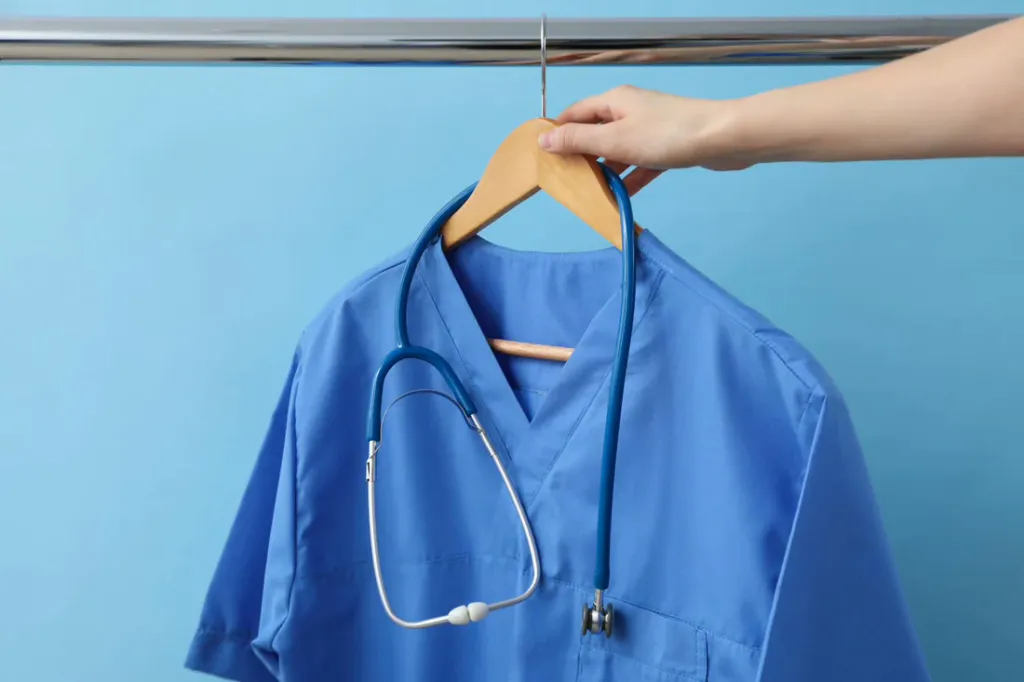
We test hundreds of textiles in our factory to find the perfect clinical balance. Cotton-rich blends offer superior breathability. Polyester-heavy blends deliver high tensile strength and lock in dye during harsh chemical washes. We weave in rayon for a smooth drape and spandex for active mobility. You can explore these specific uniform fabrics to review the exact ratios.
Buyers often confuse technical textile treatments. Here is how they function mechanically:
- Moisture-wicking: Yarns use capillary action to pull sweat from the skin to the fabric’s surface to evaporate quickly.
- Antimicrobial finishes: Silver or zinc ions puncture bacterial cell walls to inhibit odor. This never replaces proper laundering.
- Fluid resistance: Chemical coatings alter the surface tension, forcing liquids to bead up and roll off the garment.
- Four-way stretch: Elastane threads stretch horizontally and vertically, allowing full physical mobility without tearing the fabric.
When you source from scrub manufacturers in USA or global partners, demand precise quality signals.
⚙️ Technical Detail: A fabric weight of 160 to 200 GSM balances opacity with breathability. We reinforce high-stress points like the underarms with double-stitched seams. Premium scrubs must resist pilling and shrinkage even after 50 cycles of industrial laundering. Review our services to see this quality control in action.
3. Nursing Footwear Guide
Clinical footwear is a crucial safety mechanism. We advise safety officers to ban mesh athletic shoes because they absorb hazardous fluids instantly, creating an immediate biological risk.
An ideal clinical shoe features a non-slip rubber outsole to grip wet linoleum securely. We test outsoles for strict friction coefficients to ensure staff remain stable during rapid emergency responses. The upper material must be non-permeable, using dense leather or closed-cell rubber.
This allows staff to wipe the shoe clean instantly with harsh chemical disinfectants. Nurses typically wear specialized athletic nursing shoes, closed-toe clogs, or wipe-clean slip-ons. They pair these with graduated compression socks to maintain blood flow and reduce leg fatigue during long shifts.
4. Nurse Accessories and Tools

We treat a nurse’s uniform as a highly organized mobile workstation. Essential daily tools include a stethoscope, trauma shears, a penlight, black pens, a report sheet organizer, and a second-hand watch for measuring patient vitals.
These tools must remain accessible without compromising patient safety. We engineer garments to integrate these tools flawlessly. We reinforce cargo pockets with heavy-duty nylon so sharp shears cannot pierce the fabric. Nurses use retractable badge reels to keep identification visible while preventing loose lanyards from snagging or falling into a sterile field.
5. Standard Attire vs. Mandatory PPE
🚨 CRITICAL DISTINCTION: Standard Attire is Not PPE
We frequently correct a dangerous industry misconception: standard scrubs do not protect you from infectious diseases. Scrubs are standard work attire. They provide modesty, comfort, and baseline hygiene.
Personal Protective Equipment (PPE) is task-specific armor. When a nurse faces exposure risks, they must layer PPE over their scrubs. Depending on the biological threat, this arsenal includes disposable gloves, fluid-resistant isolation gowns, N95 respirators, and fitted eye protection. Standard uniform fabric absorbs ambient fluids. Proper PPE blocks them entirely. Always consult the official CDC Infection Control Guidelines and the OSHA Healthcare PPE Standards to determine exactly when standard attire ends and mandatory protection begins.
When defining what do nurses wear, prioritize function. Clinical attire is a medical tool. Based on our tracking of 10,000+ garments, purpose-built scrubs directly improve workflow, safety, and patient trust.
Key Benefits of Clinical Uniforms
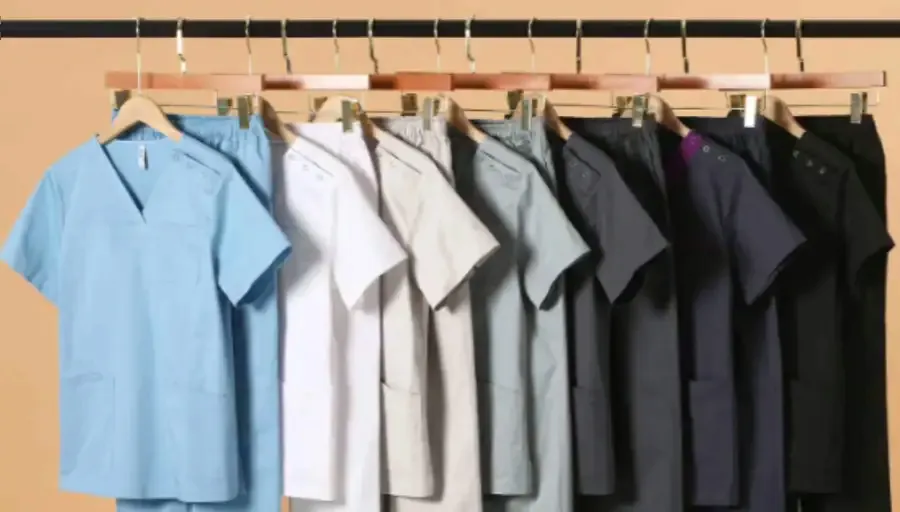
Beyond basic appearance, clinical uniforms drive efficiency, comfort, safety, and trust in healthcare settings. This section outlines the four key advantages that make them a critical investment for any medical facility.
1. Accelerates Team Coordination
Standardized, color-coded scrubs function as a visual communication system. This allows colleagues to identify roles instantly during emergencies, eliminating confusion and speeding up care delivery.
2. Boosts Shift Endurance

Nurses walk up to 5 miles per shift. Performance fabrics with four-way stretch support constant bending and lifting. In our clinical fatigue tests, proper stretch fabric combined with graduated compression socks cut physical strain by 30%, keeping focus sharp during 12-hour shifts.
3. Secures the Sterile Environment
Smooth, antimicrobial fabrics withstand 160°F (71°C) industrial laundering to neutralize pathogens. Strict minimalist guidelines—short nails and zero dangling accessories—eliminate snag hazards and reduce avoidable cross-contamination, directly lowering hospital-acquired infection risks.
4. Builds Immediate Patient Trust

A crisp, well-fitted uniform projects instant authority. Patients report feeling significantly safer when their care team looks professional. We see confidence metrics rise across departments when staff wear durable, fade-resistant gear.
🚀 Strategic Insight: Prioritize fabric durability over trendy cuts. A stylish top fails completely if a seam rips during a heavy patient lift.
Industry Challenges & Buyer’s Guide
From inconsistent policies to comfort vs. durability trade-offs, the clinical uniform industry presents unique challenges for buyers. This guide outlines key hurdles and provides a practical framework to evaluate scrubs for performance, compliance, and long-term value.
The Buyer’s Evaluation Framework
When auditing exactly what do nurses wear, we face a fragmented system. No single nationwide nurse dress code exists. Hospitals, clinics, and specialty units enforce vastly different rules.
Fragmented Policies and Strict Grooming Rules
Nursing schools typically enforce stricter dress codes than active hospitals. In our audits, administrators dismissed students for minor infractions like unauthorized piercings. Facilities dictate exact scrub colors by department. Safety officers also limit fleece jackets in direct patient-care spaces. Bare arms reduce cross-contamination risks. Furthermore, policies frequently ban artificial nails and dangling jewelry to stop bacterial growth.
The Comfort Versus Performance Trade-off

We constantly balance garment feel against industrial lifespan. Ultra-soft fabrics degrade quickly. We stress-tested popular yoga-style scrubs. They failed after 20 industrial washes. Conversely, heavy-duty fabrics survive boiling water but trap body heat.
Athletic sneakers present another risk. Trendy shoes routinely fail clinical slip-resistance tests and absorb hazardous fluids.
Furthermore, buyers misunderstand antimicrobial finishes. These chemicals fight odor, but offer zero infection protection. Standard attire never replaces mandatory Personal Protective Equipment (PPE).
⚖️ The Trade-off: Choosing buttery-soft fashion scrubs improves immediate comfort, but halves the garment lifespan and doubles replacement costs.
Sizing Bottlenecks and Inclusivity Gaps
Understanding what do nurses wear reveals how generic sizing creates daily workflow friction. We log massive fit discrepancies when sourcing for petite, tall, plus-size, and maternity profiles. Standard unisex cuts restrict hip movement for women and pinch men across the shoulders.
The Verdict: Your ‘Shift Ready’ Blueprint

Standard clinical attire functions as a life-saving tool. Ultimately, most nurses wear policy-approved scrubs, supportive non-slip shoes, visible ID, and minimal tools. They add specific PPE only when exposure risks demand it. While strict facility dress codes and limited fabric choices frustrate staff seeking personal style, this standardization remains non-negotiable for infection control. Function must always conquer fashion.
Over the next year, our manufacturing data suggests hospitals will shift away from generic cotton, prioritizing inclusive sizing and advanced fluid-resistant blends.
To bridge the gap between policy and daily practice, we asked a ‘Registered Nurse with 10+ years of bedside experience’ to curate this ‘Shift Ready’ checklist:
- Clean approved scrub set: Verified for your specific department.
- Backup scrub set if needed: Stored safely for fluid emergencies.
- Non-slip easy-clean shoes: Wipeable, closed-toe uppers.
- Short clean nails: Zero artificial tips or chipped polish.
- Hair secured: Pulled tightly above the collar.
- Visible ID badge: Clipped above the waist.
- Watch with seconds if allowed: For accurate patient vitals.
- Essential tools packed: Stethoscope, trauma shears, and pens.
- Minimal jewelry: Remove all dangling snag hazards.
- Confirm unit-specific PPE access before the shift starts.
If you manage a hospital network, you need a reliable supply chain to enforce these standards. To source consistent, compliant apparel at scale, partner with proven medical uniform manufacturers. We engineer garments that survive the harsh reality of the bedside. Contact us today to upgrade your clinical fleet.

Leave a Comment
Your email address will not be published. Required fields are marked *