Table of Contents
During a recent 10,000-unit rollout, a procurement director almost made a costly mistake by assuming all surgeons wear green. Patients and new hires often misunderstand the color of scrubs meaning, expecting a universal rule.
In reality, hospitals design specific color codes to reduce role confusion. According to the American Nurses Association, standardized uniforms help patients identify caregivers quickly. We break down common U.S. color patterns, the psychology behind surgical blues, and how administrators build smarter operational identities.

Main 8 Color of Scrubs Meaning
https://www.youtube.com/watch?v=cd3P6Cipfx4
1. Navy and Royal Blue Scrubs

When patients ask about the color of scrubs meaning, they usually start with blue. What do blue scrubs mean? Hospitals heavily favor navy or royal blue for nursing, med-surg teams, and ICU staff. These shades project calm, trust, and professionalism.
When comparing nurse vs doctor scrub colors, remember that facility rules vary. Doctors might wear royal blue in one clinic and green next door.
During a recent 5,000-unit hospital rollout, the board requested navy for all staff. We restricted navy exclusively to registered nurses to preserve instant visual recognition.
🛡️ Our Verdict: Navy is our most requested nursing color, but deep blues fade fast under harsh CDC-compliant wash cycles. Always require your manufacturer to use industrial-grade reactive dyes.
2. Ceil and Light Blue Scrubs

Patients often assume every blue uniform shares the exact same color of scrubs meaning. In reality, hospitals use shade variation to build a smart visual system.
While navy indicates nurses, administrators assign lighter shades like ceil blue to Certified Nursing Assistants, support staff, or perioperative teams. Light blue looks clean and highly approachable. This strategy keeps corporate identity cohesive while instantly separating units. Patients easily spot the difference between a navy nurse and a ceil-blue technician.
During a recent 12-location enterprise rollout, a client requested five unrelated scrub colors. I advised them to build a tonal blue hierarchy instead. This pivot prevented visual chaos on the floor.
🛡️ Our Verdict: Ceil blue is notoriously difficult to color-match across batches. If your manufacturer lacks strict AQL 2.5 quality control standards, your staff will wear visibly mismatched uniforms within six months.
3. Green and Teal Scrubs

Why do surgeons avoid white? It comes down to optical science. Green sits directly opposite red on the color wheel. In the OR, PACU, and endoscopy units, doctors stare at blood for hours. This causes severe visual fatigue. Green and teal scrubs counterbalance this glare to prevent eye strain.
Beyond physical relief, these shades create a calmer visual environment. When decoding the color of scrubs meaning, green provides the clearest example of psychological impact in medicine. It promotes healing and mental clarity.
I recently audited a surgical center using cheap green poly-blends. Under 100,000-lux operating lights, the shiny fabric caused massive glare. We replaced them with our custom matte teal blend.
🛡️ Our Verdict: Source matte, fluid-resistant fabrics for surgical teams. Shiny materials reflect bright lights and ruin the exact optical benefits you need.
4. Burgundy and Red Scrubs

Administrators often assign red and burgundy to high-movement teams. You will spot these colors in emergency departments, respiratory therapy, and phlebotomy. These deep shades project high energy and hide fluid stains perfectly.
Still, you cannot rely on tradition alone to decode the color of scrubs meaning. A burgundy uniform might signal an emergency nurse in one hospital and a receptionist next door. Facility policy always overrides general trends.
During a 3,000-unit burgundy rollout for an American Red Cross partner, we faced a strict technical requirement. Red pigments bleed easily. We solved this with a proprietary dye tested to ISO 105 colorfastness standards.
🛡️ Our Verdict: Always require colorfast technical fabrics for red garments. Otherwise, your professional uniforms will fade to a washed-out pink after just 20 industrial wash cycles.
5. White Scrubs
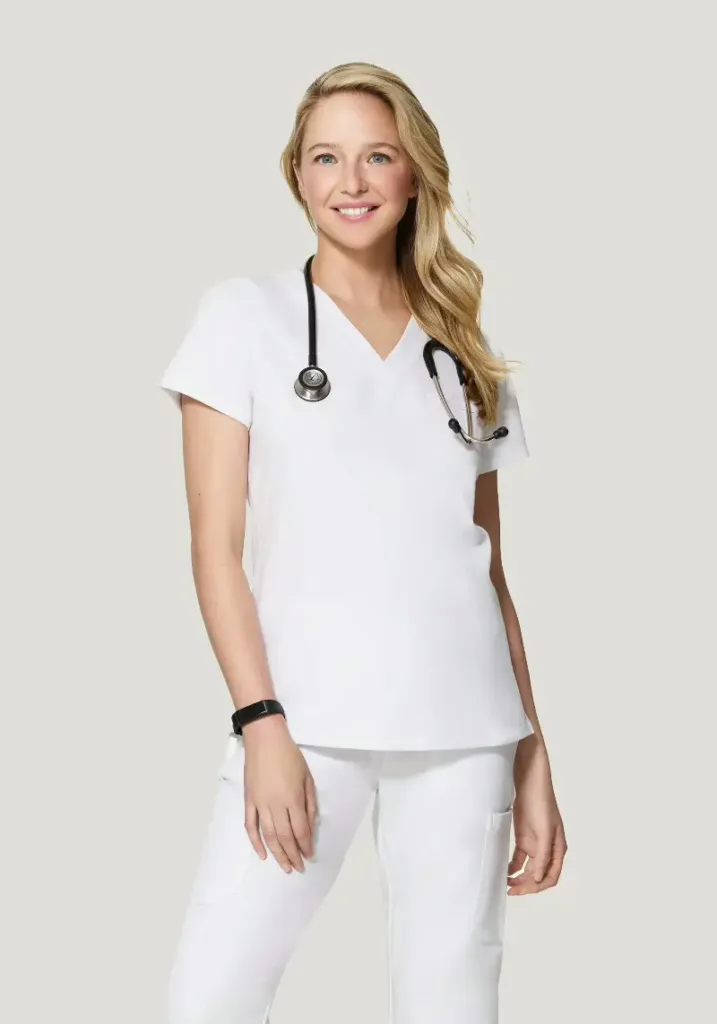
Historically, white uniforms dominated hospitals. According to the American Medical Association, they signaled absolute cleanliness, authority, and professional care for doctors and nurses.
Today, the color of scrubs meaning has shifted, making white rare at the bedside. The fabric stains instantly and creates glare under modern lights. This drives up uniform replacement costs. Now, administrators reserve white for cleaner environments. You usually spot white scrubs in pharmacies, diagnostic labs, or senior roles.
When a clinic recently requested 500 white nursing scrubs, I advised against it. We shifted their bedside staff to navy and kept white strictly for pharmacy technicians.
6. Black and Gray Scrubs

Traditional blues and greens make premium clinics look like standard hospital wards. If you research the color of scrubs meaning outside urgent care, black and gray dominate.
These neutral tones project a sleek, polished image. Administrative teams and private practices use them to build a modern brand identity. In fact, studies on color in marketing show that black directly conveys authority and sophistication.
I recently designed a uniform rollout for a luxury clinic. They wanted absolute professionalism without copying the classic medical palette. We outfitted their staff in custom charcoal gray. This immediately elevated their brand above local competitors.
🛡️ Our Verdict: Black scrubs look sharp, but cheap dyes fade quickly. Always require AATCC colorfastness standards from your manufacturer to maintain a premium aesthetic through heavy industrial washing.
7. Purple Scrubs

When exploring the color of scrubs meaning, purple signals wisdom, compassion, and comfort. Hospitals assign this specific color to oncology, women’s health, and pediatrics. These units require a softer, empathetic visual identity.
Purple serves as a strategic differentiation tool. It acts as a clear wayfinding marker for patients navigating complex medical facilities. Research from the Center for Health Design proves that deliberate color coding reduces patient anxiety.
During a recent project, we helped a procurement director separate a pediatric oncology wing from general medicine. We manufactured 600 custom plum purple sets. This distinct color helped stressed parents locate their dedicated care team without asking for directions.
🛡️ Our Verdict: Purple requires complex dye formulations. Without premium reactive dyes, the fabric fades to a muddy gray after high-heat industrial laundering. Always request colorfastness test reports before you order bulk specialty colors.
8. Pink and Patterned Scrubs

Administrators often fear that patterned uniforms look unprofessional. Yet, in pediatric wings, the color of scrubs meaning shifts entirely. Bright pinks and prints serve a proven clinical purpose. They soften the environment and actively reduce pediatric anxiety. Children feel safer when staff look approachable.
You must balance this approach with broader facility policies. Patterned tops work perfectly in child life units. Solid colors still perform better in trauma wards where rapid role recognition saves lives.
During a 1,200-unit pediatric rollout, a hospital board almost banned prints. We solved this by pairing custom-patterned tops with solid navy pants. This compromise maintained a professional operational identity.
🛡️ Our Verdict: Printed fabrics fade much faster than solid colors. Always require reactive dye printing. Without it, friendly patterns will look distressed and unprofessional after just ten industrial washes.
How to Implement a Hospital Scrub Color Policy

The federal government does not enforce a universal scrub color law. A strict policy builds role clarity, helps patients identify caregivers, and improves department workflow. Do not just copy the uniform palette of another hospital. When you define your own color of scrubs meaning, you must build a system that fits your specific daily operations.
Use this three-step playbook to build a clear operational identity.
1. Map out your clinical roles
List every active job title in your building. Group these roles by their daily patient contact levels. Assign distinct shades to separate your registered nurses from your technical staff.
2. Test the colors on the floor
Order a small test batch of 100 units before you buy in bulk. Survey your patients to confirm they understand the visual cues. Ask your staff if the colors wash out under harsh clinical fluorescent lights.
3. Write the official dress code policy
Document the final color hierarchy clearly in your employee handbook. Ban outside uniform purchases to prevent mismatched shades from different dye lots. Make this document mandatory reading for all new hires.
Review our medical uniform manufacturers capabilities for a reliable supply chain partner. When you are ready to start your custom medical uniform planning, contact us today.
FAQs About Scrub Color Meanings
1. Is there a universal nurse vs doctor scrub color system?
No universal color law exists in healthcare. We find that every hospital builds its own unique rules. Many clinics put doctors in green and nurses in blue, but this changes across different states. In our enterprise rollouts, we map colors strictly to local guidelines. Always remember that your specific facility policy is the final authority.
2. Do blue scrubs always mean nurse?
Not always. Navy blue serves as the most common nursing color, but doctors or respiratory techs might wear it at different hospitals. As we covered in the blue section earlier, the exact shade matters. Clinics often put medical assistants in light blue and registered nurses in navy. Ultimately, your local facility policy is the final authority.
3. What do burgundy scrubs usually mean?
Burgundy typically identifies emergency, trauma, or respiratory units. This dark red shade projects high energy and hides fluid stains well. During our recent manufacturing audits, we noticed many clinics assign burgundy strictly to phlebotomy teams. Do not rely on this trend everywhere. Your facility policy serves as the final authority on all uniform codes.
4. Can staff choose their own scrub colors, or does the hospital decide?
Hospital boards almost always dictate the color code. Allowing personal choice creates visual chaos and confuses patients. We frequently help procurement managers replace mixed personal uniforms with strict color systems to improve safety. If you work in healthcare, your facility policy acts as the final authority on your daily dress code.

Leave a Comment
Your email address will not be published. Required fields are marked *