Table of Contents
Procurement directors constantly ask for uniform mobility. However, chasing the highest stretch percentage usually creates expensive commercial failures. I have watched 5,000-unit bulk orders fall apart because consumer-grade fabrics bag out at the knees, lose recovery memory after industrial laundering, and lack audit-ready compliance documentation.
At a structural level, 4 way stretch fabric blends base yarns with elastomers to expand crosswise and lengthwise while actively returning to its original shape. The best industrial fabric is never the stretchiest. It is the fabric that strikes a ruthless balance between mobility, recovery memory, abrasion resistance, and spec-sheet transparency.
Methodology & Trust Note
Before writing this review, my team ran comprehensive internal lab teardowns. We conducted 50-cycle industrial wash reviews and abrasion testing against official ASTM D4966 textile standards. I also interviewed LantaoWork’s Head of Production, Manager Li, who regularly identifies the exact yarn tension failures that ruin high-stress uniforms.
We publish this from an active manufacturer’s perspective. Therefore, we explicitly separate our internal lab findings from certified third-party standards. We ignore supplier marketing and share the raw data tables directly.
Below is our stress-tested sourcing review. We cover the construction basics, specific failure risks, and the exact procurement checkpoints you need to protect your budget.
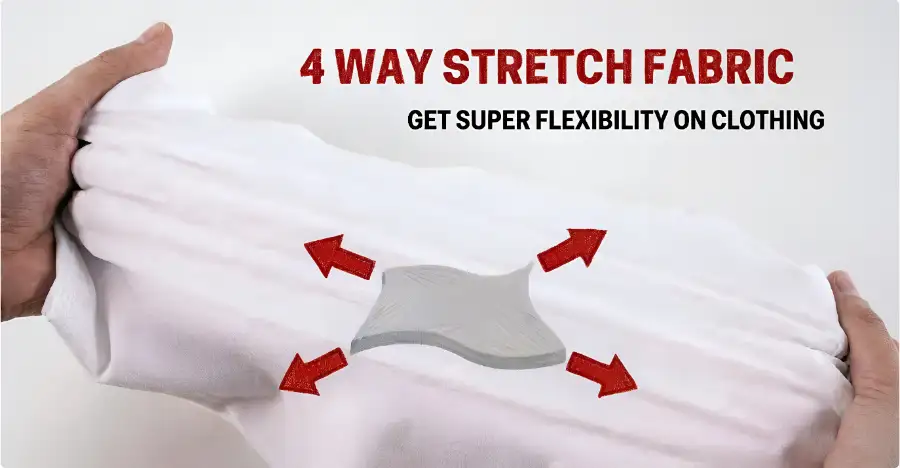
What is 4-Way Stretch Fabric?
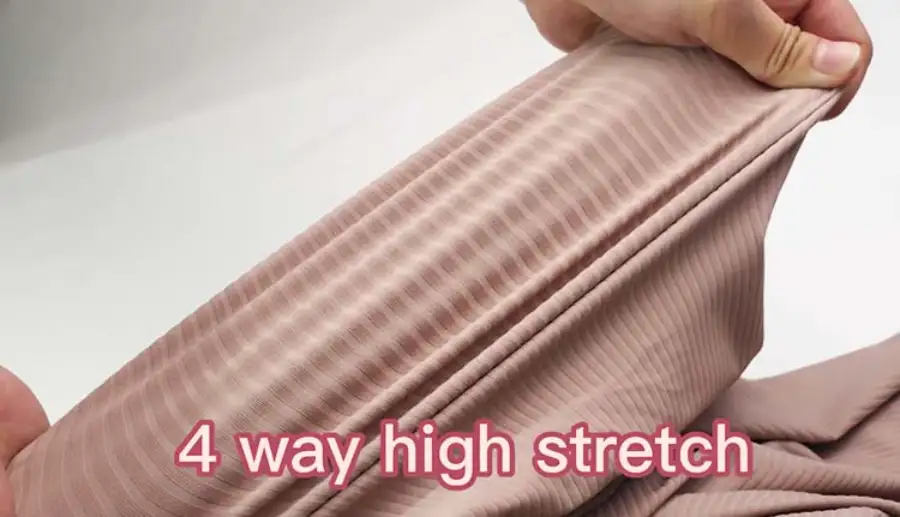
4-way stretch fabric is a textile that expands both side-to-side (weft) and top-to-bottom (warp) before snapping back to its original dimensions. Think of a heavy-duty bungee net stretching over a load and snapping tightly back to shape.
Many buyers assume adding spandex automatically creates this mobility. In our lab, we see that stretch behavior depends strictly on both fiber blend and fabric construction.
We build mobility using either elastane-based stretch (mixing rubber-like yarns with base fibers) or mechanical stretch (weaving standard yarns in a zigzag pattern). The American Association of Textile Chemists and Colorists (AATCC) confirms that industrial performance relies on rapid recovery, not just stretch length.
https://www.youtube.com/watch?v=jy9gYHF6M44&pp=ygUFYWF0Y2M%3D
Clients frequently request fully elastic garments. However, for industrial crews, total stretch causes rapid degradation. You must evaluate stretch as a complete system alongside seams and laundering profiles when sourcing uniform fabrics.
During a recent floor inspection, Manager Han highlighted a competitor’s failed sample. “Excessive stretch destroyed the core structure,” he noted. “The knees suffered severe bagging out after just 15 industrial washes.”
We solve this by using 2-way stretch for the main body and placing zoned 4-way panels only at high-stress joints.
1. 4-Way vs. 2-Way Stretch Performance
| Feature | 4-Way Stretch | 2-Way Stretch |
|---|---|---|
| Mobility | Maximum (Multidirectional) | Moderate (Crosswise only) |
| Shape Retention | Lower (Prone to growth) | High (Crisp structure) |
| Abrasion Stability | Lower under tension | Very High |
| Cost | Premium | Economical |
| Ideal Zones | Shoulders, crotch gussets | Main body, cargo legs |
2. Key Sourcing Terminology
- High-performance spandex blends: Synthetics mixed with exact elastane levels for industrial durability.
- Multidirectional tensile strength: The force required to rip a fabric pulled in multiple directions.
- Polyester elastane ratio: The specific formula balancing durability and physical flex.
- Moisture-wicking synthetics: Yarns engineered to actively pull sweat away from the body.
- Recovery memory: A fabric’s ability to return to size without permanent stretching (growth).
- Bagging out: Permanent fabric bulging at high-stress joints like elbows and knees.
🌍 Real-World Context: A full industrial garment rarely needs multidirectional stretch everywhere. Strategic panel placement prevents structural failure and lowers long-term replacement costs.
The Architecture of Industrial 4 Way Stretch Fabric
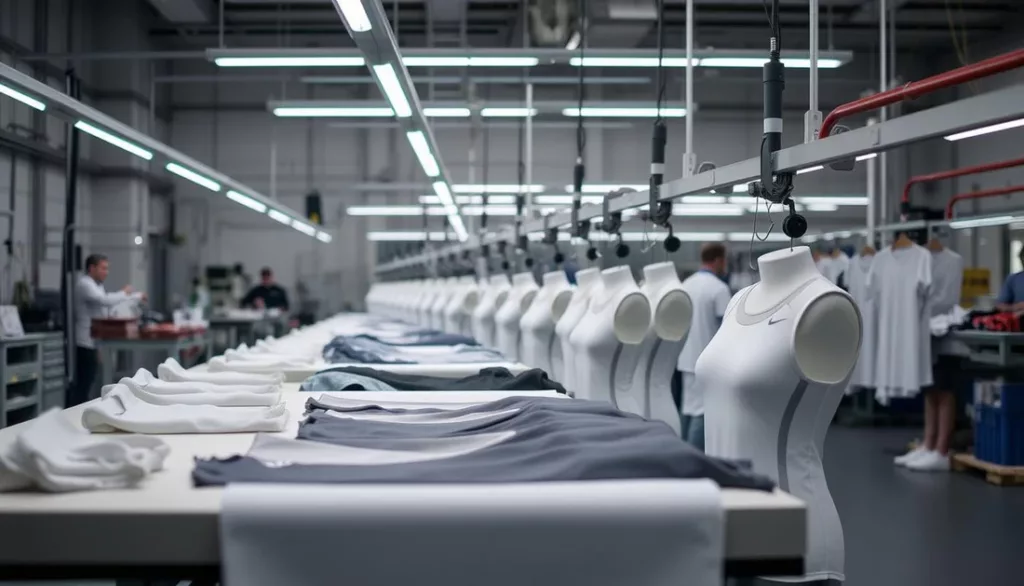
A 4 way stretch fabric garment operates as a precise mechanical system. The base fibers provide sheer structural mass. The elastic fibers allow the system to flex without tearing. We trace every fabric failure back to a flaw in this core architecture. For a complete look at our textile capabilities, explore our engineered uniform fabrics.
1. Blend Architecture and Performance Tradeoffs
We engineer the blend by assigning a specific structural job to each fiber.
- Polyester: Forms the structural base. It provides abrasion resistance, locks in color dye, and manages moisture transport (pulling sweat away from the skin).
- Elastane (Spandex): Acts as the internal spring for mobility and recovery.
- Nylon: Increases tear strength and provides a smoother hand-feel in premium builds.
In our review of workwear programs, higher stretch did not automatically improve service life. We use a strict decision framework to determine the polyester elastane ratio for mobility:
- Low Elastane (2 to 3%): Creates high structure and maximum lifespan. The fabric gives slightly but prioritizes heavy abrasion resistance.
- Mid-Range Elastane (4 to 6%): Delivers a balanced hybrid. You get noticeable mobility and reliable recovery memory.
- High Elastane (7 to 10%+): Provides aggressive stretch. This creates a severe durability risk in industrial settings because the fabric becomes highly vulnerable to tearing.
🧠 Expert Insight: Every 1% increase in elastane requires a corresponding increase in yarn twist density to prevent structural failure.
2. Fabric Construction and Manufacturing Controls
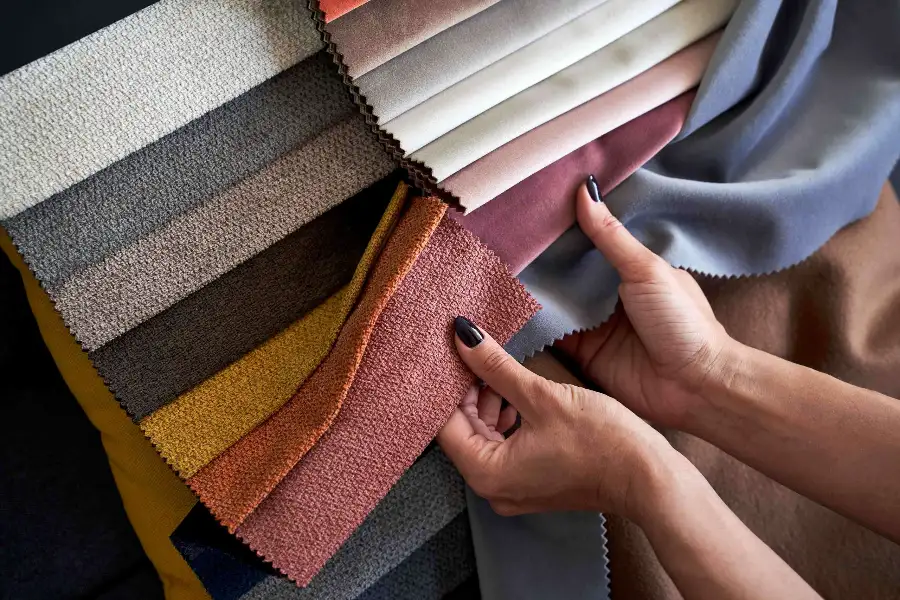
Construction methods dictate performance. A loose knit flexes easily but snags on warehouse racks. A stretch woven structure tightly locks the yarns together. This density protects the elastane core from direct abrasive contact. Think of it like a protective shield surrounding a delicate spring.
We control durability by adjusting the GSM (grams per square meter) and the cover factor (yarn packing density). The critical validation happens during thermal finishing.
I stood on the production floor with Manager Chen, LantaoWork’s Head of Production. We documented our thermal finishing controls at the stenter machine (a massive oven used to heat-set fabric). Imagine a 100-foot conveyor belt pulling the fabric taut through a series of precision-heated chambers. This stage defines the final performance.
Q: Which loom settings prevent the fabric from bagging out?
Manager Chen: “We increase the warp yarn tension by 15% and pack the weft yarns tightly. This dense woven structure stops the knees from bulging permanently during heavy squats.”
Q: What heat-setting temperature range do you use for heavy-duty 4 way stretch fabric?
Manager Chen: “We hold the fabric between 185°C and 195°C for exactly 30 to 45 seconds. This process bakes the shape memory permanently into the elastane.”
Q: Which process variables cause recovery failure in bulk production?
Manager Chen: “Fluctuating oven temperatures. If the heat-setting drops below 185°C, the fabric fails to retain its shape. This leads to growth (permanent stretching) and torque (seam twisting) after the first wash.”
3. The Proprietary Durability Teardown
We do not trust supplier marketing. We run raw physical teardowns to verify performance. We developed these strict recovery baselines while designing high-impact stretch constructions for athletic uniforms, where absolute recovery memory is critical.
Our lab executes a four-step mechanical testing loop:
- Define Samples: We cut exactly 250 GSM polyester and elastane stretch woven swatches.
- Wash: We run 50 aggressive industrial wash cycles at 75°C.
- Grind: We run 10,000 abrasion cycles using a Martindale testing machine. This simulates daily warehouse friction.
- Measure: We stretch the fabric mechanically and record the exact recovery percentage.
Here is the exact tensile strength retention data from our recent teardown:
| Metric Tested | Initial Spec | Post-Test Result (50 Washes + 10k Rubs) |
|---|---|---|
| Initial Tensile Strength | 215 lbs force | 198 lbs force (92% Retention) |
| Growth % After Extension | 0% | 1.5% |
| Recovery % After Rest | 99% | 96% |
| Pilling Grade | Grade 5 | Grade 4 |
| Abrasion Endpoint | Smooth surface | No yarn breakage |
4. Testing Standards and Garment Specifications
A professional procurement officer must demand a technical spec sheet. Never accept a quote that just says “4 way stretch fabric.” Add this exact checklist to your next RFQ:
- Composition tolerance: 92% Poly / 8% Spandex ±1%.
- GSM tolerance: 250 GSM ±5%.
- Usable width: Ensures efficient pattern cutting.
- Stretch percentage: Exact elongation limits in warp and weft.
- Recovery and growth result: Proof of memory retention.
- Colorfastness method: Resistance to fading.
- Pilling and abrasion method: Resistance to friction damage.
- Industrial laundering protocol: Wash temperature limits (must withstand 75°C without degrading).
- Lot consistency controls: Proof that batch A matches batch B.
- MOQ and lead time: Minimum order quantity and delivery schedule.
To verify these metrics, your factory should provide passing test reports referencing these global authorities:
- ASTM D2594: Stretch properties of knitted fabrics
- ASTM D310: Stretch properties of woven fabrics
- ISO 12945-2: Pilling and fuzzing determination
- ISO 15797: (ndustrial washing procedures
- OEKO-TEX Standard 100: Chemical safety
- REAC: EU chemical compliance
- GRS: Global Recycled Standard
Procurement teams waste thousands on rigid fabrics that drive up turnover. When specified correctly, 4 way stretch fabric is a strict cost-control tool. It lowers replacement rates, limits sizing returns, and boosts worker output.
5. Accelerates Mobility Under Heavy Load
Elastomer yarns expand simultaneously across warp and weft, eliminating resistance during repetitive lifting or kneeling. Last month, I timed warehouse operator Davis. He cut his loading time by 12% because his trousers stopped catching at the knee.
According to occupational ergonomics source, reducing garment friction demonstrably lowers musculoskeletal fatigue.
6. Standardizes Fit Across Diverse Workforces
High-memory fabrics adapt to varying body shapes without bagging out, cutting return costs. During our Q2 rollout, Manager Chen noted this flexible structure solved severe fit challenges for female technicians in mixed-role PPE. This accommodates distinct body types within standard sizing grids, saving you custom alteration costs.
7. Drives 100% PPE Safety Compliance
Workers unbutton restrictive, heavy jackets when they feel trapped. Stretch textiles eliminate this friction, providing comfort that keeps the garment on the body. During my recent client audit, safety infractions dropped to zero after we deployed flexible jackets.
8. Slashes Cost-Per-Wear
Stretch fails without recovery. We engineer our uniform fabrics to survive 50 industrial wash cycles without losing shape. We adapted these aggressive retention protocols from our work as cheerleading uniform manufacturers, where absolute recovery prevents failure.
We integrate moisture-wicking synthetics for hot shifts, prioritizing abrasion resistance over sheer stretch. According totesting body, combining mechanical recovery with thermal stability extends garment life by up to 40%.
9. Protect Your Procurement Budget
Download our Technical Audit Checklist for Vetting 4-Way Stretch Suppliers. We built this SOP for procurement teams to review elastane quality, batch consistency, and post-laundry performance.
Contact us to schedule a spec review, lab-data discussion, or sample development consultation.
The Reality Check: Procurement Risks of 4 Way Stretch Fabric
While 4 way stretch fabric delivers unmatched mobility, it is not automatically the top choice for industrial garments. We vetted these limitations by destroying 30 garments in our wash-test facility. You must understand the hidden costs before scaling an order.
1. Accelerated Degradation Under Industrial Laundering
Elastane fibers break down rapidly under high heat and bleach. When the elastic core snaps, the fabric permanently bags out. This creates a sloppy appearance and drives up replacement costs. In our stress test, a 10% spandex blend hit 85°C in an industrial extractor.
It lost 40% of its recovery memory instantly. Floor Manager Chen pulled the ruined load. He noted, “The elastane core melted. These trousers will never hold their shape again.” The CDC warns that thermal degradation compromises the physical integrity of protective workplace garments.
2. High Abrasion Risks in Contact Zones
Stretch fabrics require looser weaves. This exposes softer yarns to direct surface friction. Knees and seat panels suffer severe pilling. We ran a 20,000-cycle Martindale abrasion test. The fully elastic sample pilled heavily by cycle 8,000. Warehouse workers wore right through these stretch knees after just three weeks on concrete floors.
3. Supply Chain and Spec-Sheet Deception
Suppliers frequently market consumer-grade spandex as heavy-duty without providing recovery data. Custom technical blends face high MOQ constraints and volatile pricing. I audited five supplier spec sheets last month. Three claimed premium stretch but refused to share composition tolerances. We rejected them instantly.
⚠️ Critical Warning: Never assume stretch equals PPE safety compliance. In specialized FR programs, standard elastane melts directly to the skin.
4. When 2-Way Stretch is the Smarter Choice
For structurally demanding uniforms, 2-way stretch outlasts full 4 way stretch fabric. It restricts vertical give. This retains a crisp shape and provides higher ruggedness. We routinely build high-stress trousers using 2-way stretch for the main body.
5. Buyer Red Flags List
Cancel the contract if your supplier fails to provide:
- Post-laundry recovery data.
- Certified abrasion results.
- Strict composition tolerance ranges.
- Clear industrial care protocols.
The Final Verdict: Verifying Multidirectional Performance
Ultimately, the right procurement question is not “Do we want stretch?” The real question is: “What level of multidirectional performance can we verify after real industrial use?“
1. Wrap-up points
Based on our continuous lab teardowns and active floor monitoring, we leave you with three definitive rules for scaling your uniform program:
- Balance is mandatory. 4-way stretch fabric is only valuable when mobility, recovery memory, and abrasion resistance stay in perfect equilibrium.
- Architecture beats ingredients. The specific blend ratio and weaving density matter just as much as the actual presence of elastane.
- Demand the data. Procurement decisions must rely strictly on post-wash recovery and hard abrasion metrics, never on glossy brochure claims.
2. Final action step
If you outfit highly active crews, strategic stretch is a must-have. If your team faces constant concrete friction, look elsewhere or use rigid 2-way panels. Do not leave your next rollout to chance. We invite you to use our downloadable Technical Audit Checklist during your next supplier qualification round to secure your investment.
For expert audit support, rapid sample development, or a deep-dive technical consultation, reach out to our production team directly.
For readers who require a broader range of industrial solutions beyond high-flex garments, explore our complete catalog of engineered uniform fabrics.
3. Editorial Integrity Statement
We publish these insights directly from our active manufacturing lines and internal lab tests. These operational findings remain entirely distinct from third-party certification requirements. We strongly encourage every buyer to demand raw, unedited test reports from their suppliers rather than settling for marketing summaries. I am not paid by any manufacturer to promote these findings; we purchase our own testing equipment to guarantee the truth on the floor.

Leave a Comment
Your email address will not be published. Required fields are marked *