Table of Contents
The short answer Safety helmet types split into two impact families and three electrical classes, and you have to pick both. Type I stops a top impact only; Type II adds a foam liner for lateral blows. Class E resists 20,000 V, Class G 2,200 V, Class C none. Brim shape and color never change the rating.
Buyers often make a dangerous procurement mistake: they compare brands before classifying site hazards. That backwards order risks your Occupational Safety and Health Administration (OSHA) compliance.
We see the same pattern across the shells sold by the top safety helmet manufacturers in China: buyers copy the specification off the last purchase order instead of deriving it from the hazard. The fix is to read the standard before the catalog.
Trust disclaimer: My recommendations come from first-party factory experience — not paid placement, and not a laboratory test report. Technical figures below are attributed to ANSI/ISEA Z89.1, OSHA 29 CFR 1910.135, or the issuing body.
6 Safety Helmet Types
Six shell configurations, each matched to the hazard it actually stops.
| Type | Core Protection | Ideal Use Case | Key Feature | Compliance |
|---|---|---|---|---|
| Type I Safety Helmet | Overhead (crown) impact only | Open trenches, flat-ground labor | Four- or six-point suspension webbing | ANSI/ISEA Z89.1 Type I |
| Type II Safety Helmet | Top and lateral impact | Work at height, confined space | EPS foam liner plus four-point chin strap | ANSI/ISEA Z89.1 Type II |
| Class E / G / C Helmet | Electrical contact resistance (none in Class C) | Live electrical work | Unvented shell; Class E 20,000 V, G 2,200 V, C none | ANSI/ISEA Z89.1 Class E/G/C |
| Full-Brim and Cap-Style Helmet | Sun, glare, rain, clearance | Full-brim outdoors, cap-style indoors | Brim geometry, not impact rating | ANSI/ISEA Z89.1 (brim is not a rating) |
| High-Visibility Helmet | Low-light and traffic visibility | Rail, road, night utility crews | Fluorescent shell plus factory reflective tape | ANSI/ISEA Z89.1 (color is not a rating) |
| Specialized Integrated PPE Helmet | Impact plus climbing and task hazards | Sites mixing industrial and climbing risk | Shell, visor, and ear protection tested as one unit | EN 397 + EN 12492, factory-kitted |
1. Type I Safety Helmets for Overhead-Impact Jobs
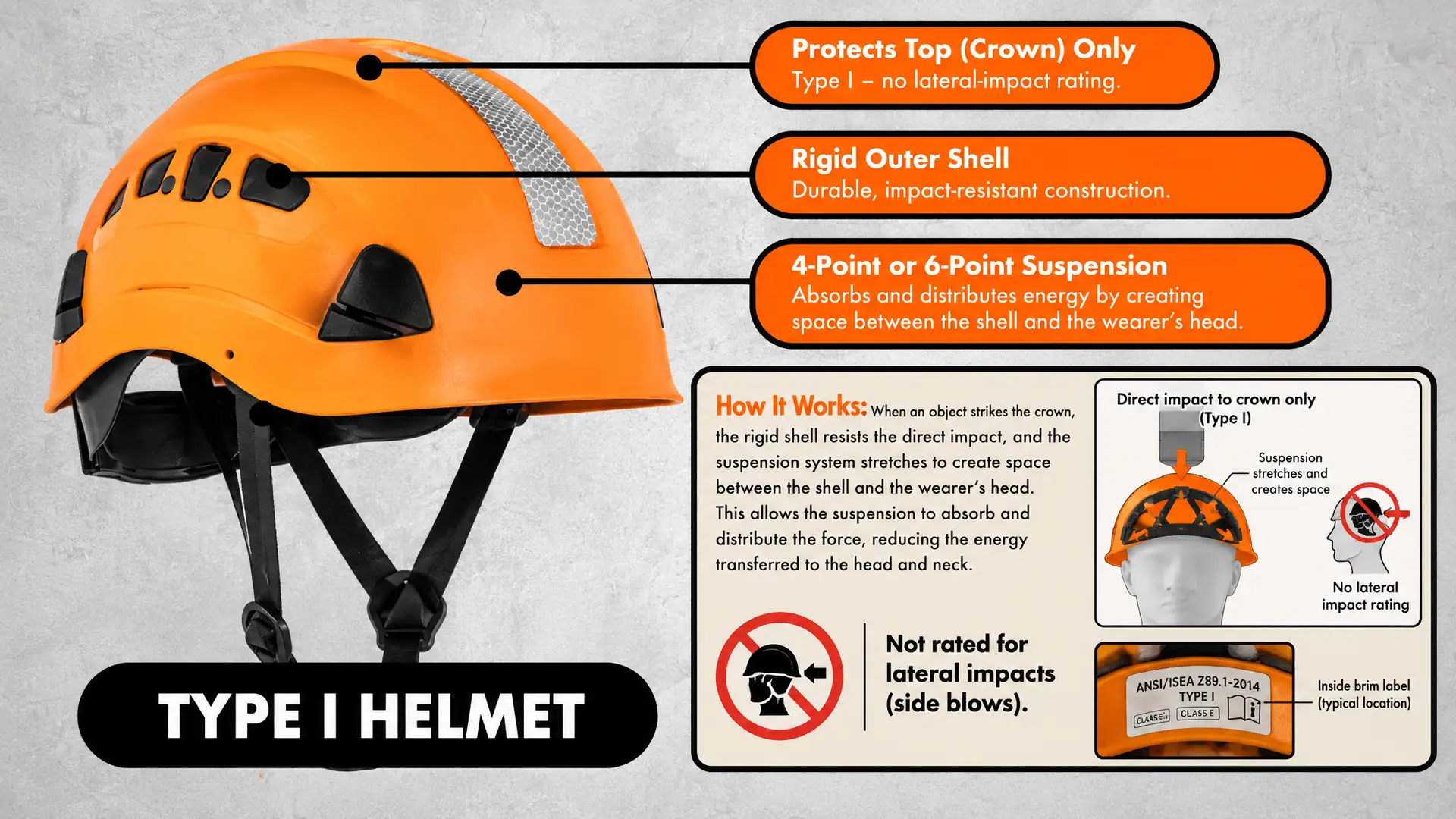
Evaluating safety helmet types starts here. A Type I helmet is a rigid shell rated for a direct blow to the crown, with no lateral-impact rating, yet most buyers assume a standard hard hat handles swinging pipes. It does not.
Structurally it is a rigid shell plus a four-point or six-point suspension system, and the suspension is the only thing absorbing energy. NIOSH has measured how much of it actually reaches the headform.
ISEA’s test diagram shows the striker landing on the apex, with the webbing stretching to slow the headform underneath. Nothing in that setup addresses a sideways blow, which is why a crown-only helmet has no answer for one.
Always verify the shell by checking the inside brim label. Look for the ANSI Z89.1 marking. It lists both the Type and the Class (like Class E for electrical risk). If your crew works in open trenches with purely overhead falling hazards, this tier remains highly effective.
🛡️ Our Verdict: Type I helmets excel in low lateral-risk zones: in our own purchasing, a cap shell lands roughly 40% below a Type II climbing helmet and weighs less, which helps airflow and accessory fit. If the crew climbs scaffolding or faces swinging debris, upgrade immediately.
2. Type II Safety Helmets for Side-Impact and Work-at-Height Jobs
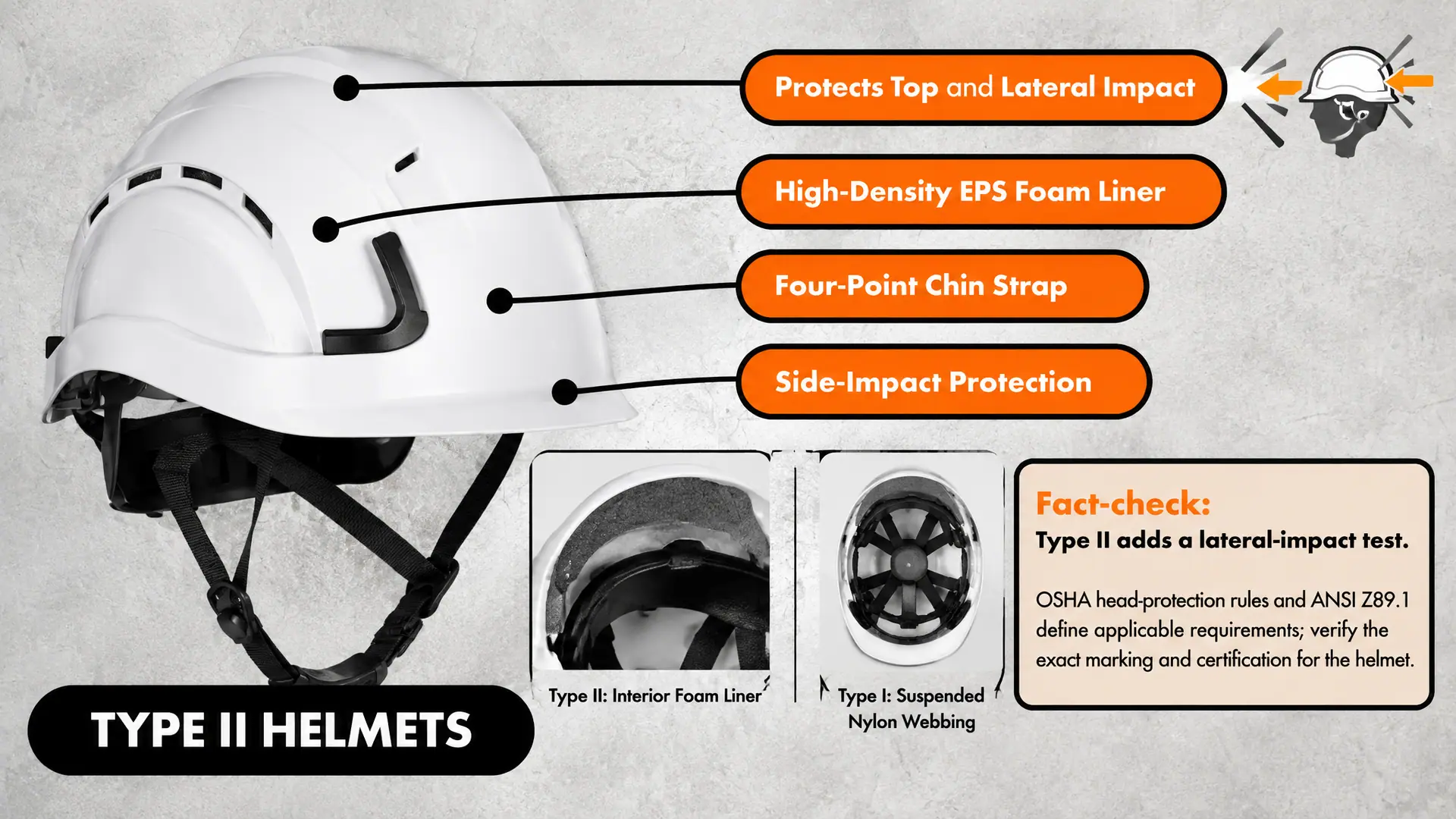
A Type II helmet is a hard hat rated for both top and lateral impact. Many buyers assume it just carries a different sticker. The structural difference is real: a traditional Type I hat hangs on suspended nylon webbing, while a Type II wraps the whole interior in high-density EPS foam.
That foam is what manages a lateral blow. Type II adds a side-impact test that a Type I shell never has to pass.
The liner deforms and spreads the energy across the shell instead of letting it concentrate at one point on the webbing, and posture matters too — peer-reviewed testing measured hard hat performance with the head flexed forward.
OSHA’s head protection rule is what makes that type distinction enforceable on a site.
Type II also brings a four-point chin strap, and retention is the failure mode buyers underestimate. Read the ANSI Z89.1 requirements with that in mind: a hard hat that comes off on the way up a ladder protects nobody, which is why the crew setting matters as much as the shell rating.
Procurement teams face serious tradeoffs. These modern helmets cost more than legacy versions, and they trap heat. The thick foam blocks internal airflow, and crews complain about the heavier feel during summer shifts.
🛡️ Our Verdict: Buy Type II safety helmets for work at height and confined spaces. Stick to legacy Type I hard hats for flat-ground labor in extreme heat where lateral impacts remain impossible.
3. Class E, Class G, and Class C Safety Helmet Types for Electrical Exposure
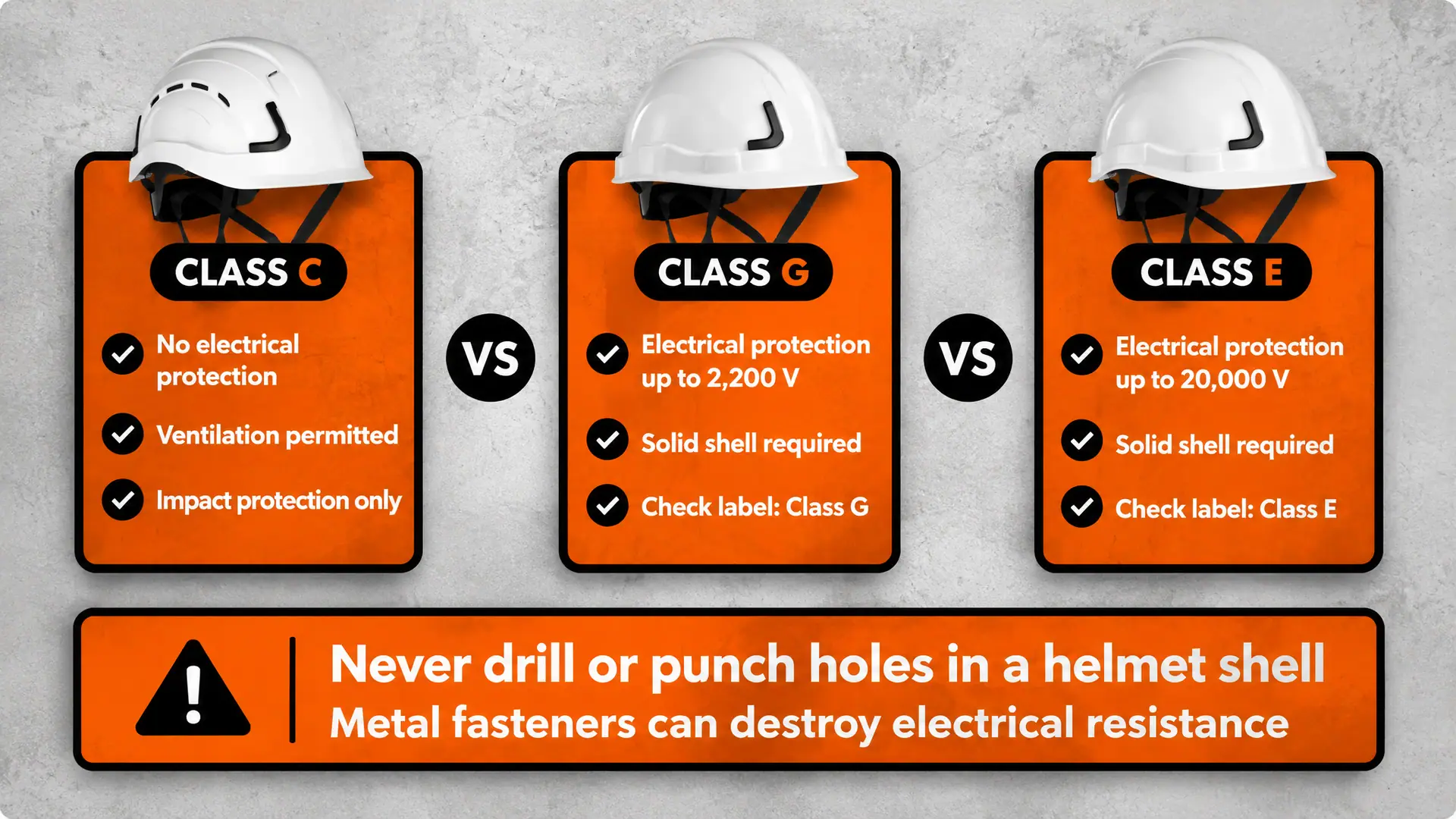
A helmet’s class is the electrical rating that travels alongside its type — the letter that decides whether vents are even permissible on that shell.
We often see a fatal compliance mistake: clients choose a helmet type for impact, then buy a vented version to keep crews cool. Where high voltage is present, a vent is a hole straight through that insulation.
Helmet type handles impact geometry; helmet class dictates electrical resistance, and you have to pair the two correctly. Class E withstands 20,000 V, Class G 2,200 V, and Class C none.
The most common field modification we see is ventilation: workers drilling or punching holes in a shell to make summer shifts bearable. That single change takes a compliant Class E shell out of its rating entirely. It is the fastest way to turn a certified helmet into an uncertified one.
Follow this procurement checklist:
- Check Labels: According to OSHA’s protective equipment standards, the interior label must explicitly state Class E or Class G.
- Ban Vents: Solid shells block electrical arcs. Vents invite them.
- Restrict Accessories: Metal fasteners immediately destroy electrical resistance.
🛡️ Our Verdict: The class rating is only as good as the shell’s continuity. Class E and Class G both depend on an unbroken insulating shell, and vents, drilled holes, or metal fasteners are what take a helmet out of either category. Do not trade a rating for airflow.
4. Full-Brim vs Cap-Style Safety Helmet Types for Weather and Clearance
When comparing safety helmet types, brim shape often gets mistaken for a safety certification. A full-brim helmet carries a 360-degree rim; a cap-style helmet carries a front brim only. Neither shape changes the certification.
Brim style dictates field performance, not impact resistance, and it layers on top of the ANSI Z89.1 compliance rating.
Shell shape changes daily operations more than buyers expect. A full brim blocks harsh UV glare and keeps rain off the neck, but that extra plastic limits upward visibility.
The cap style wins on clearance. Cap shells do not snag in tight ductwork or confined spaces, and they let welders attach face shields cleanly. A full-brim model pushes face shields too far from the eyes, which throws off the entire center of gravity.
🛡️ Our Verdict: Send full-brim helmets outside. Utilities, road and infrastructure crews, and outdoor contractors need continuous sun and rain defense. Keep cap-style helmets indoors. Plant workers, fabricators, and tight-clearance crews require the compact mobility a short brim provides.
5. High-Visibility Safety Helmet Types for Traffic, Rail, and Low-Light Sites
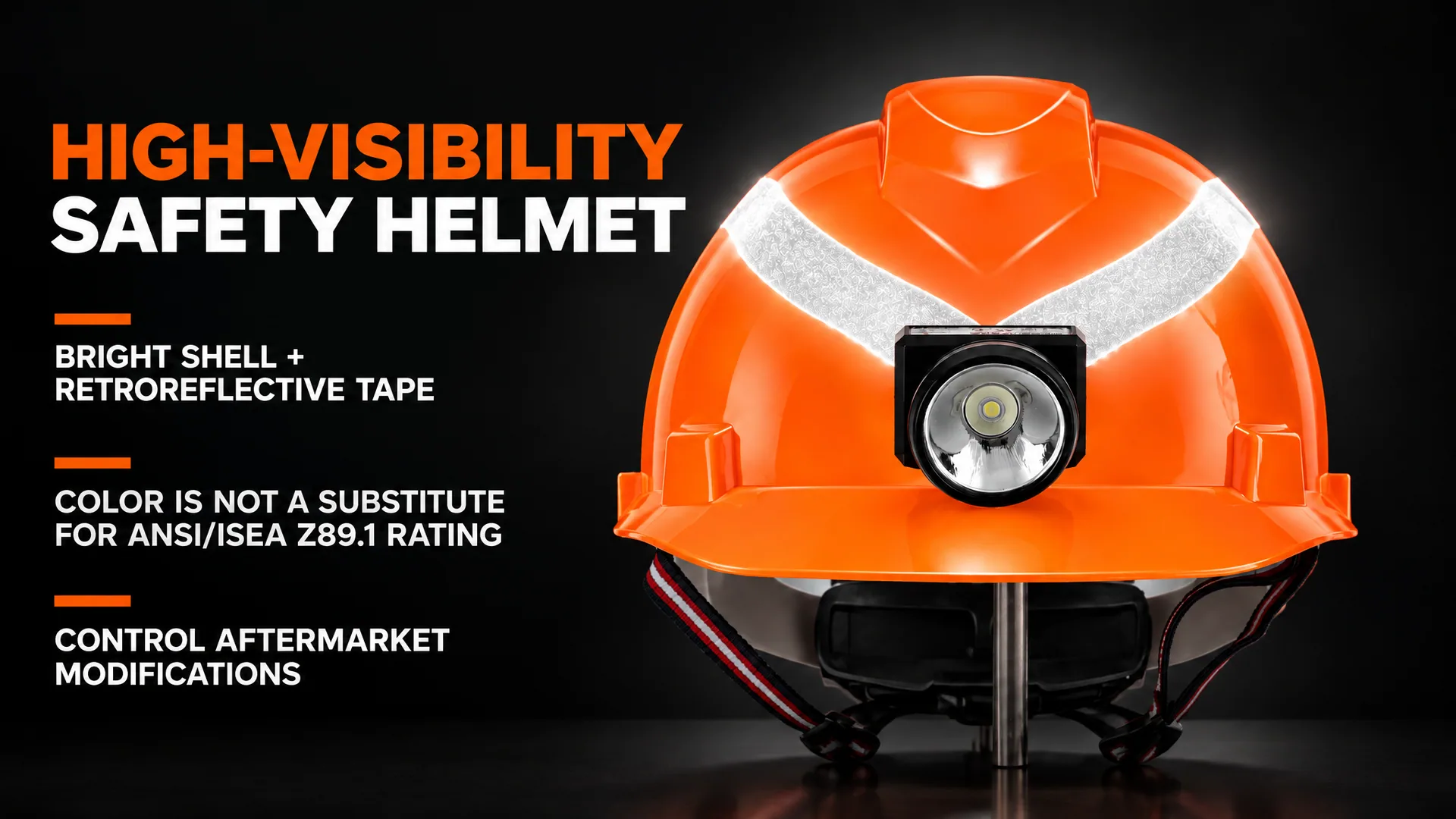
A high-visibility safety helmet is a fluorescent shell with factory-applied retroreflective tape, specified for traffic, rail, and utility work.
Color gets filed under branding more often than under safety, and that mistake endangers crews on low-light sites, where the shell is often the first thing a machine operator sees — the same color-coding logic that governs vest visibility.
True visibility requires bright shell colors combined with reflective treatments, and those hi-vis material standards are a separate regime from head protection.
Still, a neon shell must always carry the correct ANSI/ISEA Z89.1 impact and electrical classification underneath that visibility treatment. Color is never a substitute for the rating.
Standardize visibility rules across the fleet — helmets, safety vests, and outerwear — to avoid confusion. We typically mandate neon lime for rail crews and high-visibility orange for traffic spotters.
Aftermarket modifications need strict control. Off-the-shelf reflective stickers are the usual offender: solvent-based adhesives degrade polycarbonate and strip its UV stability.
Unauthorized decals also hide micro-cracks from the visual safety inspection that should catch them. Factory placement should still leave clear space for mounted headlamps and face shields, whatever tape you buy.
🛡️ Our Verdict: Treat high-visibility as a strict compliance metric. Ban all aftermarket stickers. We require factory-applied, 360-degree reflective tape for night crews to preserve shell integrity and ensure rapid visual identification.
6. Specialized Safety Helmet Types with Integrated PPE
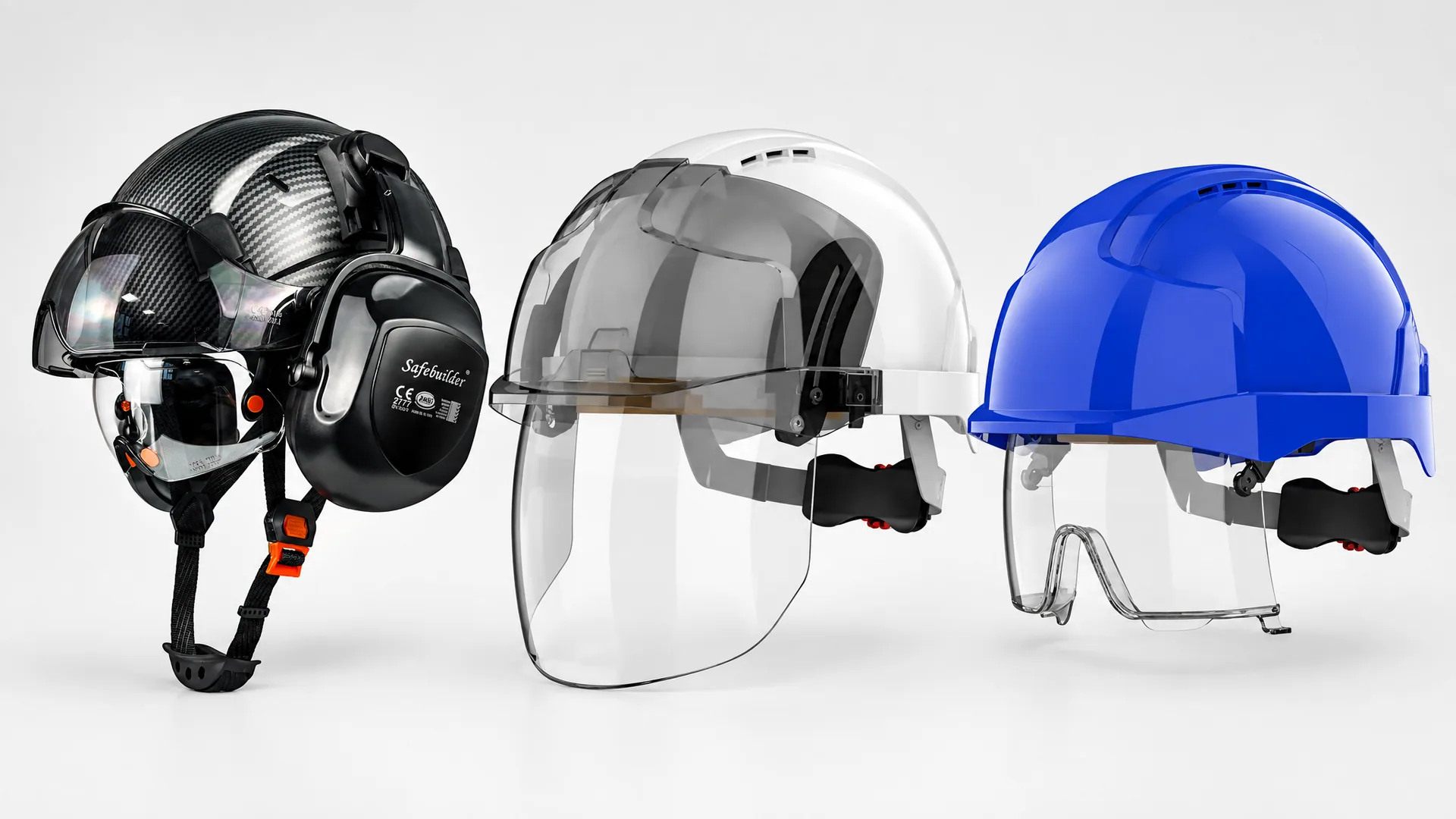
Advanced sites blend industrial and climbing risks, and heavy-industry safety programs demand specific safety helmet types meeting both EN 397 and EN 12492 — normally supplied with the visor, ear protection, or chin strap as one tested unit.
The base shell usually gets purchased first, with accessories added later. This creates a dangerous trap.
Adding forestry chainsaw systems or face shields changes the balance entirely. Ear-muff mounts and visor brackets add weight forward of the crown, and the heavier the accessory, the further the center of gravity shifts.
The predictable result is that the crew removes the attachment instead of fighting it — a bracket that catches on scaffolding is what settles the argument.
Those attachments also void the original certification scope. HSE’s construction PPE guidance is explicit that modifying headwear alters its impact protection.
A bolted-on visor bracket changes where the load lands, and the shell underneath it was never tested with that load present. Stop building DIY protective gear.
🧠 Author’s Take: Before approving a multi-PPE rollout, demand combined testing data from the manufacturer. Source factory-integrated systems where the shell, visor, and ear protection carry one unified safety certification.
What Do the Markings Inside a Hard Hat Actually Mean?
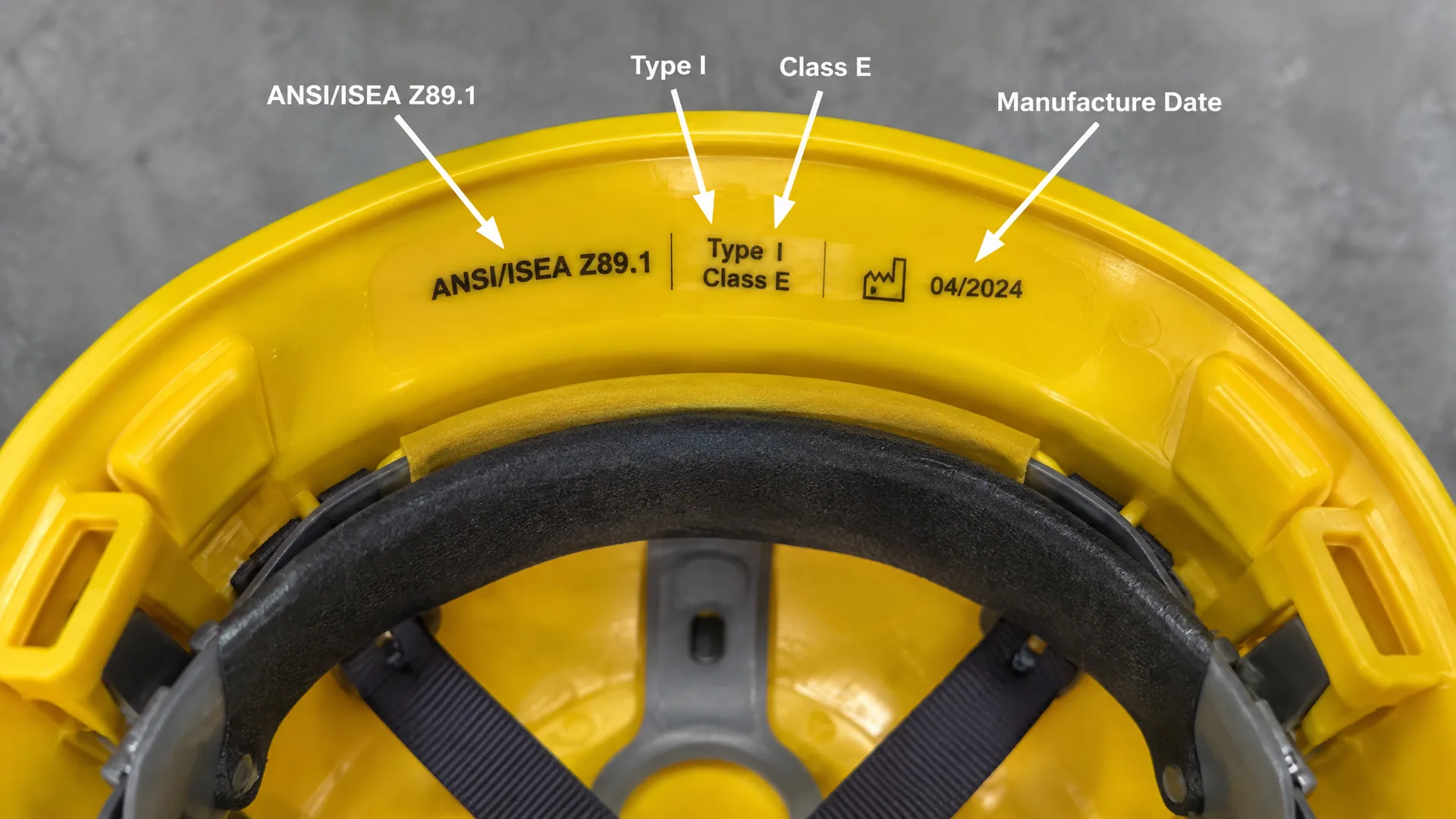
Every compliant shell carries a stamped or stickered line inside the brim, and most buyers read only the standard number. The rest of the string states which impacts and voltages that shell was tested against — ISEA’s head protection reference lists every permitted mark.
| Label marking | What a compliant shell shows | What it decides |
|---|---|---|
| Standard line | ANSI/ISEA Z89.1-2014 (R2019) | Which edition of the test the shell passed |
| Type | Type I or Type II | Whether lateral impact is covered at all |
| Class | Class E, G, or C | How much electrical contact the shell resists |
| Date of manufacture | Month and year | When the replacement clock starts |
Three things go wrong on real purchase orders. A missing class letter is not the same as Class C. An unmarked shell has no electrical rating at all, whereas a Class C shell is explicitly certified as offering none.
The marking is also frequently just a sticker, and stickers are what get painted over, peeled, or lost on the first hot shift — a shell whose marking is gone fails third-party inspection later, whatever the spec sheet said.
And the date matters as much as the ratings, because the 5-year service life most manufacturers specify counts off the manufacturing month, not the issue date.
Nor is the label the same everywhere. EN-marked shells carry no Type I or Type II at all. European industrial helmets are certified to EN 397, and any extra protection shows up as optional suffix codes.
Those codes are 440 V AC for electrical insulation, LD for lateral deformation, MM for molten metal splash, and −20 °C or −30 °C for very low temperature. A shell stamped EN 397 with no suffixes is a crown-protection helmet, full stop.
How to Choose Safety Helmet Types for Your Team?
https://www.youtube.com/watch?v=8NEMsn1WD9w&pp=ygUhaG93IHRvIGNob29zZSBiZXN0IHNhZmV0eSBoZWxtZXQg
Three checks separate a compliant fleet from one that fails its first audit.
Step 1: Audit the Shell Material and Liner
Do not trust spec sheets alone — ask what the shell is made of. High-density polyethylene (HDPE) is the cheaper option and it gets brittle in cold weather. Acrylonitrile butadiene styrene (ABS) holds up in freezing conditions and costs more.
That single material choice decides whether a shell belongs on a winter site at all. Pick the shell material and the liner for the climate your crew actually works in.
Step 2: Use the Hazard Selection Matrix
Map the site hazards strictly before buying. Run each hazard through the five rules below, and where two rules overlap, apply the stricter one:
- Electrical Work: Choose Class E, Type II, non-vented. Nearly all electrical work happens at height, so Type I is not enough. Replace the shell immediately after any arc exposure.
- Work at Height: Choose Type II with a chin strap. Pick Class E if there is any electrical exposure along the route, and Class C only where there is none. Inspect the retention system daily.
- Heavy Machine Traffic: Choose a high-visibility, full-brim helmet. Add retroreflective tape that meets the specification in the MUTCD, the manual that governs US work-zone visibility.
- Heavy Weather Exposure: Choose Class G, Type I, non-vented full-brim helmets, and pull the replacement date in if the shells live outdoors.
- Integrated PPE Needs: Choose a factory-kitted Type II system. Never drill holes to mount aftermarket face shields. This voids the certification.
Step 3: Run a Field Reality Check
What the ANSI Z89.1 standard cannot cover is storage. It tests a new shell; it says nothing about what six months in a hot warehouse or a humid container does to the polymer first.
Verify supplier certificates against the laboratory that issued them, and keep the result inside your safety uniform compliance record. For help configuring a fleet safely, talk to our team.
Frequently Asked Questions About Safety Helmet Types
1. What is the exact difference between Type I and Type II safety helmets?
Type I helmets only block top impacts. Type II helmets block top and side impacts. The difference is structural, not cosmetic: a Type I shell carries suspension webbing, while a Type II adds a high-density EPS foam liner that deforms and spreads a lateral blow across the shell.
Type II models also come with chin straps for secure retention. They cost more and trap heat. Buy Type II whenever workers face swinging debris, fall risks on ladders, or lateral contact — not as a default upgrade for every crew.
2. Can we put custom stickers or paint on our safety helmets?
No. Ban all aftermarket paint and unauthorized stickers. Solvents in off-the-shelf adhesives attack the polycarbonate, and a decal laid over a crack hides exactly what an inspection is looking for.
If you need company logos, order factory-printed shells instead of DIY decals. Before accepting any shipment, confirm the ANSI Z89.1 marking is still clearly visible inside the brim.
3. Are vented hard hats safe for electrical work?
Never. Vents give electricity a direct path to the skull, and Class E and Class G both depend on the shell acting as a continuous insulating barrier. This is why almost every vented shell on the market is Class C.
If your team works near power lines, issue solid, non-vented helmets and check the class letter on the label rather than assuming last year’s model still qualifies.
4. How long do safety helmets last in storage before expiring?
Most manufacturers specify a 5-year service life from the manufacturing date, and that is the number to write into a policy. Extreme heat, UV, and chemical exposure shorten it, so outdoor fleets should bring the date forward rather than wait for a shell to fail.
Ask the manufacturer for its own published replacement guidance and follow that over any generic figure. Finally, formalize a written policy that has workers check their suspension webbing before every use.
What this guide is based on: Factory-side procurement and production experience, plus the published ANSI/ISEA Z89.1, OSHA, HSE, and ISEA material cited above. It is not a laboratory test report, and no helmet brand paid for placement.

Leave a Comment
Your email address will not be published. Required fields are marked *