Table of Contents
The short answer EN ISO 20471 sets the class from fluorescent and retroreflective area, measured on the smallest size in the range. Material approval decides it, not final inspection.
2,000 hi-vis jackets land looking bright. Six weeks later one comes back: the reflective tape cracked after ten industrial washes, and the smallest size in your run fails the fluorescent background area.
It is not an outlier. EN ISO 20471 compliance problems rarely start at final certification — they start with fabric and tape selection. In my years managing incoming material QC at LantaoWork, the same failures repeat across dozens of factories.
This buyer-focused guide covers hi-vis workwear materials EN ISO 20471 — what a verifier should measure, and the shortcuts that create compliance risk.
Methodology: LantaoWork has been a cut-and-sew workwear manufacturer since 2015 — ISO 9001:2015 certified, running 12 production lines across 10,000+ SQM at 50,000+ units per month.
Everything below comes from LantaoWork’s own incoming-material QC log: the SOP in use, a 12-month wash-retention record, and the technician who signs it off.
What is EN ISO 20471?
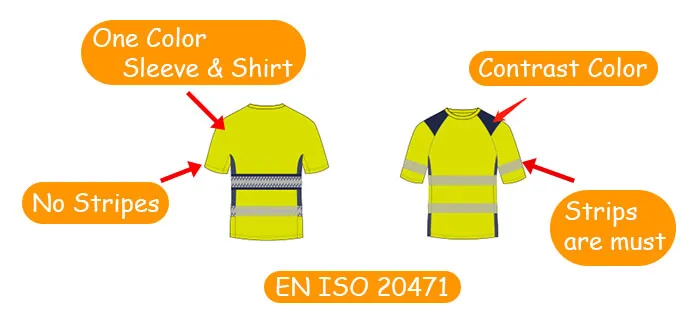
EN ISO 20471 — current version EN ISO 20471:2013+A1:2016 — is the European standard for high-visibility clothing. I treat it as a system standard, not a color spec.
It sets minimum visible area, reflectivity, coverage, and wash durability for EU/EEA/UK programs. It is not interchangeable with US ANSI/ISEA 107. The class areas match, but test geometry and the Type system differ.
Three material systems matter:
- Fluorescent background material: bright yellow or orange fabric that boosts daytime visibility. It converts absorbed light into longer-wavelength visible light.
- Retroreflective material: silver tape that bounces light back to its source at night. It uses glass beads or microprisms.
- Combined-performance material: one material meeting both fluorescent and retroreflective requirements. It often appears on sleeves or trouser legs.
EN ISO 20471 vs ANSI/ISEA 107
The two standards look interchangeable on paper because their minimum areas match. They are not — retroreflective material is graded using different measurement geometry, so the same tape can pass one and fail the other.
| Requirement | EN ISO 20471 (EU/EEA/UK) | ANSI/ISEA 107-2020 (US) |
|---|---|---|
| Governing document | EN ISO 20471:2013+A1:2016 | ANSI/ISEA 107-2020 |
| Class system | Class 1, 2, 3 | Type O / R / P, each in Class 1, 2, 3 |
| Fluorescent background material, Class 1 | 0.14 m² | 217 in² |
| Fluorescent background material, Class 2 | 0.50 m² | 775 in² |
| Fluorescent background material, Class 3 | 0.80 m² | 1,240 in² |
| Retroreflective material, Class 1 | 0.10 m² | 155 in² |
| Retroreflective material, Class 2 | 0.13 m² | 201 in² |
| Retroreflective material, Class 3 | 0.20 m² | 310 in² |
| Smallest-size rule | Every size in the certified range must meet the area — no small-size exemption (EN 471 exempted the smallest size; EN ISO 20471 does not) | The smallest size may drop to 540 in² background (Type R Class 2) or 1,000 in² (Type R Class 3); larger sizes revert to full thresholds |
| Approved fluorescent colors | fluorescent yellow, fluorescent orange-red, fluorescent red | fluorescent yellow-green, fluorescent orange-red, fluorescent red |
| Top-class garment rule | Class 3 needs sleeves and/or full-length trouser legs; a two-piece set qualifies only when certified as a set | Same construction rule for Type R and Type P Class 3 |
| Retroreflective test geometry | Set by EN ISO 20471 | Set by ANSI/ISEA 107 — different angles, so headline R′ values are not comparable |
| Certification route | EU type-examination by a notified body under Regulation (EU) 2016/425; CE mark | Voluntary consensus standard — the manufacturer self-declares |
| Reports transferable between markets? | No | No |
The ANSI Class 3 area above is the Type R figure. A Type P Class 3 public-safety garment uses a lower background minimum — 775 in² — with the same 310 in² retroreflective minimum.
The final class is set by whichever area falls short. A garment with Class 3 background but Class 2 retroreflective area is Class 2.
Class 3 high visibility garment requirements go beyond area: torso coverage plus sleeves and/or full-length trouser legs with reflective bands.
A vest alone cannot be Class 3, and a two-piece set qualifies only when certified together — so the certificate has to name the exact garment or set being bought.
Buyers should monitor two lab metrics: luminance factor (brightness) and chromaticity coordinates — the exact color box on the CIE diagram. Fluorescent fabric that drifts outside that box fails, even when it looks bright on the roll.
Under the EU’s PPE Regulation (EU) 2016/425, hi-vis garments are PPE Category II, so the CE mark rests on an EU type-examination carried out by a notified body.
https://www.youtube.com/watch?v=tKCFFMVYlBs
💡 Key Insight: Class is a system result. Area, reflectivity, and design are verified together, and one component that washes out drops the whole garment’s class rating.
What the Care Label Has to Carry
Auditors read the label before they touch the fabric. An EN ISO 20471 garment has to be marked with the standard number, the class, the pictogram, and care and content labeling — including the maximum number of wash cycles it is certified for.
That cycle count is the number that gets tested. A label claiming 50 cycles needs a test report that says 50. A label that claims more cycles than its test report supports is the fastest way to fail an audit, and that mismatch is the one to check first.
How to Verify Hi-Vis Raw Materials Before You Cut?
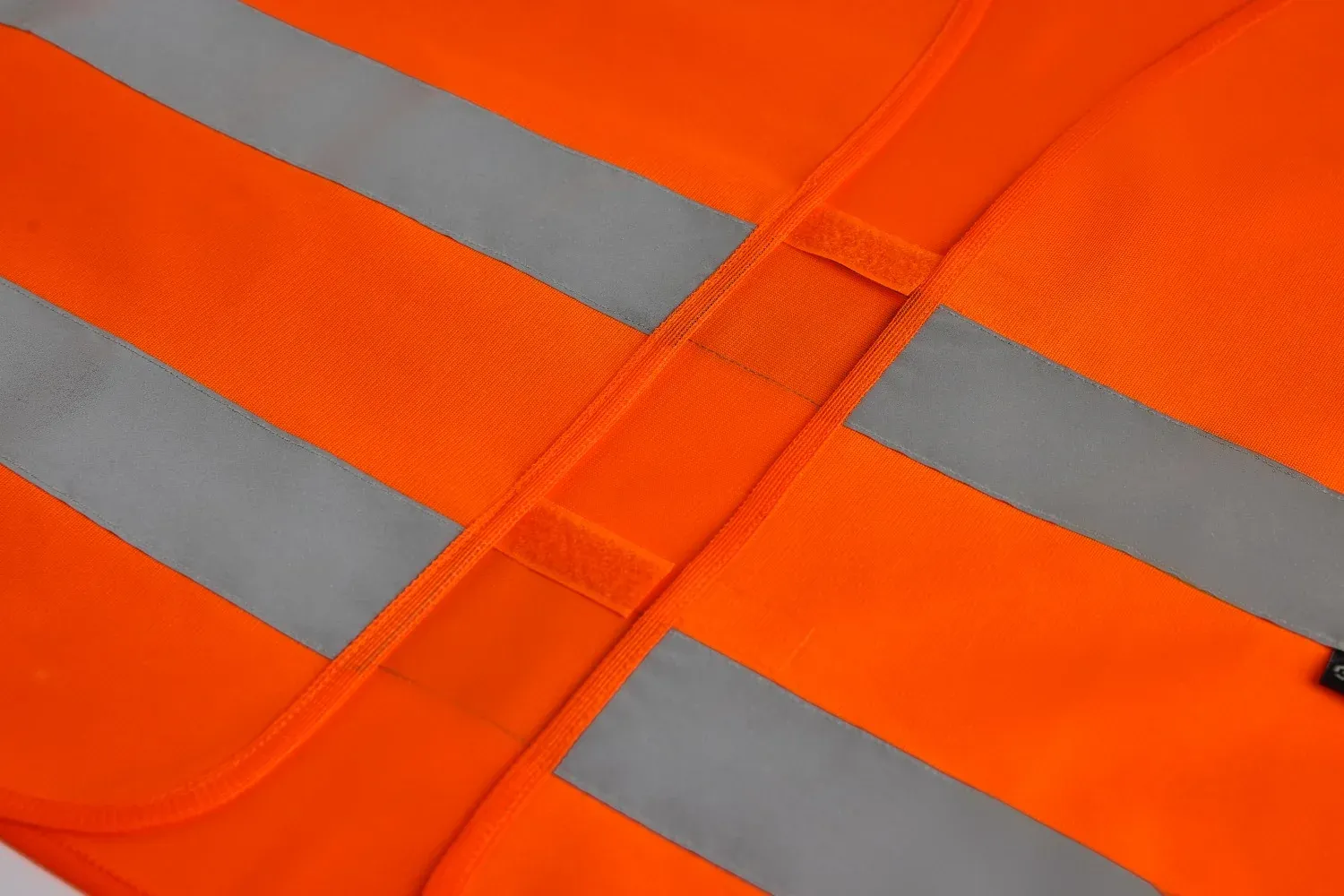
We do not rely on supplier certificates. I open cartons, cut cross-roll samples, and run the wash drum. This is the incoming QC workflow, in the order it runs.
Step 1: Quarantine and Document Intake
We hold every fluorescent roll and tape carton in locked QC. PO, lot numbers, supplier reports, care claims, and destination market all get matched. EU/UK-only programs reject ANSI test data.
Step 2: Build a Cross-Roll Sampling Plan
I pull cuttings from start, middle, and end of each roll, plus two tape cartons per lot. Edge-only samples hide inconsistency. Dye application and reflective bead density vary across the width.
Step 3: Verify Fluorescent Background Material
A spectrophotometer reads chromaticity coordinates and luminance factor. Chromaticity is the exact color box. Luminance factor is brightness under the required light source.
Fluorescent background fabric colorfastness is not a single snapshot: the sample must stay inside tolerance after light, sweat, and wash.
Step 4: Review Colorfastness and Durability Reports
Ask the supplier for light (ISO 105-B02), wash (ISO 105-C06), and perspiration (ISO 105-E04) reports, plus rubbing and dimensional stability. A fabric can pass day one and drift after UV, sweat, or 20 washes — which is why the tests get repeated.
Step 5: Check Incoming Retroreflective Tape
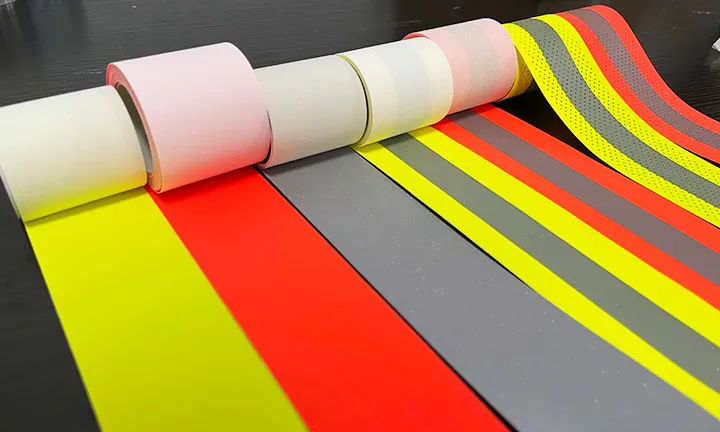
I measure tape width against the approved technical file. I confirm whether the tape is separate-performance or combined-performance.
Retroreflective tape minimums are not a single number. The headline R′ value in EN ISO 20471 material reports depends on exact geometry. I also audit orientation-sensitive tape.
Step 6: Audit the Tape Attachment Method
Sewn tape risk is seam penetration and thread tension. Heat-transfer or segmented tape risk is bubbled adhesive, edge lift, and inconsistent activation. Bond temperature, pressure, and curing time all get checked on the first run.
Step 7: Validate Wash Durability Against the Claim
Domestic and industrial laundry differ. Testing hi-vis washing cycles under ISO 6330 uses milder domestic action; ISO 15797 simulates harsher industrial rental laundering.
If the garment claims 50 washes, you need materials that survive that claim. Always ask which protocol was used, and demand ISO 15797 for any rental program.
Step 8: Simulate Visible Area Before Cutting Bulk
Material approval alone is not enough. I lay the smallest pattern and calculate visible fluorescent area and reflective band layout.
If the area drops below the class threshold, the design fails, even with compliant fabric. These checks add lead time, so they belong in the production schedule before the bulk cut is booked.
12-Month Anonymized Durability Data
The log below covers twelve months of pass/fail results at 50 cycles under ISO 15797 (industrial) and ISO 6330 (domestic), and records retention rather than absolute compliance. Customer names are removed; the failure pattern is consistent.
| Blend | Initial colorfastness | Post-wash colorfastness | R′ retention at 50 cycles | 50-cycle result | Common failure mode |
|---|---|---|---|---|---|
| 100% polyester knit | Pass | Pass | 96% | Pass | Minor tape edge lift at seams |
| 80/20 poly-cotton twill | Pass | Pass (domestic) | 97% | Pass | Slight dye shift after 50 domestic washes |
| 65/35 poly-cotton twill | Pass | Borderline (industrial) | 69% | Fail in industrial | Dye bleed and tape adhesion loss |
| PU-coated outer shell | Pass | Pass | 96% | Pass | Delamination risk with heat-transfer tape |
Certified reflectivity is a lab figure that depends on measurement geometry. EN ISO 20471 sets its headline minimum at 330 cd/(lx·m²), read at 12° observation and 5° entrance angle.
That number only comes off an accredited test report, never off a comparative wash trial.
Procurement lesson: some blends pass domestic but fail industrial. We never accept domestic reports for a rental uniform program.
The Commercial Case: Why Strict Verification Protects Margins?
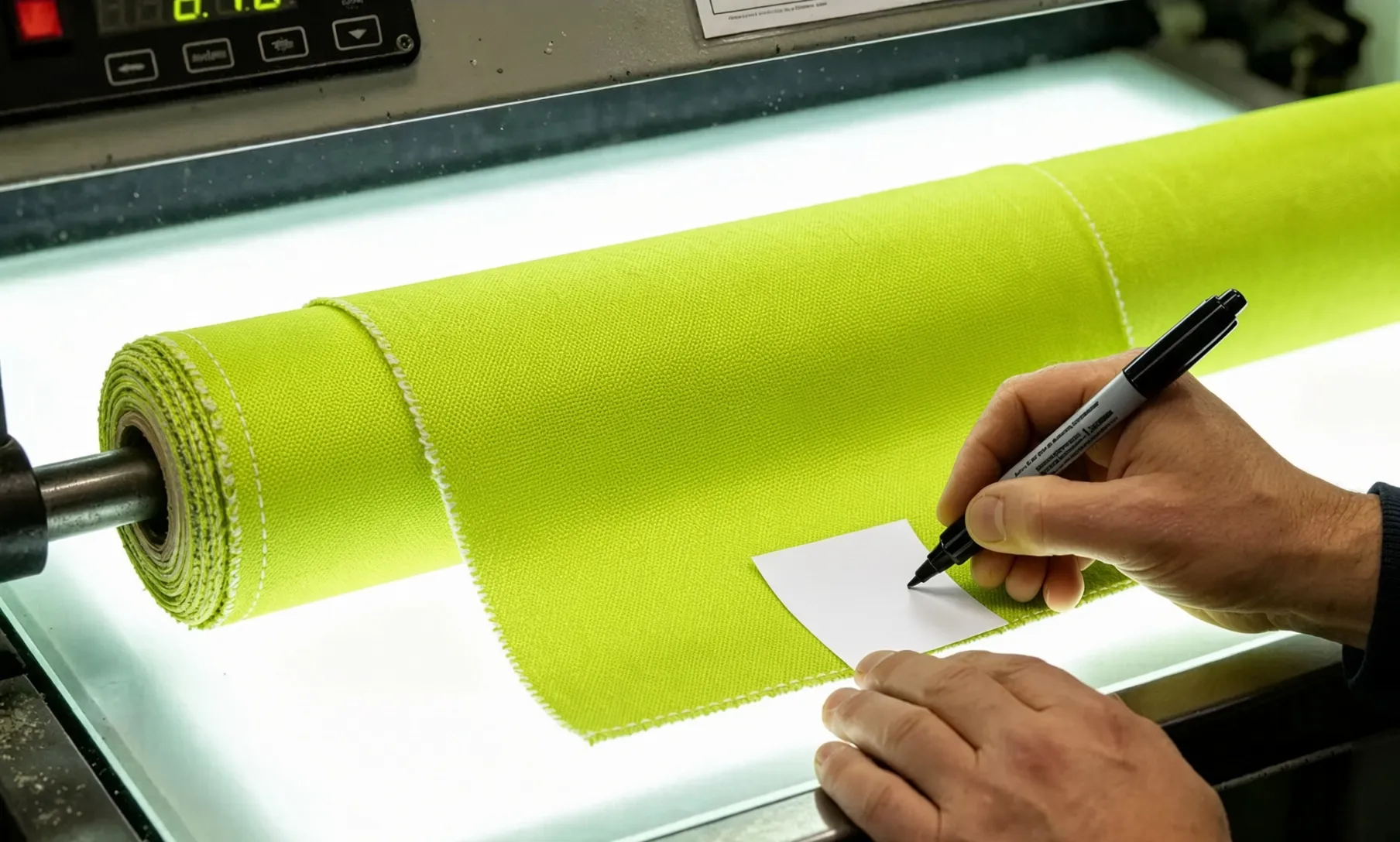
In our own production cost reviews, catching a defect at roll stage has cost roughly 80% less than catching it after garment production — by then the fabric is cut, the labor is spent, and the finished-goods test units are built.
Early verification protects margins, not just compliance.
Lower Retest and Rework Risk
In our recorded data, that 65/35 dye bleed surfaced at roll stage, before thousands of units of dead inventory were cut. Caught after production, the same defect sits in unsellable stock.
Defend Tender Claims with Evidence
A report from a SATRA-accredited laboratory — or any lab accredited to ISO/IEC 17025 — carries more weight than a supplier letter when a client challenges a wash-life claim. A clear audit trail makes tender defense faster.
Compare Suppliers Accurately
Two identical prices are not equal. Test geometry changes the R′ number, so ask for the R′ figure from the test protocol, not just the certificate.
The bulk wholesale workwear pricing guide shows verification costs running far below rework costs, and full test geometry belongs in that comparison.
Stabilize Private-Label Programs

Distributors selling to utilities, construction, rail, or security clients need repeatability.
Fabric and tape specs get locked at pre-production for private-label programs, our repeat-order audit showed color drift below tolerance, and programs stay stable across security uniform programs.
Plan Dual Markets Smarter
Selling into both the EU and the US means carrying two approval paths, two label sets, and two test reports from the first quote — US roadway work layers MUTCD worker-apparel rules on top of ANSI/ISEA 107.
Deciding that early removes the temptation to assume one certificate covers both.
📈 ROI Check: Track claims, returns, and relabeling costs per lot. The cheapest tape often becomes the most expensive after claims.
Request a materials review before bulk approval.
Challenges & Limitations: Where Hi-Vis Sourcing Goes Wrong?
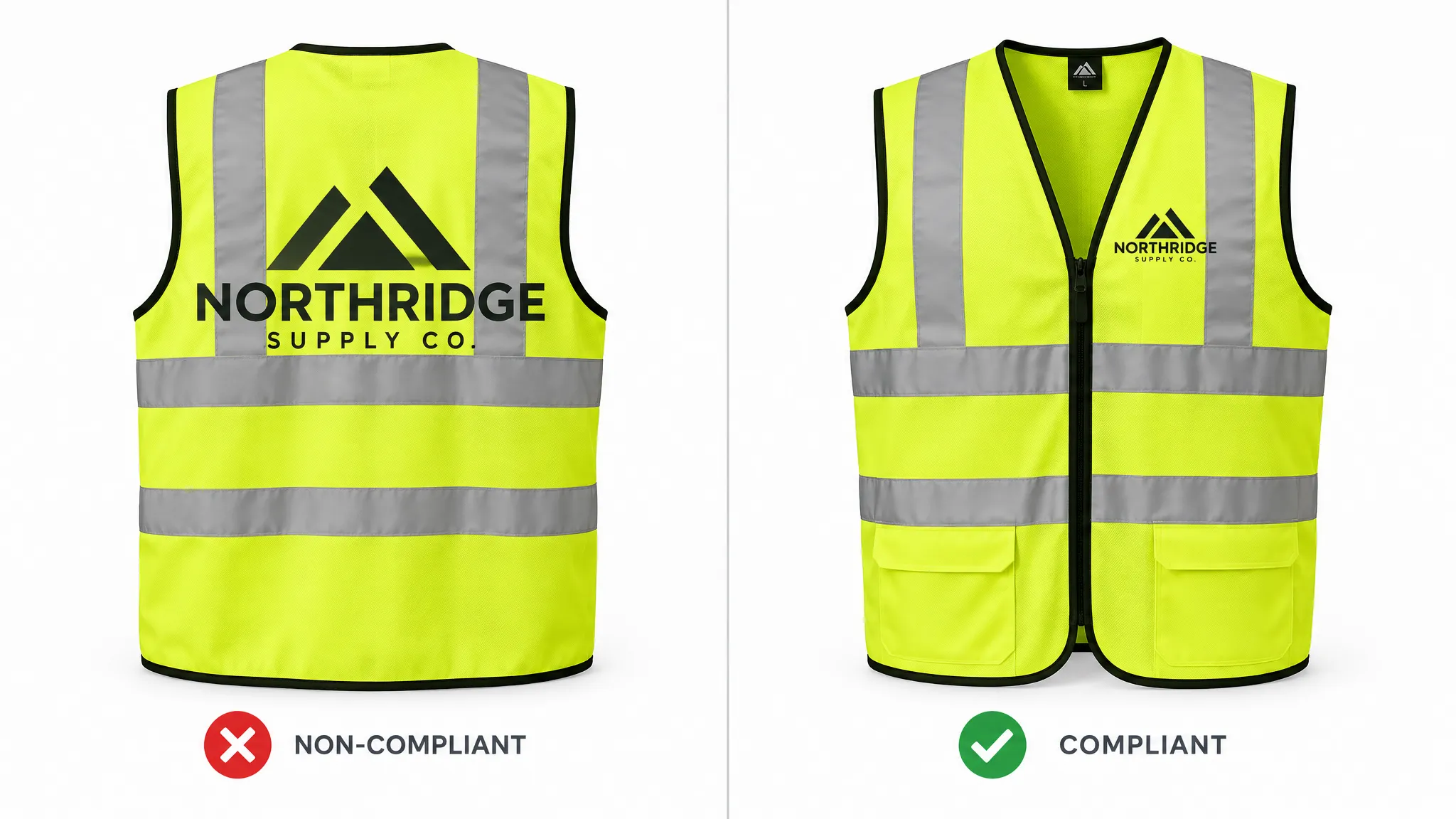
These failures showed up in pattern reviews, wash trials, and incoming QC.
Smallest-Size Compliance Trap
A size L can pass Class 3. XS often fails once visible area is measured. In one order, L and 5XL passed. The added XS dropped below 0.80 m². The Lead Technician found the lower back seam ate fluorescent area.
Measure the smallest size before approval. A size L report does not certify XS.
Branding and Logo-Area Loss
A 20cm heat-seal logo on a Class 2 vest covered required tape. The garment dropped to Class 1. The fix was moving branding to the chest. Ask: does the logo reduce visible material?
Tape Sourcing Volatility
Factories may substitute visually similar uncertified tape. Last quarter a switch surfaced after the tape failed post-wash R′. Lock the approved supplier on the PO and inspection sheet.
Comfort vs. Compliance Tension
PU coatings reduce breathability. Workers unzip or roll sleeves, exposing non-fluorescent linings. A compliant garment worn incorrectly loses its class rating. Balance weather resistance, style, and breathability.
Pre-PO Buyer Checklist
- Smallest size area measured?
- Branding subtracts compliant area?
- Wash claim tied to actual laundry method?
- Reflective report matches correct geometry?
- Approved tape supplier locked on PO?
Packaging obligations under EU PPWR and the MOQ floor both get locked at the same spec-freeze stage as the fabric and tape approvals.
Frequently Asked Questions About EN ISO 20471
Our Lead Technician inspects pre-production materials every day. These are the six shortcuts flagged most often.
1. Which reflective-tape shortcut do factories use most often?
“They swap approved tape for visually similar lower-grade tape. It reflects less after five washes. Check the coefficient, not the color.”
2. How do you spot a tape substitution before sewing starts?
“I measure roll width and inspect glass-bead density under a loupe. Then I wash a swatch. If post-wash R′ falls below the EN ISO 20471 minimum, the lot is dead.”
3. What wash-cycle claim makes you suspicious?
“A factory claiming 50 washes but showing only a rapid 10-cycle domestic test. Dye and adhesive degrade gradually. I require the full 50-cycle report.”
4. Which material type fails most after 50 washes?
“65/35 poly-cotton twill. The cotton degrades in industrial laundry, and the tape lifts at the seams. It passes domestic but fails rental programs.”
5. What is the most common mistake buyers make comparing EN ISO 20471 and ANSI programs?
“They assume one tape works for both. ANSI/ISEA 107 uses different test geometry and minimum R′ values. EU-approved tape may fail US photometric tests.”
6. When does a fabric pass lab color checks but still cause field complaints?
“When the buyer orders Class 2 in small sizes without checking visible area. The fabric passes, but the garment area fails. Simulate the smallest pattern before cutting.”
Final Take: Verify Before the First Cut
We have reviewed thousands of rolls and caught too many near-miss substitutions. The evidence is clear: EN ISO 20471 passes or fails at material approval, not at final inspection. That is why the pre-PO checklist above matters more than the certificate does.
Internal cost reviews put early roll-stage rejects at roughly 80% less than post-production failures. If you are buying for rental, construction, rail, or security programs, this sequence prevents dead inventory and audit collapse.
Ready to lock your hi-vis specs before sampling? Contact LantaoWork for a pre-production material review or read the guide on choosing a custom workwear manufacturer.
Disclosure: We are a cut-and-sew manufacturer, not a tape or fabric supplier. Our own production-floor QC practice, disclosed rather than disguised. Verify your program before the cut; do not explain it after a failed audit.

Leave a Comment
Your email address will not be published. Required fields are marked *