Table of Contents
The real buying mistake in workwear certifications is not under-ordering garments. It is over-trusting labels that do not match the hazard, market, or factory scope.
A buyer receives a low-cost quote stamped “certified FR,” the paperwork looks solid, and the order ships. Then the audit fails: the test report covered fabric only, named no production site, and cited a standard edition that was replaced two years earlier.
The short answer Workwear certifications are four separate families, each proving a different claim. Check all four before you approve a PO:
- FR and heat/flame — NFPA 2112, ISO 11612
- High visibility — ANSI/ISEA 107, ISO 20471
- Chemical safety — OEKO-TEX STANDARD 100
- Proof of compliance — the documents that tie a certificate to your actual factory
Certifications are not paperwork extras. They are procurement controls, and they govern worker safety, audit exposure, claims risk, and whether a shipment clears acceptance at the dock.
OSHA’s PPE standard requires a written hazard assessment before the employer selects the equipment, not a supplier’s marketing claim, and no certificate in this guide replaces a site-specific risk assessment. EU market access adds a separate check under the EU PPE Regulation.
North American bid sheets still cite ANSI/ISEA 107-2020 while the 2026 edition is published, and the edition number defines the test method, the pass/fail threshold, and the label workers must wear. Treat every “ANSI 107” claim as edition-specific, or budget for re-bids. Version control is the cheapest error to fix and the most expensive to miss.
Methodology: This article works through the four certification families below, then the verification route for each. It draws on official standards scopes, buyer-side verification logic, and a QA workflow built on AQL 2.5/4.0 inspection records.
Workwear Certification Types: The 4 Families That Matter
Workwear certifications are not one universal badge. Buyers who ask for “the certification” as if one document covers everything end up with audit failures and rejected shipments.
Four evidence types get confused constantly: a product standard publishes the test method and the pass/fail threshold, a third-party certificate confirms an independent body verified a specific product against it, a laboratory report records raw data from one sample, and a declaration of conformity is the manufacturer’s own written statement. Only the certificate speaks to a specific garment, and none covers performance beyond its stated scope.
The construction workwear checklist maps hazards to specs, which matters most where a crew mixes exposure: FR and high-vis for construction, chemical screening for utilities, and documentation plus facility audits for a security program.
One hierarchy sits above all four. ISO 13688 covers the basics of protective clothing — ergonomics, innocuousness, marking, and manufacturer information — and is intended to be used alongside hazard-specific standards, not on its own. A supplier citing it as proof of FR performance has shown you a foundation, not a hazard shield.
💡 Key Insight: Treat a certificate logo as a specific claim, not a general safety badge.
FR and Heat/Flame Certification: NFPA 2112 vs ISO 11612
https://www.youtube.com/watch?v=1xPGFVEBHzk
NFPA 2112 is the North American standard for flame-resistant clothing that protects industrial personnel against short-duration thermal exposure from fire.
The 2023 edition tightened the certification chain: annual recertification of listed products, annual factory inspections by an ISO/IEC 17065 certification body, annual sampled product testing, and manikin testing at least every five years.
ISO 11612:2015 covers flexible protective clothing against heat and flame.
| Field | NFPA 2112 (North America) | ISO 11612 (Europe/International) |
|---|---|---|
| Hazard focus | Short-duration thermal exposure from fire | Heat and flame, including radiant, convective, contact, molten metal |
| Garment scope | Industrial FR clothing | Protective clothing from flexible materials |
| Common buyer use case | Oil and gas, chemical, electrical | Foundry, welding, industrial heat exposure |
| Labeling checkpoints | Certification mark, edition year, garment type | CE mark, performance code letters |
| Documents to retain | Certificate, annual recertification record, manikin test report | EU type-examination certificate, test report, Declaration of Conformity |
Either way, the certificate has to cover the exact garment style and fabric, not just the fabric supplier’s general capability.
Shell, liner, and closure choices change what has to be certified, and the FR coverall manufacturing page covers those combinations.
The EN/ISO 11612 code letters are A (limited flame spread), B (convective heat), C (radiant heat), D (molten aluminum), E (molten iron), and F (contact heat), each carrying a performance level such as A1 or A2.
Plants that combine FR with chemical or arc exposure need several letters on one garment, which the heavy-industry safety solution maps out. Match the letters to the hazard assessment, not to the price list.
The current text and edition history are on the NFPA 2112 standards page, and the test requirements sit on the ISO 11612 catalogue page.
The coverall safety standards breakdown sets out the garment-level requirements that sit alongside the fabric tests, line by line.
As of November 2026, the 2015 edition remains the published standard. The revision has reached final draft stage, so confirm the edition with your certification body before the PO.
High-Visibility Certification: ANSI/ISEA 107 vs ISO 20471
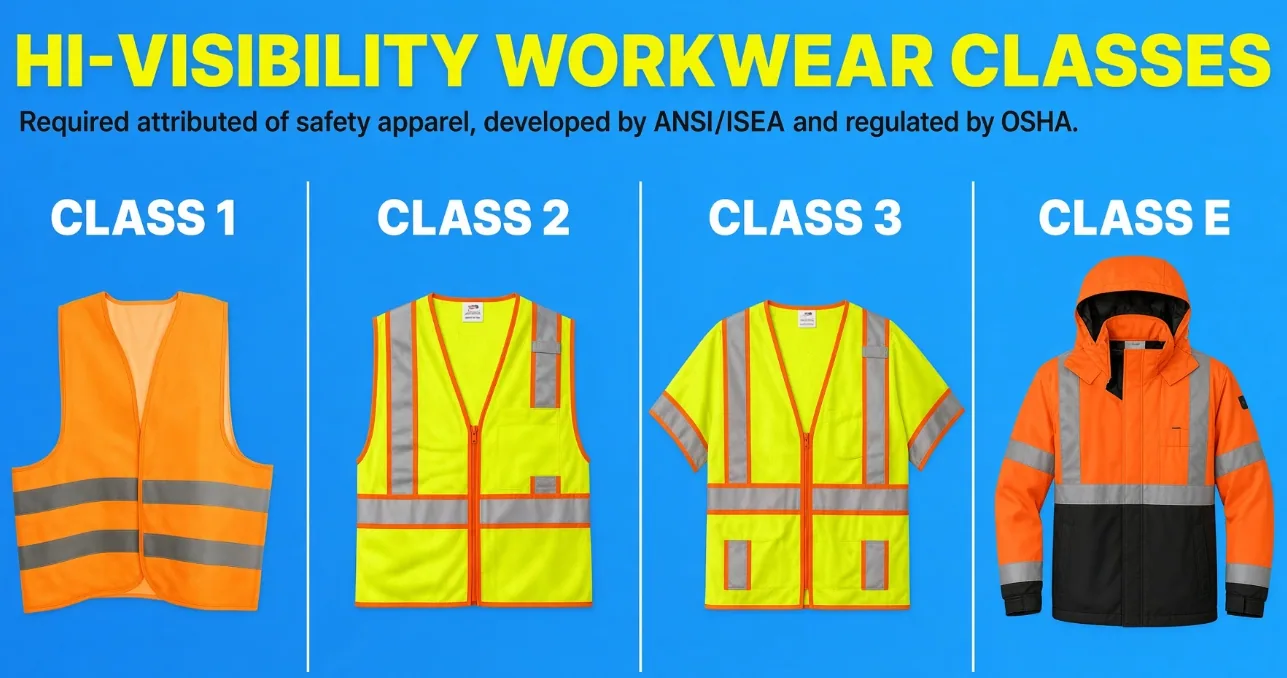
ANSI/ISEA 107 is the U.S. framework for high-visibility clothing in roadway, non-roadway, and public-safety environments, covering garment types, performance classes, design, marking, testing, and care.
The sixth edition, ANSI/ISEA 107-2026, was published on 26 October 2026, and two changes matter to buyers.
The reduced-background-material allowance that used to apply only to a manufacturer’s smallest size now extends through size Medium on Type R Performance Class 2 and Class 3 garments.
Test methods now reference current AATCC, ASTM, and ISO procedures, though the performance thresholds are largely unchanged.
Garment types, performance classes, and the three fluorescent background colors did not change, and labels to the 2020 or 2026 edition are expected to coexist during a transition period.
A 2020 label is therefore not automatically a rejection; a bid sheet that names one edition and a quote that names none is.
ISO 20471 focuses on conspicuity through color, retroreflection, and minimum material areas and placement, with three performance classes based on minimum visible material.
The two systems are not interchangeable: ANSI/ISEA 107 defines U.S. classes and types, while ISO 20471 defines international performance levels.
The full scope and design requirements sit in the standard itself, and ISEA’s 2026 publication announcement sets out what changed.
The ISO 20471 catalogue page covers the international counterpart.
Type, class, and end-use quick match
- Type O (off-road): warehouses, terminals, and plant yards. The area thresholds are lower than for roadway work — 217 in² background and 155 in² retroreflective on Class 1 — but retroreflective material is still required.
- Type R (roadway): workers exposed to traffic, with retroreflective material required.
- Type P (public safety): police, fire, and emergency responders.
- Class 2: moderate traffic or low speed.
- Class 3: high traffic, high speed, or a task that needs more visible material.
The hi-vis workwear materials guide shows which fabric and tape tests decide a class.
The vest-specific boundary between Class 2 and Class 3 is set in safety vest classes, where a two-piece set has to be certified as a set.
Beyond traffic, the neighbouring standards are EN ISO 11611 for welding, IEC 61482-2 or ASTM F1506 for arc, EN 343 for rain, EN 1149-5 for antistatic, and EN 13034 or EN ISO 13982 for chemical suits. None substitutes for another.
Construction and infrastructure programs combine hi-vis with FR and durable construction, which the construction solution maps hazard by hazard.
Chemical Safety: What OEKO-TEX STANDARD 100 Covers
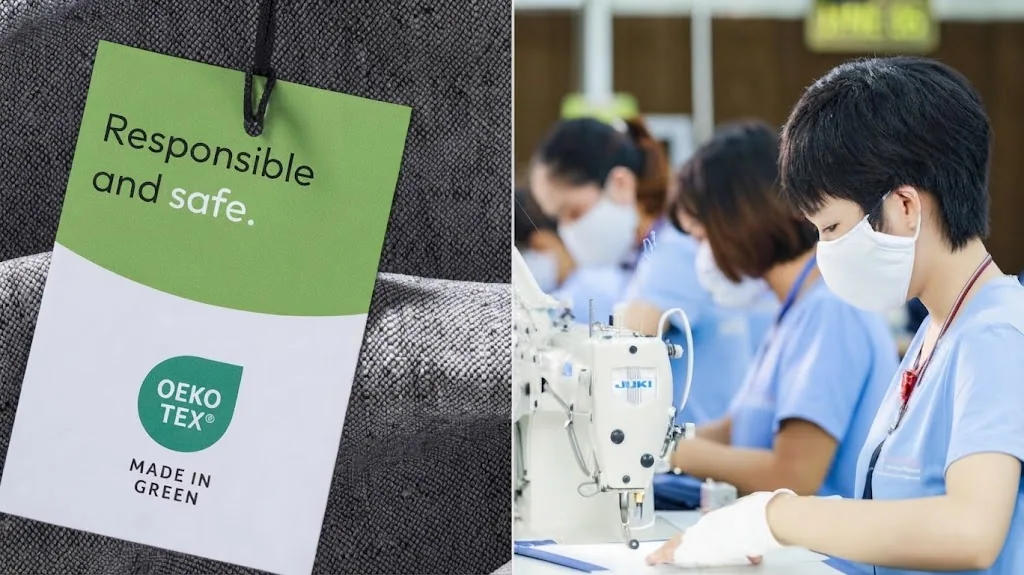
OEKO-TEX STANDARD 100 screens finished articles for harmful substances: not just the fabric, but thread, buttons, zips, and accessories. Limits are set by product class, and uniform programs usually sit in Class II.
The four classes run from Class I for baby and toddler articles, through Class II for articles worn against the skin, to Class III for articles not worn next to the skin, and Class IV for furnishing materials. A certificate issued in Class III does not transfer to a skin-contact garment.
It is not a substitute for REACH compliance, though it supports it. It does not prove FR, arc, or hi-vis performance, and it says nothing about fiber origin, organic content, or recycled content. It also does not assess the mill’s wastewater or chemical management, which sit under STeP or bluesign rather than STANDARD 100.
Treat it as a chemical-safety screen, not a performance badge, and verify the certificate number on the OEKO-TEX STANDARD 100 page before it goes into the technical file.
Proof-of-Compliance Documents: How to Verify a Workwear Certificate

Most buyers stop at the logo, and that is the missing fourth check. Ask for the certificate itself and verify six fields: holder name, facility address, scope, issue date, expiry date, and exact product match. On a group certificate covering several facilities, check that your production site is listed.
A fabric test report does not prove the finished garment passes. Quality Manager Bai checks the facility field first, because a group certificate that omits the production site fails the audit no matter how strong the test data is.
| Document | Issuer | Where to verify it |
|---|---|---|
| OEKO-TEX STANDARD 100 | OEKO-TEX association | Certificate number lookup on the OEKO-TEX site |
| EU type-examination certificate | Notified body | NANDO database, using the four-digit body number |
| NFPA 2112 certification | ISO/IEC 17065 certification body | Issuing body’s online certificate register |
| ISO 9001 / BSCI | Certification or audit body | IAF CertSearch and the body’s own register |
| Laboratory test report | ISO/IEC 17025 accredited lab | Report number plus the lab’s accreditation scope |
The safety uniform compliance guide maps where national rules overlap for a program that spans several markets.
Beyond the certificate itself, these five matches decide whether the PO clears:
- Wash claim names the cycle or ISO 15797 method.
- Labeling pack matches tested care and importer marks, and care and content labeling meets the destination market’s rules.
- Invoice and packing list match the lot and the certificate scope.
- Declaration of conformity names the same standard edition as the certificate.
- Packaging file matches the destination market’s rules.
The same standard applies to us: LantaoWork, whose full credential list sits on our about page, is certified to ISO 9001:2015, ISO 13485, OEKO-TEX STANDARD 100, GRS, GOTS, WRAP, and BSCI, and audited under SMETA.
None of those prove that a garment stops a hazard. They prove process control, chemical screening, fiber origin, or social compliance. The hazard-specific certificates are separate, and we do not present the two as the same thing.
EU Market Access: PPE Categories, Notified Bodies, and the Technical File
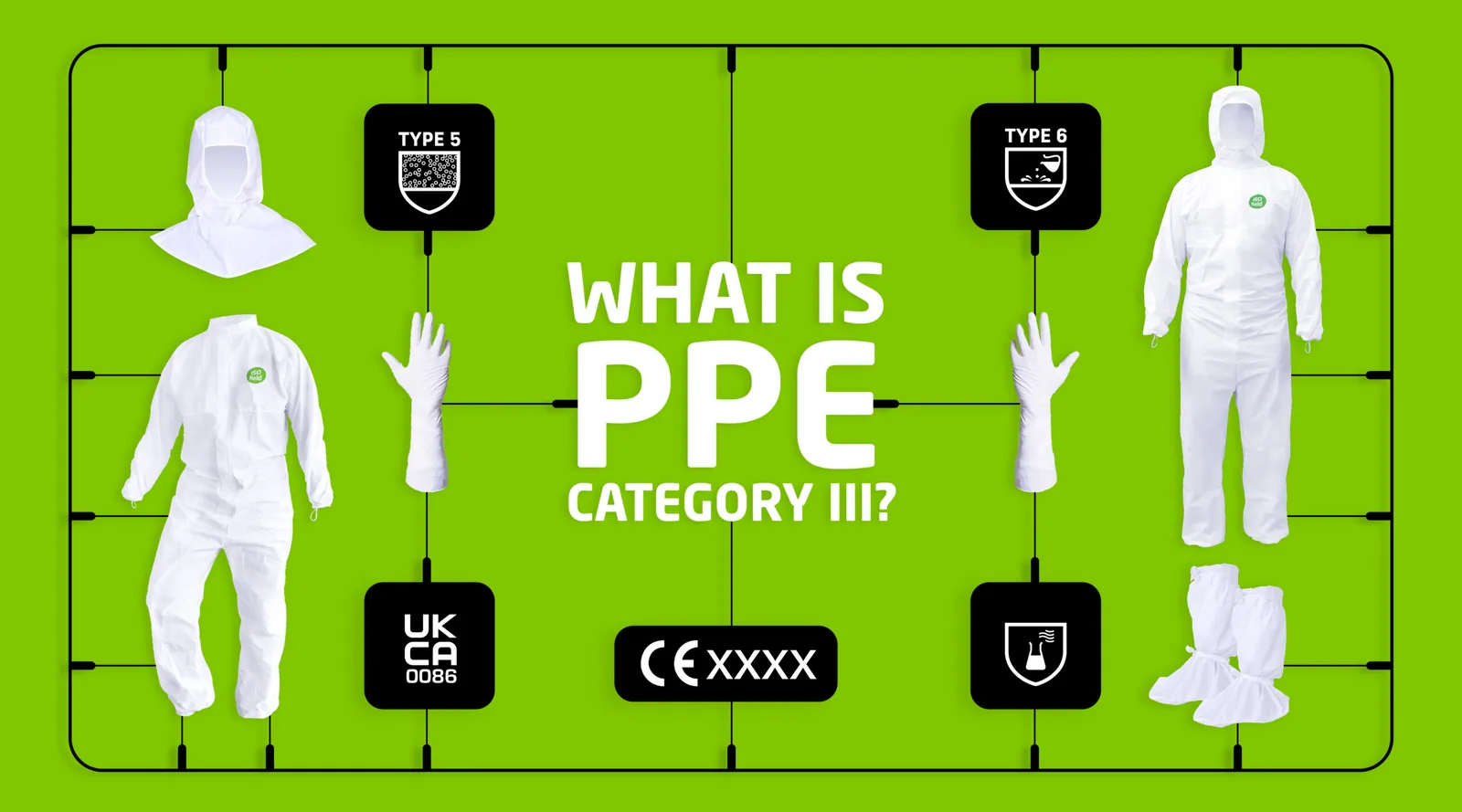
European buyers carry one layer that U.S. buyers do not face in the same form: the PPE Regulation classifies products as Category I, II, or III.
Industrial workwear that protects against serious or fatal hazards sits in Category III, which needs an EU type-examination certificate from a notified body plus ongoing production control through Module C2 or Module D.
Two details fail audits most often. The CE marking must carry the notified body’s four-digit number on Category III products, and the body must actually be notified for PPE — a genuine certificate from a body outside that scope is worthless.
Confirm the number in the Commission’s NANDO database before accepting the file.
Type-examination certificates run for a maximum of five years, and technical documentation has to be retained for ten. UK buyers need a UKCA route with separate approval.
Where Workwear Certifications Stop Covering You
Certifications are useful filters, not a transfer of risk. Our certificate review runs before quoting, yet valid certificates still fail scope, edition, site, or end-use checks. Those gaps need factory controls, not more paperwork.
A Valid Certificate Can Be the Wrong Certificate
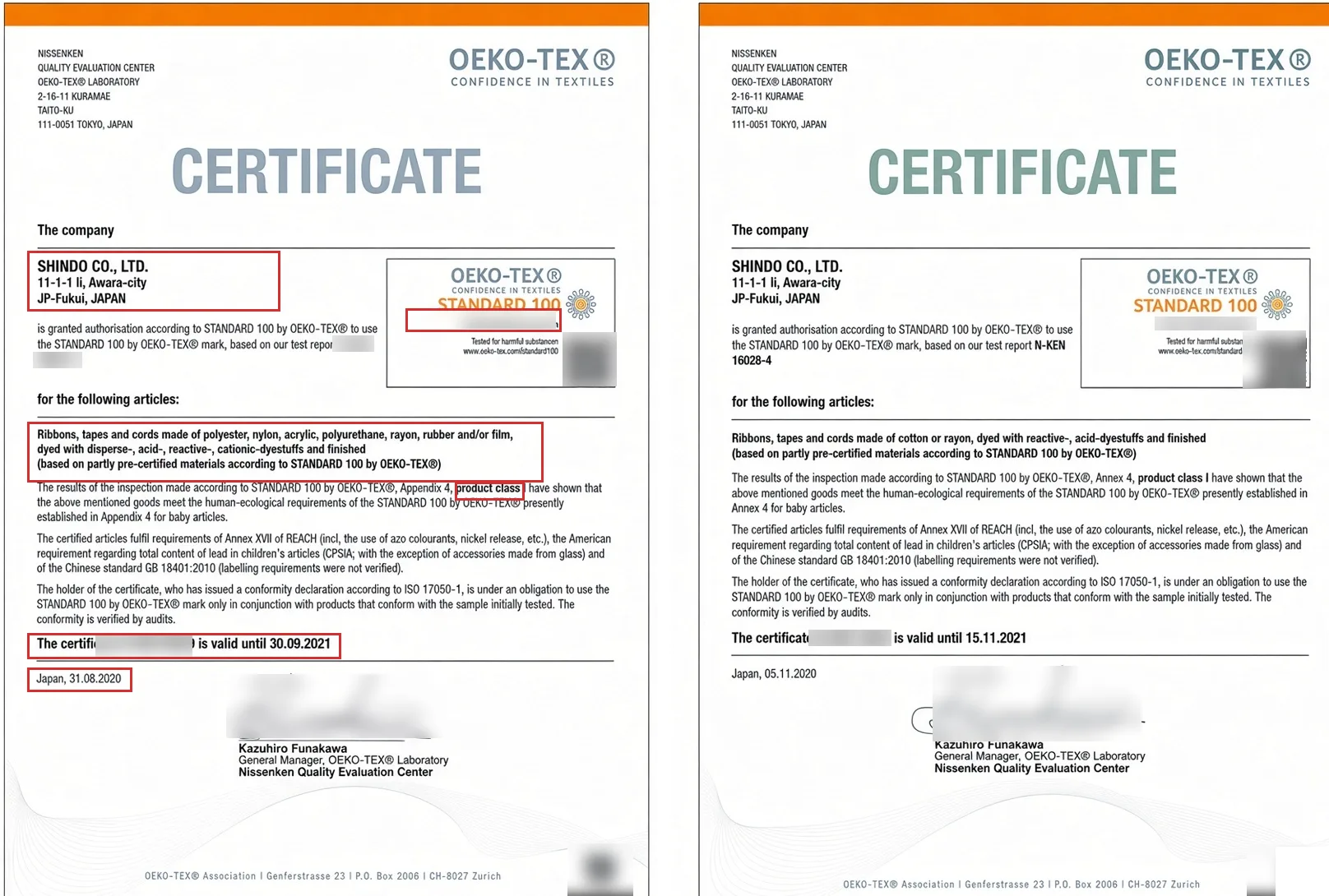
Both certificates above fail three checks at once: they expired in 2021, the holder is a Japanese tape supplier rather than the garment factory, and the scope covers ribbons and cords rather than finished workwear. A common file does the same thing at a smaller scale, pairing an OEKO-TEX fabric certificate with a finished FR trouser: the certificate is genuine, the garment is not covered, and FR performance, trims, and build are all unproven.
Edition and facility scope fail the same way. A tender citing ANSI/ISEA 107-2020 against a brochure citing 2026 freezes approval until the quote names one edition and one test method, and a group certificate listing three factories says nothing about a fourth.
Use-Phase Degradation and Multi-Norm Trade-Offs
Performance falls in use: fading, contamination, trim failure, poor care control. A taped high-visibility vest washed through 20 industrial cycles lifted at the tape edge while the care label claimed industrial laundering. Where washing matters, tie acceptance to ISO 15797.
Multi-norm builds create trade-offs. FR chemistry, antistatic yarns, waterproof laminates, and segmented tape can cut breathability, change hand feel, raise MOQ, add cost, and add lead time. Set the priority before the sample, not after.
⚠️ Experience Warning: Put the wash protocol and test method in the PO. Require post-wash samples from the production line, not the lab.
Label-Only Claims and Customs Files
A visible label is not due diligence. OEKO-TEX’s STANDARD 100 FAQ states that the standard covers the certified article and its components, not FR or hi-vis performance.
Customs files can still delay a good garment. Technical files, declarations, care labels, packaging rules, and importer-of-record duties all have to line up before the container ships.
Our Pre-Shipment QA Workflow for FR and Tear Strength
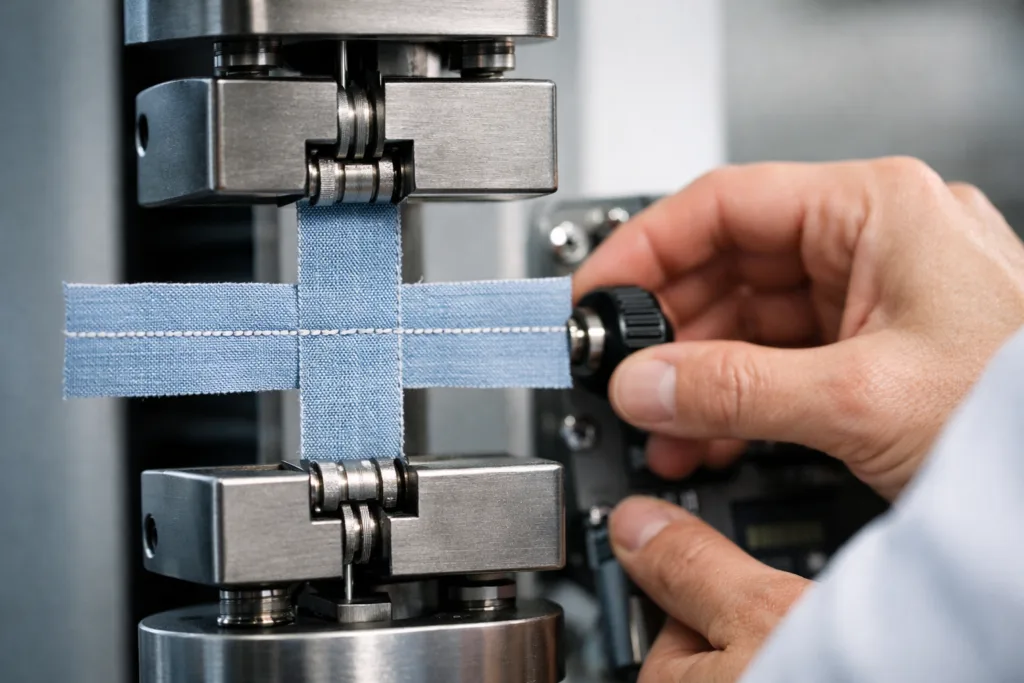
Our workflow runs before every bulk shipment, and each step generates a record for the export document pack. Test methods and equipment IDs are logged per test, and our records are kept for at least three years.
- Hazard and market mapping at tech-pack stage. Match garment to hazard (flash fire, arc, hi-vis, chemical) and destination market (NFPA, ISO, ANSI).
- Fabric BOM review and standard-edition check. Confirm the fabric supplier’s certificate matches the current edition.
- Raw-material intake and conditioning. Verify composition, GSM, weave or knit, and shade-lot identity against the approved BOM, and condition samples per standard.
- Flame-resistance and thermal testing. Run required tests (vertical flame, manikin) on lab samples per bid spec.
- Tear-strength and seam-strength verification. Test lab samples and sealed pre-production garments; record exact force at failure.
- Post-laundry and pilot-wear review. Re-test after laundering for dimensional change, reflective performance, and protective performance, then assess mobility, coverage, and trim placement on workers.
- Pre-shipment AQL gate. Use AQL 2.5/4.0 inspection and reconcile each certificate to the production lot.
- Document pack release. Compile certificates, test reports, and inspection records into one traceable file.
Where a program involves repeated commercial washing, we tie durability to the ISO 15797 industrial-laundry method.
Failure Points and Corrective Actions
| Failure point | Buyer impact | Corrective action |
|---|---|---|
| Certificate scope mismatch | Rejected shipment, audit failure | Verify scope and facility before order |
| Reflective tape wash failure | Fails hi-vis after washes | Require wash-cycle test reports |
| Seam slippage | Premature seam failure | Increase stitch density or stronger thread |
| Shade inconsistency | Mixed lots look unprofessional | Lock shade lot at mill |
| Incorrect care label | User washes incorrectly, voids protection | Audit label against tested care |
| Fiber-content variance | Performance claims become false | Test fiber content each lot |
| Carton-to-lot document mismatch | Customs delays, traceability gaps | Reconcile carton labels to lot numbers |
When a failure point shows up in both audit findings and inspection records, we add a mandatory check at the fabric or cutting stage.
The table is reviewed quarterly, and a repeat failure is escalated to the fabric supplier. The defect-reduction program tracks the same signal across orders.
How to Check Workwear Certifications Before You Approve a PO?
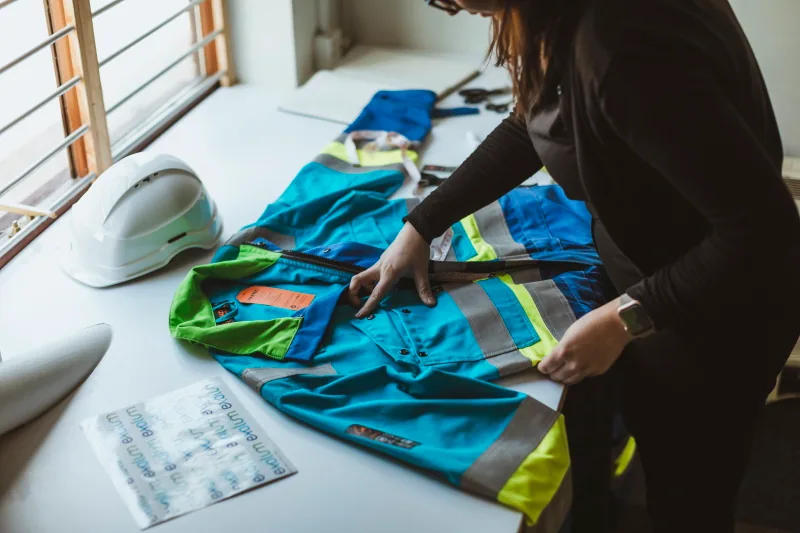
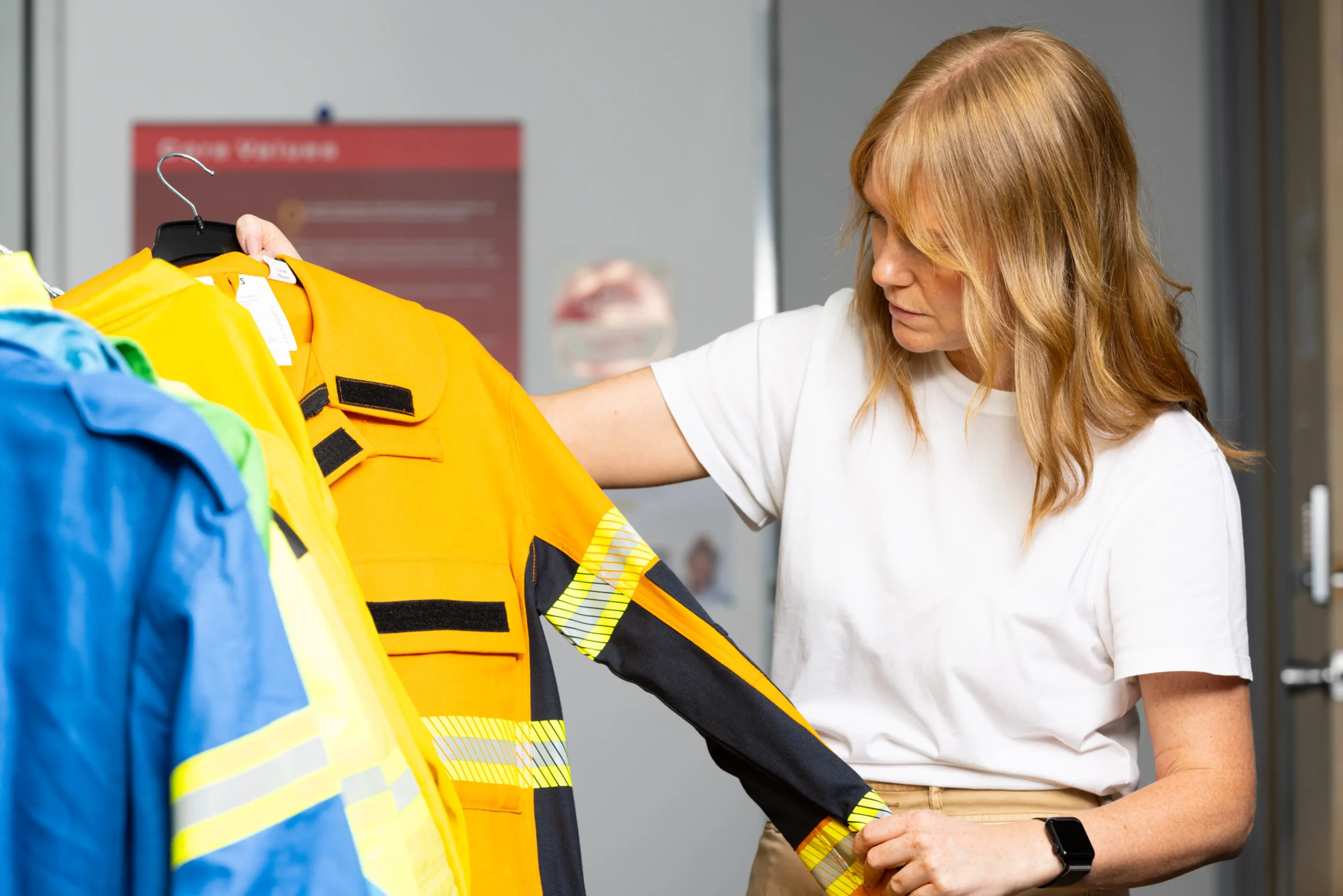
Certifications protect you only when they match the job. Start with the hazard, find its row below, then run the four checks in order.
| Scenario | United States | EU / international | Certificate to retain |
|---|---|---|---|
| Roadway and traffic exposure | ANSI/ISEA 107 Type R, Class 2–3 | EN ISO 20471 Class 2–3 | Garment certificate naming the type or class, plus the edition year |
| Warehouse, terminal, plant yard | ANSI/ISEA 107 Type O, Class 1 | EN ISO 20471 Class 1 | Same, with the area thresholds stated |
| Flash fire (oil and gas, chemical) | NFPA 2112 | EN ISO 11612 (A/B/C codes) | NFPA 2112 certificate with the manikin report, or the EU type-examination certificate |
| Electric arc | ASTM F1506, with arc rating per NFPA 70E | IEC 61482-2 | Arc rating in cal/cm² on the label and in the test report |
| Welding | ANSI Z49.1 sets safe practice; no US garment-performance standard is specific to welding | EN ISO 11611 Class 1–2 | Certificate naming the class and the garment style |
| Molten metal splash | NFPA 2112 does not cover it | EN ISO 11612 code D or E | Certificate showing the D or E code and its performance level |
| Chemical splash or particulate | NFPA 1991 and 1992 cover emergency-response suits only | EN 13034 (Type 6), EN ISO 13982-1 (Type 5), EN 14605 (Type 3–4) | Type-examination certificate naming the type |
| Everyday skin contact (all garments) | No garment-standard equivalent | OEKO-TEX STANDARD 100 Class II | Certificate number and the product class |
Step 1: Match the Thermal Standard to the Hazard
Match NFPA 2112 or ISO 11612 to the thermal hazard, and confirm the edition year. A certificate to a superseded edition was issued against a different test method, so the edition number belongs in the PO, not in the appendix.
Step 2: Match the High-Visibility Type and Class to the Traffic
Match ANSI/ISEA 107 Type and Class, or the ISO 20471 class, to the traffic and the task. Type O covers off-road work, Type R covers roadway exposure, and Class 3 applies where the visibility demand is highest.
Step 3: Screen for Chemical Safety Without Treating It as a Performance Badge
Screen with OEKO-TEX STANDARD 100 or an equivalent for harmful substances, in the product class that matches how the garment is worn. It is a chemical-safety screen, not proof of FR, arc, or hi-vis performance.
Step 4: Verify the Certificate, the Scope, and the Exact Production Site
Ask for the certificate itself and check holder, scope, issue and expiry dates, and the exact production site. A group certificate that omits your factory says nothing about your order, however strong the test data behind it.
Start with the hazard itself, then map it to the correct regional standard, verify the documentation, and confirm the exact production site. Skipping any step leaves you holding the risk.
Frequently Asked Questions About Workwear Certifications
1. Is OEKO-TEX STANDARD 100 a PPE certification?
No. STANDARD 100 screens finished articles, including trims and accessories, for harmful substances. It supports REACH compliance without replacing it, and it does not test FR, arc, or hi-vis performance.
2. Do I need a new certificate for the ANSI/ISEA 107-2026 edition?
Not automatically. The 2026 edition supersedes 2020, but labels to either edition are expected to coexist during the transition. What matters is that the bid sheet and the certificate name the same edition, and that your program sets a date for moving to 2026.
3. Can a fabric test report certify a finished garment?
No. A test report covers the sample submitted, usually fabric, and says nothing about production consistency or the finished build. A garment claim needs a certificate that names the garment, plus test data tied to the same material and construction.
4. What is the difference between ISO 9001 and a product certificate?
ISO 9001 certifies the factory’s quality management system, not what the garment does. A product certificate, such as NFPA 2112 or an EU type-examination certificate, proves the garment met a specific performance standard — a plant can hold ISO 9001 and still produce non-compliant workwear.
5. How long is an EU type-examination certificate valid?
A maximum of five years. Category III PPE also needs ongoing production control through Module C2 or Module D, so the type-examination certificate alone is not enough. Check the expiry date against your shipment date.
6. Does NFPA 2112 cover high-visibility or arc-rated workwear?
No. NFPA 2112 covers flash fire resistance only. A garment that has to be both FR and visible carries an ANSI/ISEA 107 claim for visibility and an NFPA 2112 claim for flash fire, and an arc-rated garment adds ASTM F1506 testing on top. Three certificates, three separate claims.
7. Is CE marking required for hi-vis workwear sold in the EU?
Yes. Hi-vis apparel sits in PPE Category II, so it needs an EU type-examination certificate from a notified body plus Module C production control before the CE mark goes on. Category II CE marking carries no notified body number — that is a Category III requirement.
Conclusion
The four families never overlap. A thermal standard, a visibility standard, a chemical screen, and the paper trail that ties each one to your factory answer four different questions, and a file that satisfies three of them still fails the fourth.
Work in that order. Hazard assessment first, standard and edition second, certificate verification third, and the production-site match last. A buyer who starts from the supplier’s brochure is auditing marketing, not compliance.
Our team runs that review before quoting, so the certificate holder, scope, edition, and facility are checked against the tech pack and any gaps come back to you in writing. Send your tech pack and certificates and we will tell you which of the four families your order still owes you.
Disclosure: The QA examples in this article come from LantaoWork’s internal inspection records. We do not receive payment from certification bodies or standards organizations. We have no commercial interest in the specific standards mentioned.

Leave a Comment
Your email address will not be published. Required fields are marked *