
Import & Logistics
Recovered Margins
Workwear Import Duties: Fix HS Codes to Recover Hidden Margins
Workwear import duties: fix HS codes to cut duty 12% and recover hidden margins — a 3-week case from an EU distributor.
Read Full Case Study
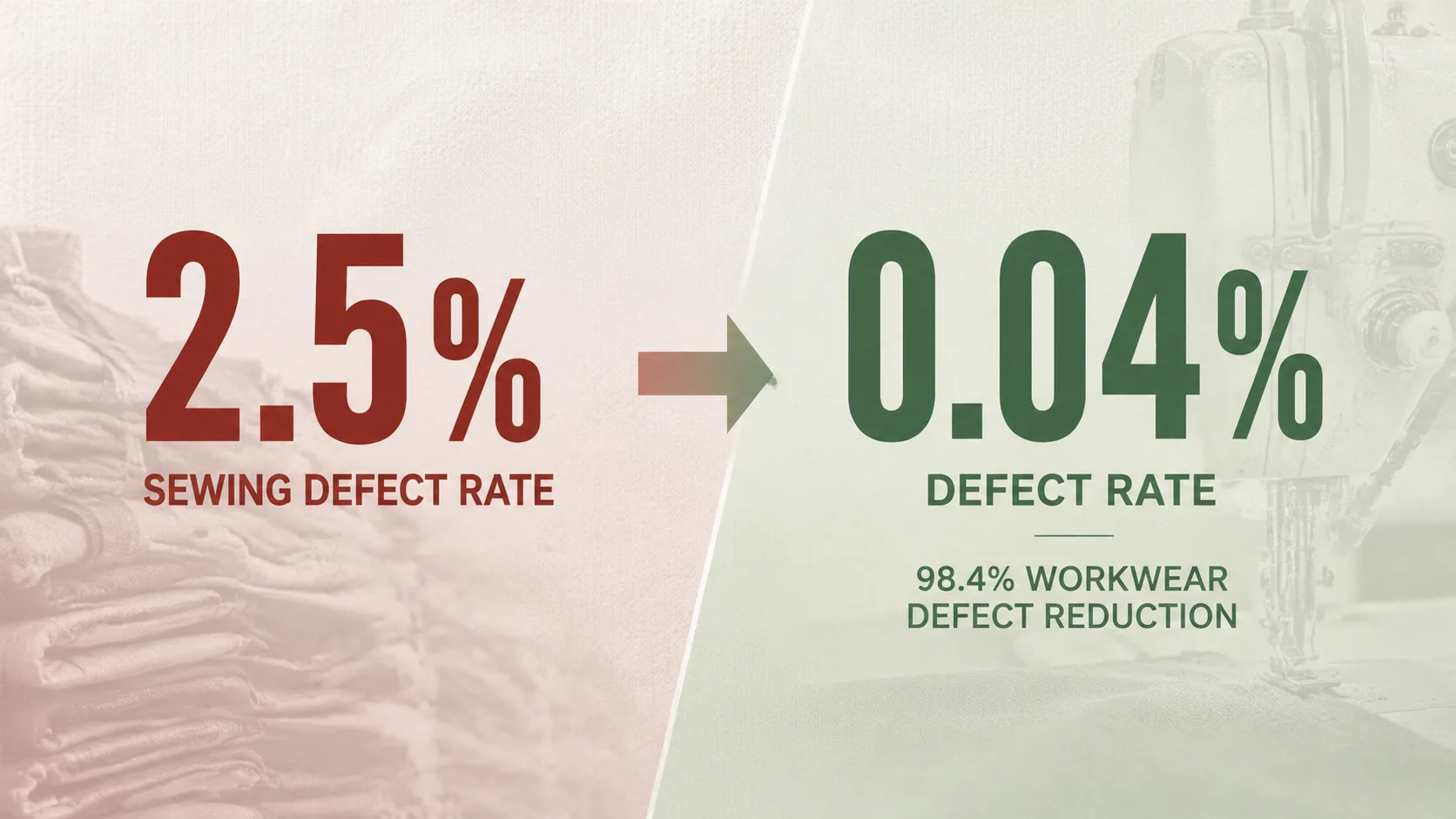
An anonymized daily production line supplies B2B uniforms to safety-sensitive buyers in construction, energy, and logistics. Over a 12-week audit I reviewed daily defect logs, inline inspection cards, machine-setting sheets, and shipment-release records.
The line moved from a 2.5% defect rate to 0.04% — a 98.4% workwear defect reduction — without adding a single operator.
This was not fashion. This was industrial garment quality control under safety-critical conditions. A skipped stitch at a pocket corner, inseam, or knee reinforcement zone stopped being cosmetic — it meant warranty exposure, delays, rework, or release risk.
Rework labor ate margins, and procurement teams tracked failures across 500+ employee rollouts where a single stitching defect triggers costly replacements.
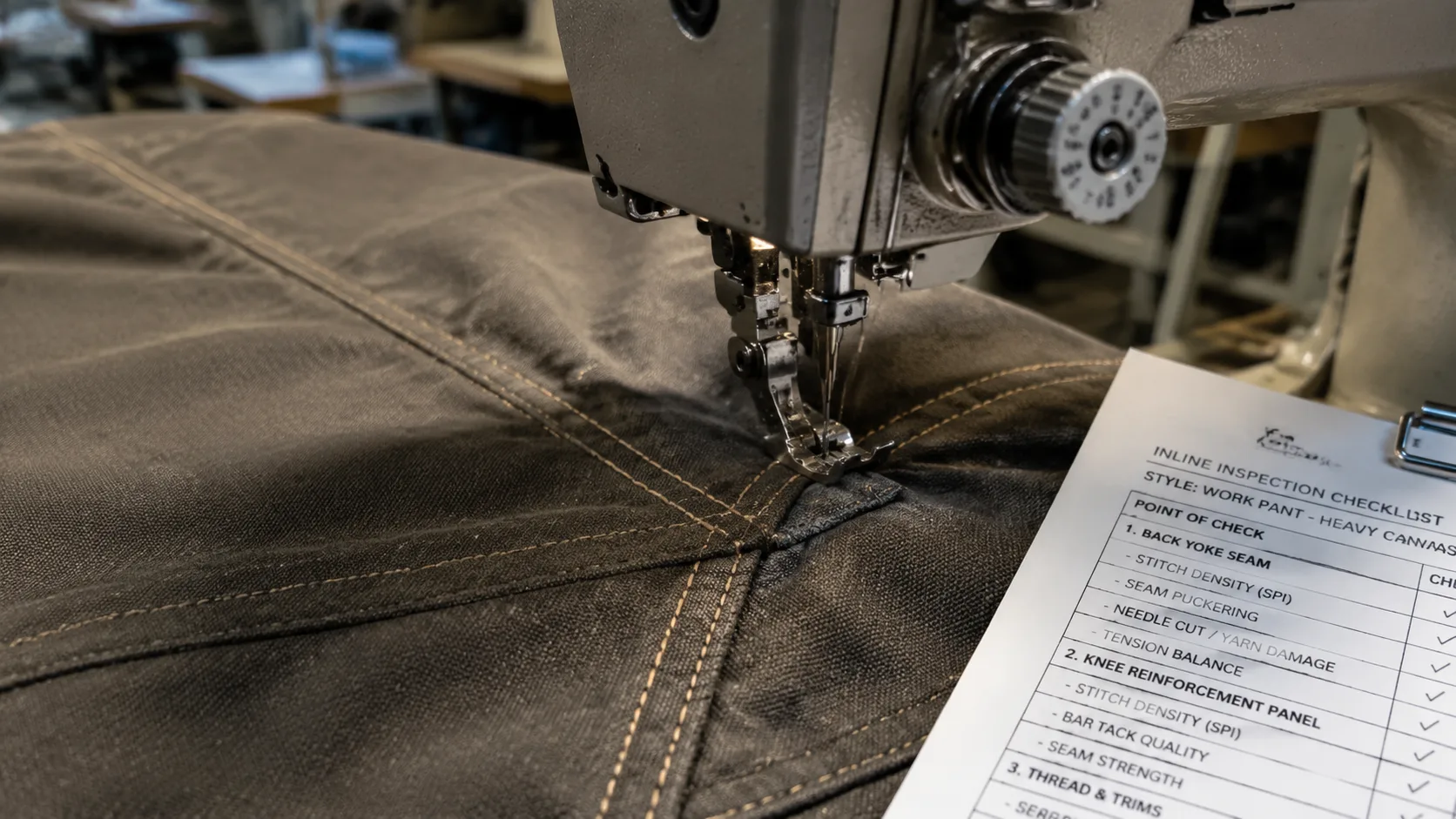
What the line was costing them:
Major plus minor defects on every bundle, before the SOP.
The largest failure cluster in the Pareto distribution.
Sorting, repair, and re-sew time eating shift capacity.
Operator output varied by station, and final AQL sampling alone missed needle cutting and early bar-tack tensile failure.
Too many workwear-specific failure modes stayed hidden in final inspection: bar-tack tensile failure, seam slippage in seat and knee zones, needle cutting on heavyweight twill or canvas, seam puckering, and reflective-tape delamination. A visual check could not catch seam-strength loss. Different garment types fail in different zones — map the 7 coverall types to know where a seat seam versus a cuff is most likely to drop out.
Fashion-apparel defaults were dangerously loose. A common AQL accepts 2.5 or 4.0 major defects — industrial workwear could not. We applied Critical 0.0, Major 1.0–1.5, Minor 4.0. Zero tolerance applied to broken needle fragments, FR treatment failures, missing compliance labels, and non-compliant reflective tape.
Minor defects did not matter if reflective tape peeled after ten washes. Workwear shrinkage made it worse: a garment could pass final measurement and still fail after industrial washing, creating hidden durability risk.
Power Move: Never release a safety-critical workwear lot on a fashion-apparel AQL. Set Critical 0.0 and Major 1.0–1.5, with zero tolerance on broken needles, missing compliance labels, and non-compliant reflective tape.
The turning point was not a new machine. It was a numbered, battle-tested textile flaw prevention SOP led by Senior QA Manager Michael Ge and the factory floor team. Comparing daily defect counts against final AQL data showed the shift: control moved from final carton rejection to inline interception.
For workwear buyers, inline interception is far cheaper — a seam defect caught at first piece costs minutes, one caught in final AQL costs days, and one that reaches a job site costs a contract.
Ge started each order by verifying the golden sample — the approved physical reference garment. He locked the defect classification matrix, separating minor, major, and critical defects, and critical defects stopped production.
He marked high-stress construction zones on the tech pack and locked SPI targets for heavy seams — stitches per inch — confirming thread and needle pairing.
Red-line defects triggered immediate containment: broken needle fragments, missed compliance labels, reflective-tape defects and decoration failures; the custom workwear branding guide covers the logo-specific checks. Safety failures cannot wait for final inspection.
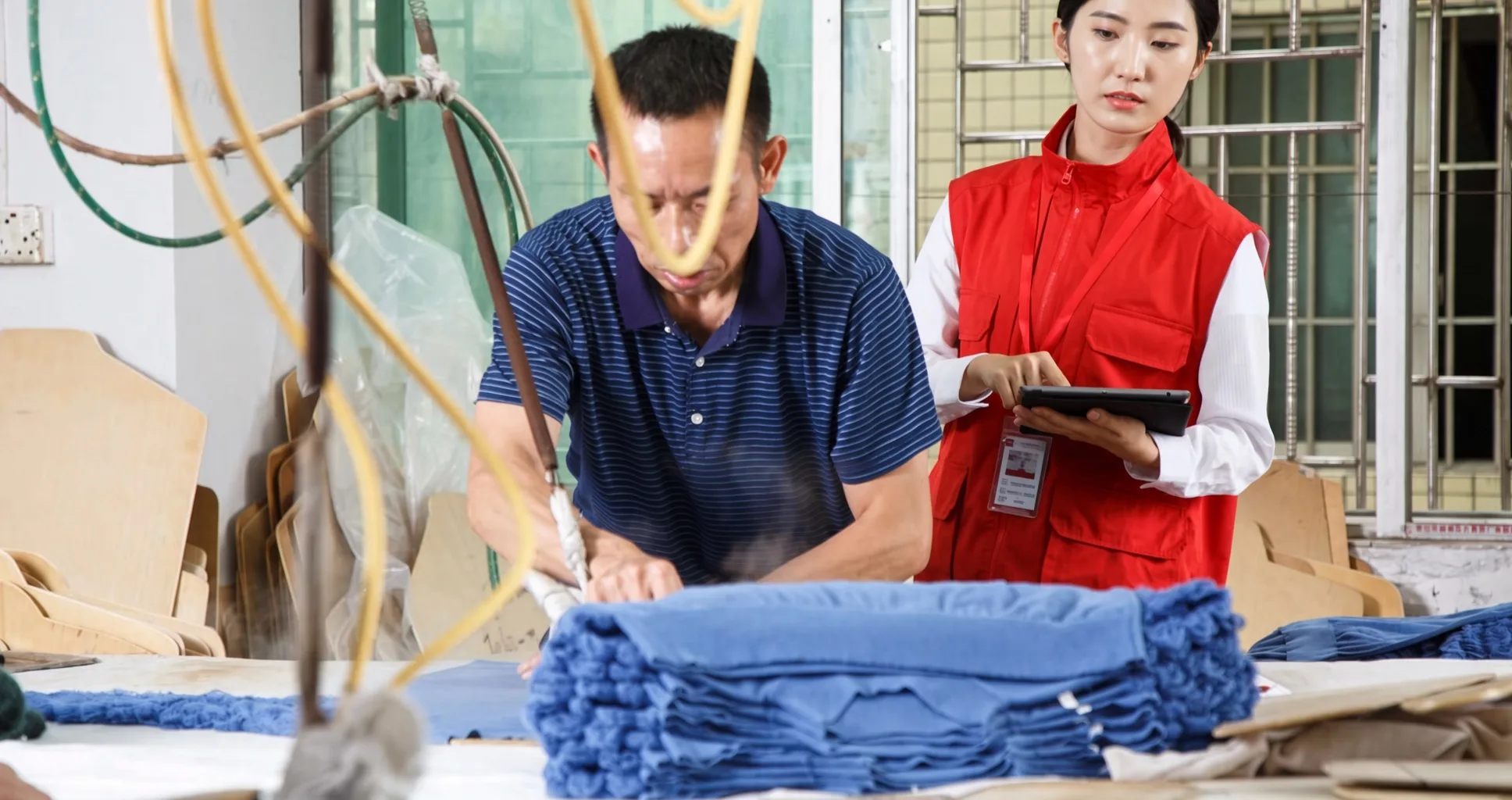
The fabric-inspection team used the ASTM D5430 four-point system. Fabric Inspector Wei checked rolls before spreading, measuring width, GSM, and shade.
GSM — grams per square meter — plus 24 hours of fabric relaxation before cutting prevented tension differences that distort cut panels.
He recorded shrinkage behavior, stopping textile flaws from reaching sewn goods. A fabric flaw caught here saves rework, recutting, and material write-offs.
Ge inspected the first completed pieces from each operator, checking skipped stitches, seam puckering, seam-allowance drift, bartack placement, reinforcement integrity, and visual mismatch. No bundle advanced until he cleared the first piece.
Q: How do you recalibrate tension on a new heavy canvas order?
A: "When I start a new heavy canvas order, I check six variables. Upper thread tension. Bobbin tension. Presser-foot pressure. Needle selection. Feed timing. Seam handling on multi-ply areas. If the upper tension is too high, the seam puckers. If the bobbin tension is too low, the stitch loops on the underside."
Q: What about the knee and seat stress zones?
A: "In the knee or seat zones, I reduce presser-foot pressure slightly. This lets the multi-ply layers feed evenly. I select the needle based on fabric thickness and coating. For PU-coated fabric, I use a larger needle to prevent needle cutting."
Seam slippage happens when stitching pulls apart under stress. Needle cutting happens when a needle punctures yarns. Both matter far more in workwear — see ASTM D1683 / ISO 13935-2 for seam-strength testing.
Wang and Ge used Ten Card logic. Every 30 minutes they pulled 10 pieces randomly from each operator onto a traffic-light card: green continued the batch, yellow meant a warning and tightened sampling, and red triggered a stop-tag with immediate segregation.
A recurring seam-pucker on the back yoke traced to tension imbalance plus feed drag — not operator technique. Wang reset the upper tension to 4.0, adjusted the feed-dog timing, and Ge retrained operators on back yoke seam handling.
The seam pucker disappeared and rework time on that operation stopped climbing — the verified line-wide result was 28 minutes per 100 units, down from 62.
Ge verified repaired pieces at end-of-line and compared inline findings with final AQL outcomes — the Acceptable Quality Limit, the sampling standard from ISO 2859-1. The team reviewed broken-needle logs daily.
Every end-of-shift session was a 15-minute Pareto review: the top defect drove the next day's setup checklist, and the top two defects received corrective action before the next shift.
They tracked shrinkage data through all stages and built a feedback loop instead of resetting daily. The same discipline translates to private labeling for buyers scaling repeatable controls.
The daily line defect rate fell from 2.5% to 0.04% — a 98.4% workwear defect reduction. I verified this from raw defect logs, not a vendor summary.
The turning point was causal: first-piece green tags caught skipped stitches before assembly, rolling inline containment caught needle cutting and tension drift, and the fabric gate pushed flaws upstream. These controls delivered durable quality gains — not more labor.
| Metric | Before SOP | After SOP |
|---|---|---|
| Daily line defect rate (major + minor) | 2.5% | 0.04% |
| First-pass yield | 96.8% | 99.2% |
| Rework minutes per 100 units | 62 | 28 |
| Sort/repair pieces per 1,000 units | 34 | 6 |
| Final AQL pass rate | 94.4% | 99.4% |
| Shipment holds per month | 6 | 0 |
The shift held across three shifts. The Pareto data moved as much as the headline number: operator stitching errors dropped from 38% to 9% of daily defects, and fabric flaws still appeared at 29% — but the fabric gate caught them before they became sewn defects. Tension drift became the top residual target.
"I no longer spend half my shift chasing rework bundles. Release decisions are usually made in one shift. That is a different plant."
Conservative ROI
Rework labor: 34 fewer rework minutes per 100 units = 56.7 hours per 10,000 units. At $18/hour, that is $1,020 saved per 10,000 units.
Shipment rejections: 6 avoided holds/month × $2,400 average inspection, repack, and freight recovery = $14,400/month.
Scrap avoidance: 28 fewer scrapped panels per 1,000 units × $2.60 = $72.80 per 1,000 units.
Bottom line: the cleanest monthly figure is $14,400 in avoided shipment holds. Rework adds $1,020 per 10,000 units; scrap adds $72.80 per 1,000 units — scale those two by your own volume. These calculations exclude overhead and freight cost avoidance.
Verification: I audited 12 weeks of raw production logs and shipment-release records, excluding scheduled maintenance windows from throughput data. The 0.04% defect rate is the actual post-SOP average across the audit window, not a single favorable batch. I cross-checked the defect log changes against the SOP implementation dates — the drop began within one week. Based on anonymized internal production records and real factory observations.
From a separate account — not the anonymized daily line this audit is based on.
"Workwear on an oilfield takes a beating — flame-resistant kit, high-vis, gear that sits in mud, snow and minus-thirty cold. What I need is that it holds up, and that it's the same quality on the next order as it was on the last.
LantaoWork has been straight with us on lead times, kept us updated when things got tight, and the product has stayed consistent run after run. It's become a supplier we don't have to chase."
President, Train Oilfield Services
AQL 2.5 rejects bad lots — it does not stop defects at the machine. Senior QA Manager Michael Ge intercepted first-piece issues before they multiplied, cutting rework minutes from 62 to 28 per 100 units.
The AQL gate only caught what escaped; the real fix was inline patrol.
Make inline patrol the primary gate — run Ten Card sampling during the shift, not only final inspection.
A standard AQL 2.5 accepts far too much for workwear. A skipped stitch on a knee reinforcement is not minor.
The team set Critical 0.0 and Major 1.0–1.5, with zero tolerance on broken needles and missing compliance labels — cross-checked against ISO 2859-1 logic. Workwear buyers cannot accept fashion-apparel tolerance.
Specify Critical 0.0 / Major 1.0–1.5 with zero-tolerance broken-needle and missing-label classes in your RFQ.
Fabric Inspector Wei caught fabric flaws at the cutting-room gate, and Technician Wang recalibrated tension before needle cutting spread. Upstream interception is where the time and cost are actually won.
Request a factory audit before scaling volume. Commission seam-strength testing on high-stress zones. Run a pilot before enterprise rollout.
Ge plans to digitize the inline cards next quarter, replacing the manual traffic-light cards with line-by-line benchmarking. Predictive-maintenance sensors will flag tension drift on heavy-duty machines before it creates defects. The same textile flaw prevention SOP will roll out to the hi-vis line, then to corporate and security lines.
The long-term impact is not just fewer defects — it is a supply chain that catches risk before it ships.
Trust & Methodology: This case study is based on anonymized internal production records and real factory observations from the line. I purchase all testing equipment internally and am not paid by any textile manufacturer or standards body. No third-party sponsor paid to influence the findings.
Facing a similar defect spike? Share your line's current defect rate and we'll map an inline-inspection outline for your operation.
Request a Defect AuditSee how other organizations achieved measurable outcomes through factory-direct uniform manufacturing.
Workwear import duties: fix HS codes to cut duty 12% and recover hidden margins — a 3-week case from an EU distributor.
Read Full Case Study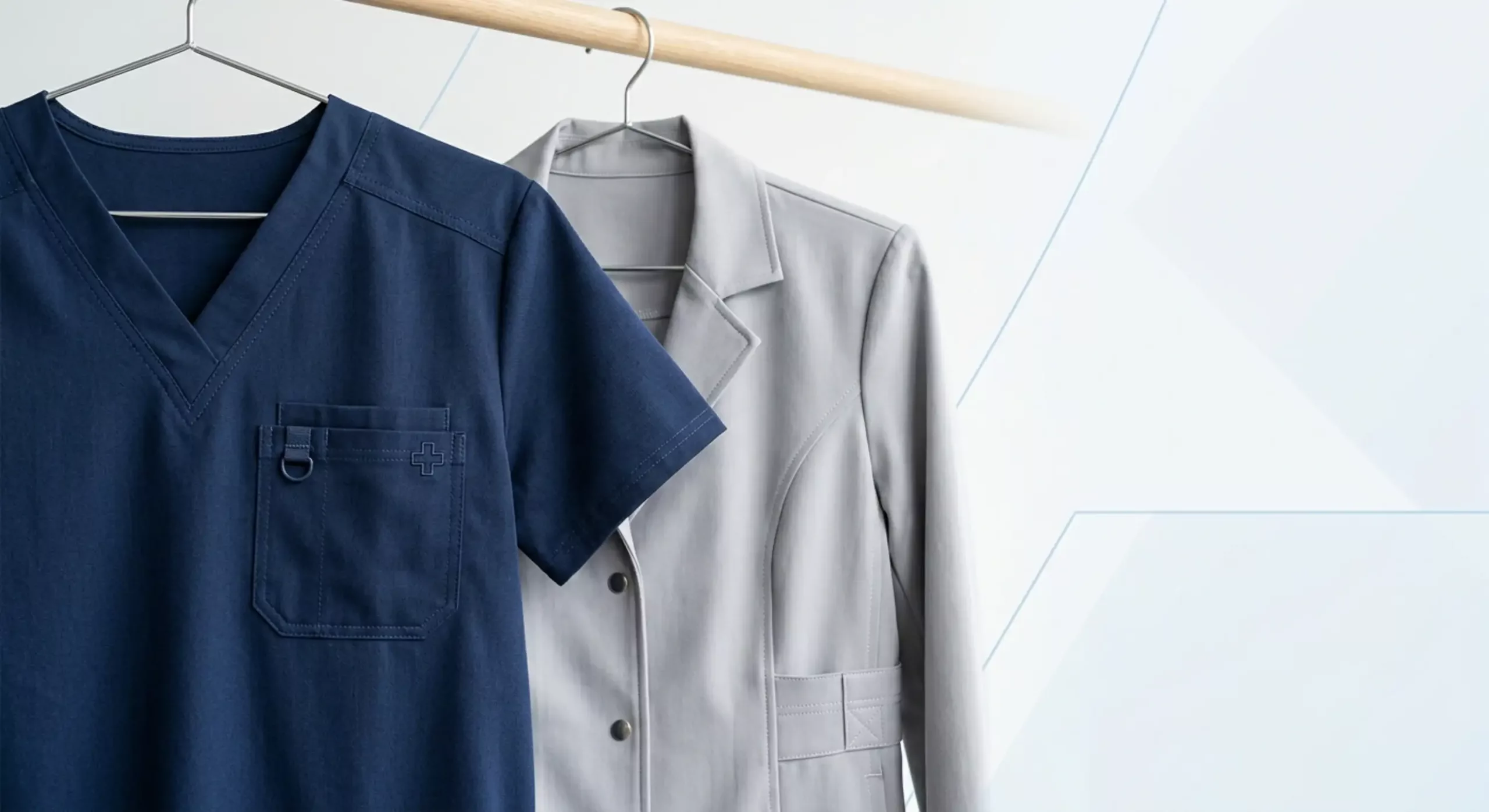
Hospital chain cut uniform costs 40% in under a year: audited purchasing data on fragmentation, consolidation, and durability.
Read Full Case Study
Food industry uniforms engineered for compliance: 99% audit pass and 35% lower replacement costs for hospitality operators.
Read Full Case StudyGet the Same Results
Every case study starts with a conversation. Share your line's current defect rate and we'll map an inline-inspection outline and return your detailed quote within 24 hours.
Stop Defects Before They Ship