Table of Contents
The short answer EN 343 grades rainwear on two numbers: water penetration (Wp) and breathability (Ret). The mandatory tests cover the outer material and seams; the optional rain-tower test covers the assembled garment. A mill fabric ticket is not a class claim.
A waterproof fabric ticket can pass while the finished jacket leaks. Your crews complain about seams, pockets, vents, zippers, and logo points, while the supplier points to a strong fabric test.
The claim is narrower: EN 343 waterproof workwear is built from material and seam tests, not a single fabric number. The gap shows up as returns, crew downtime, and tender disputes.
The guide answers the questions buyers actually ask. What do EN 343 classes actually mean? How are water penetration (Wp), water-vapour resistance (Ret), seams, and optional rain-tower results tested? How should buyers write an OEM RFQ so the delivered style matches the claim?
The workwear manufacturing team at LantaoWork reviews rainwear claims by style, by seam, and by test report. That review matters for construction and infrastructure crews and for white-label distribution programs, where one bad batch damages trust.
Methodology box: This guide uses the published standards and EU decisions cited below, plus a pass/fail RFQ checklist.
Production rule: If the report does not name the style, there is no claim to make.
What Is EN 343 Waterproof Workwear?
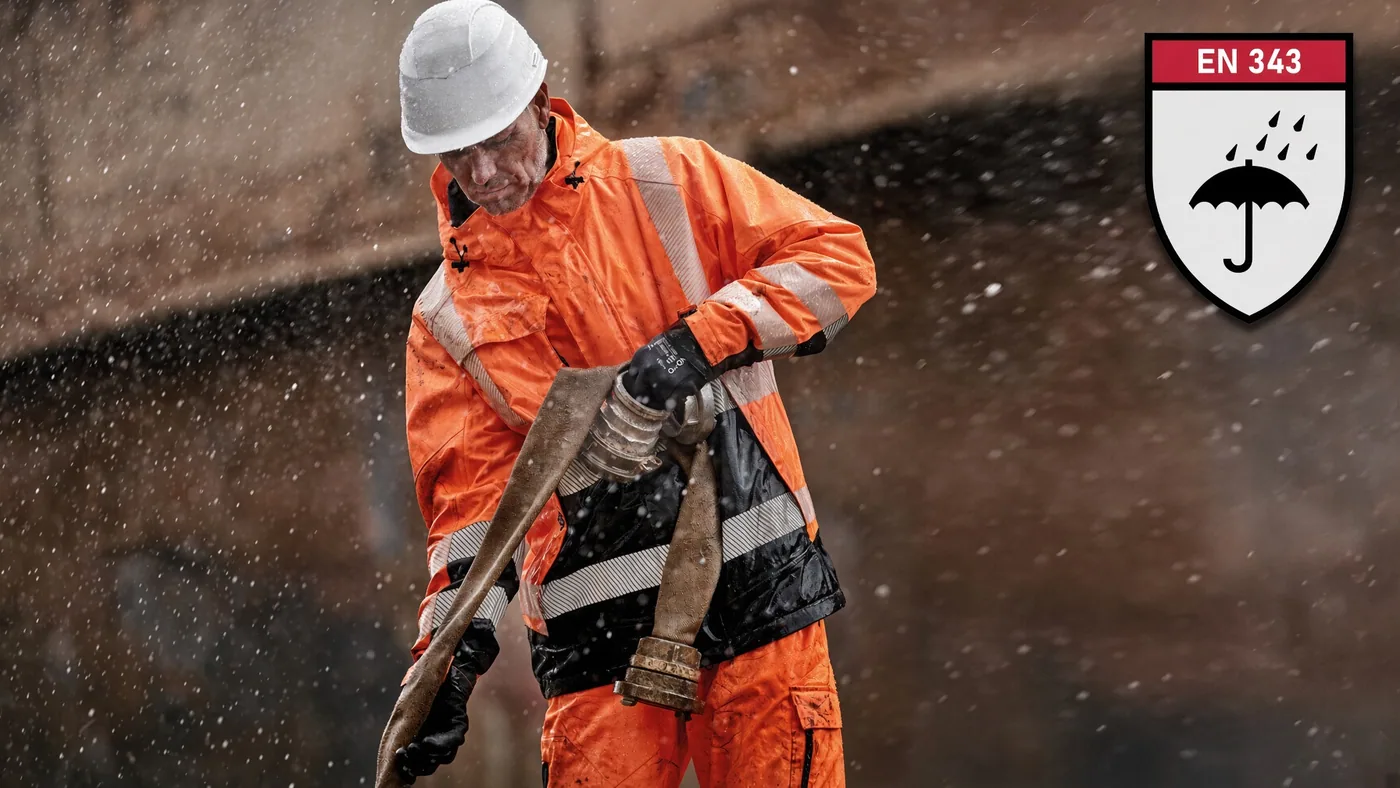
EN 343 waterproof workwear is rain-protective clothing graded on two properties: keeping rain out and letting sweat escape. It covers rain, snowflakes, fog, and ground humidity, and grades water penetration resistance (Wp) and water-vapour resistance (Ret) independently. A shell can be good at one and poor at the other.
The label carries two scores plus an optional third mark. One score records how well the material blocks water. The other records how well body vapour passes through. A lower Ret value means better breathability, and the Ret class rises as that value falls.
Seams and closures decide the result as often as the fabric. In QC reviews, untaped seams, unsealed pocket zips, and loose storm flaps fail first, not the shell. Ask for the report on the exact shell, seam tape, and zipper combination you will receive.
Reading the label
- First number (Wp class): water penetration class. Higher is better.
- Second number (Ret class): breathability class. Higher is better, because it means a lower Ret value.
- Third mark R: the finished garment passed the optional rain simulation (rain tower).
- Third mark X: the optional garment test was not run.
So “3/3/R” means Wp Class 3, Ret Class 3, plus a passed rain simulation on the assembled style. An X is not an automatic fail, and it does not replace the first two numbers.
Fabric ticket vs class claim
| Question | Mill fabric ticket | EN 343 claim |
|---|---|---|
| What was tested? | A material swatch | The named style’s material and seams, plus the optional rain tower |
| Whose name is on the report? | The mill or fabric supplier | The factory’s legal entity |
| Are pretreatments included? | Often not stated | Required at Class 2 and above |
| Are seams included? | No | Yes; Class 4 also after cleaning |
| Is the assembled garment tested? | No | Only if the R mark is claimed |
| Can it support a class claim? | No | Yes, for the edition and style named in the report |
Where the standard stands today
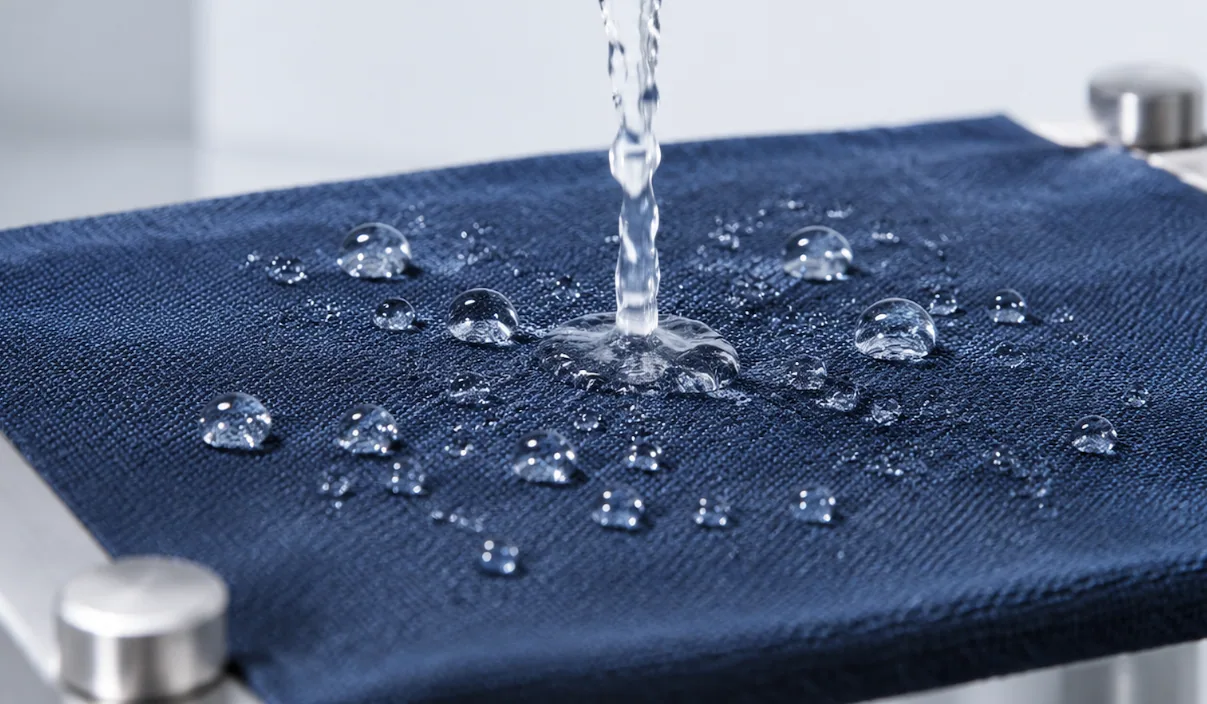
Many explainers still repeat the older three-class model. EN 343:2019 actually defines four water-penetration classes, and it is now superseded at standards level by EN ISO 24232:2025, which adopts ISO 24232:2024.
In the EU Official Journal, Decision (EU) 2026/1971 added the new reference, and Decision (EU) 2026/2505 (EUR-Lex correction) keeps EN 343:2019 listed until 4 March 2028.
Until that date, both references can support a presumption of conformity for EU PPE rules. After that date, plan EU bids around EN ISO 24232:2025. Check other markets, including Great Britain, separately.
Plain-language glossary
- EN 343 water penetration resistance: the hydrostatic pressure the material survives without leaking.
- EN 343 Ret breathability class: vapour resistance, where a lower value is better.
- EN 343 rain tower test: the optional simulation on the assembled garment.
- Waterproof workwear taped seams: sealed stitch lines that stop water at needle holes. These are verified during pilot sampling.
How Are EN 343 Claims Tested?

We trace rainwear claims from lab to finished garment. A 20,000 Pa fabric can still leak at the chest pocket in a rain-tower simulation.
The sections below follow that path: material, full stack, seams, then the assembled garment. Senior QA Manager Michael Ge reviews rainwear files the same way.
Water Penetration Resistance (Wp): The Hydrostatic Head Test
Water penetration resistance measures how much water pressure a material resists before water pushes through. The test uses a water column: the taller the column, the higher the pressure.
Labs record pressure in Pascals (Pa) or millimetres of water head (mm), usually using the hydrostatic method in EN 20811 (ISO 811). About 1,000 Pa equals 102 mm, so 20,000 Pa is roughly 2,040 mm. Mill tickets often quote millimetres; the waterproof fabric guide explains how those ratings are produced.
A 20,000 mm ticket is about 196,000 Pa, far above the 20,000 Pa Class 4 threshold, so the two numbers are not comparable.
Four water-penetration classes sit under EN 343:2019. Class 4, the highest, requires Wp ≥20,000 Pa after the required pretreatments, plus seam performance after cleaning at that level.
EN 343:2019 classes
| Class | Wp material | Wp seams | Ret (m²·Pa/W) |
|---|---|---|---|
| Class 1 | ≥8,000 Pa on new material | ≥8,000 Pa on new seams | > 40 |
| Class 2 | ≥8,000 Pa after each pretreatment | ≥8,000 Pa on new seams | 25 < Ret ≤ 40 |
| Class 3 | ≥13,000 Pa after each pretreatment | ≥13,000 Pa on new seams | 15 < Ret ≤ 25 |
| Class 4 | ≥20,000 Pa after each pretreatment | ≥20,000 Pa after cleaning | ≤ 15 |
Class 3 (≥13,000 Pa) suits sustained rain with moderate exposure and active crews who need better Ret. Class 4 (≥20,000 Pa) suits severe, sustained rain, stationary crews, or a tender that names Class 4.
Even a high mill ticket does not create an EN 343 Class 4 waterproof jacket. A material rated at 25,000 Pa can fall below the Class 4 threshold after abrasion and washing. Our Lab Supervisor Royee Wang checks the treated sample, not the mill ticket.
Pretreatments Buyers Usually Overlook
EN 343 cares about durability, not just day-one lab performance. Class 1 is tested on new material and seams. At Class 2 and above, the material must still meet its threshold after each pretreatment named in the standard: abrasion, flexing, fuel and oil exposure, and laundering or dry cleaning.
A fabric that passes 30,000 Pa new can drop below 20,000 Pa after these cycles. Abrasion and laundering sit inside the wider fabric durability testing file.
So a 20,000 Pa mill ticket is not automatically a Wp Class 4 claim after pretreatment. We ask for the report listing the exact pretreatment sequence; a mill certificate alone is incomplete.
For a Class 4 claim, the lab must also test the seams after cleaning. Ask whether the tape still holds at cross-seams and curves. The material may still pass even though the seam has failed.
Breathability and the Full-Stack Ret Problem
https://www.youtube.com/watch?v=uGsAtPn4sKM
Ret measures water-vapour resistance, tested to ISO 11092. Lower values mean sweat vapour escapes more easily. Ret is the second number on the EN 343 label, and a higher Ret class is more breathable because it means a lower Ret value. The breakpoints are in the class table above.
The point most buyers miss: test Ret on the complete stack, not only the face fabric or shell laminate. The shell alone can pass Ret Class 4. Then the factory adds a mesh liner, quilted insulation, taped seams, and branding. Final Ret often drops to Class 2 or 3.
The usual drop: a shell that passes Ret Class 4 falls to Ret Class 2 once a mesh liner, taped seams, and branding go in. The liner traps still air, and tape adds mass, so added layers push the number the wrong way.
Our Fabric Director Jennifer Wei treats the shell’s Ret class as a starting point; the approved liner, tape, and branding decide the final claim.
Why Do Seams, Zips, Pockets, Vents, and Logos Leak First?
We check every style for these leak paths:
- Taped seams: Tape lifts at cross-seams and curved shoulders.
- Cross-seams: Intersections create weak points.
- Front zip and storm flap: Short flaps let water track through zip tape.
- Chest pocket entries: Zips and welts allow ingress.
- Ventilation openings: Vents must shed water, not funnel it.
- Logo zones: Heat-applied or stitched branding punctures the waterproof layer. Validate logo placement on a sealed sample before bulk.
EN 343 evaluates more than fabric. The optional ready-made garment simulation can expose design failures such as water ingress through openings or wicking at cuffs; catching that before bulk is a defect-reduction problem, not a fabric problem.
A waterproof zipper on its own does not stop water. It needs a storm flap and drainage path. Otherwise, water sits on the tape and wicks inside.
The Optional Rain-Tower / Ready-Made Garment Test

Buyers often call it the EN 343 rain tower test, or cite EN 14360. The current test method is ISO 24231:2024, which checks a ready-made garment on a static manikin under high-energy droplets from above. National versions of EN 14360:2004 have been withdrawn in favour of EN ISO 24231:2024.
The third character in the pictogram shows whether the garment passed that simulation:
- R = tested and passed the garment-level simulation.
- X = the optional garment test was not run. This is not an automatic fail.
Buyers who need proof of construction performance should specify R in the RFQ.
Case Example: When a Class 4 Fabric Failed the Finished Garment
A 2025 review file shows why the test sequence matters. Style RW-2407-HV01 (anonymized) was booked against a 3/3/R requirement. On 12 August 2025, the fabric report showed Wp above 20,000 Pa after pretreatment, which looked like Class 4.
The finished garment did not match it. In the ISO 24231 rain-tower test, water entered at the chest pocket zipper and at the pinholes around the heat-transfer logo.
The full-stack Ret result had also fallen from Class 4 on the fabric to Class 2 on the assembled garment, below the booked requirement. The fabric report was real; the style had never been assessed as a structure.
The fix touched the garment, not the fabric:
- Replace the chest pocket zipper with a waterproof zipper and widen the storm flap.
- Seal the logo area with a waterproof membrane before heat transfer, so the pinholes sit on a sealed layer.
- Re-press the seam tape at every cross-seam.
The rain-tower work was run by a SATRA-accredited lab working to ISO/IEC 17025. The retest passed the rain tower and produced an R mark, with Wp Class 3 and Ret Class 3. That met the 3/3/R requirement, even though the Wp Class was lower than the fabric ticket suggested.
The lab issued a complete report for the named style, covering pretreatment, seams, and the finished garment test, instead of a mill swatch certificate.
The RFQ should enforce the same rule: book the class on the style you will ship.
Buyer Decision Guide: Three Rainwear Scenarios
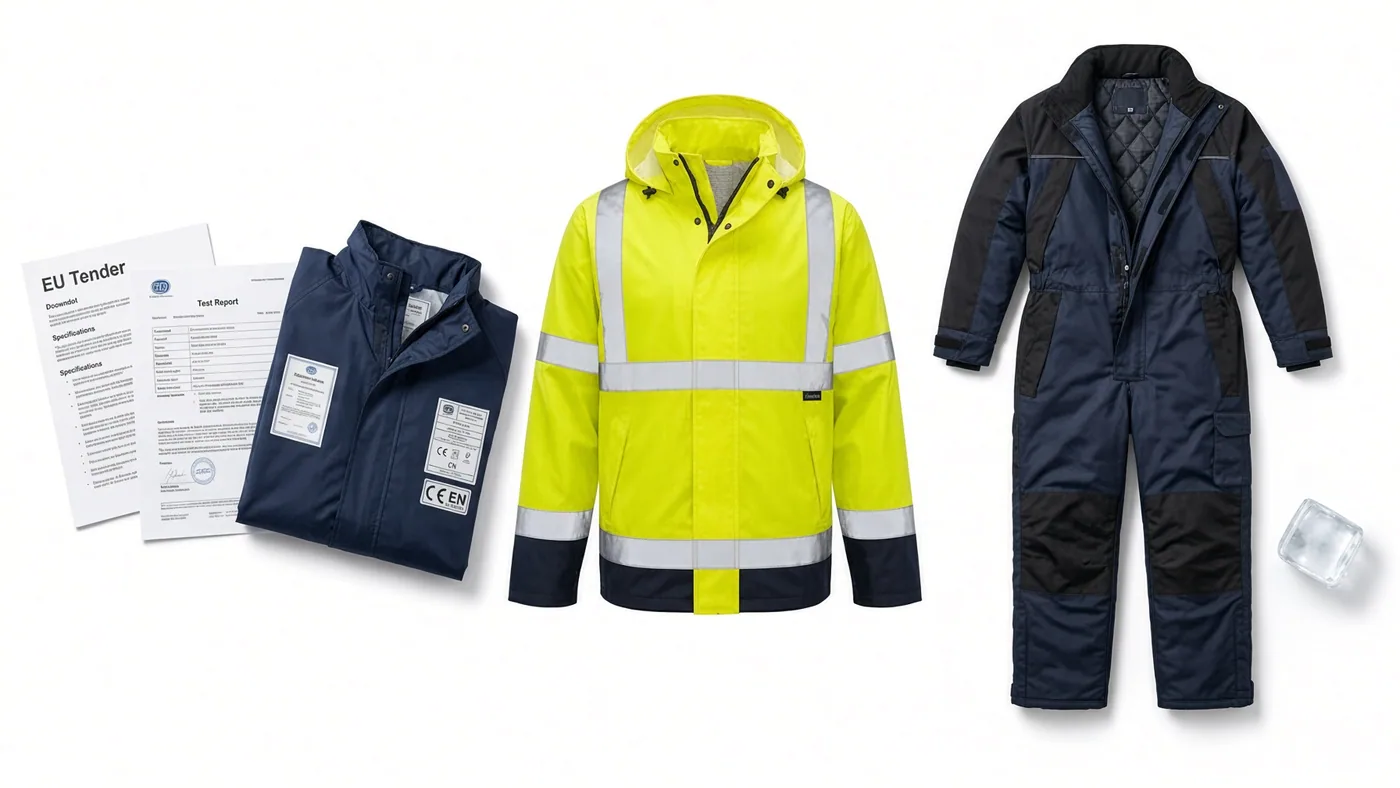
The same standard leads to different decisions depending on exposure, activity, and companion claims. Most rainwear briefs fall into one of three patterns.
Scenario 1: EU Tender or Framework Agreement
For EU bids, put EN 343:2019, EN ISO 24232:2025, the Wp/Ret classes, and the R requirement in the bid text. Ask for the named-style report with pretreatments and seam results, and reject a fabric certificate offered as a class claim.
The main risk is a verbal spec change after award, so check the report edition against the tender text. The workwear certifications guide explains how reports, declarations, and certificates fit together.
Scenario 2: Hi-Vis Rainwear Program
Treat rain and visibility as two claims. EN 343 sets the Wp and Ret classes; EN ISO 20471 sets the fluorescent and retroreflective areas. Reflective tape can block seam sealing, each segmented break needs its own seal, and hi-vis colours can limit fabric choice.
EN 343 alone is usually a Category I claim under PPE Regulation (EU) 2016/425. The visibility claim moves the finished garment to Category II, which adds a notified-body route.
Specify the classes on the final garment, not the shell, because tape, pockets, and branding change the result. The EN ISO 20471 hi-vis materials guide covers visibility, and an R result is the best construction proof here.
Scenario 3: Cold-Weather Rainwear Program
Keep EN 14058 and EN 343 separate; EN 14058 does not carry a rain claim.
Insulation and liners change Ret, so test the complete stack, which can also change MOQ and lead time.
Active crews in mild climates often do better with a Class 3 Wp shell and a higher Ret class than with a Class 4 shell that scores poorly on Ret. For coveralls, see the coverall safety standards guide.
Which Target Fits the Brief?
| Brief | Set these targets | Require this proof | Main risk |
|---|---|---|---|
| EU tender | EN 343:2019 + EN ISO 24232:2025; Wp/Ret/R named | Named-style report under the factory’s legal entity; seam and pretreatment results | Spec change after award; wrong standard edition |
| Hi-vis program | EN 343 + EN ISO 20471 as two claims | Separate reports; rain tower if construction proof is needed | Tape blocks seam sealing; visibility area measured on the wrong size |
| Cold-weather program | EN 14058 + separate EN 343 claim | Ret on the full stack; cold report on the final style | Insulation drops Ret; assumed rain claim |
Turn the Spec into an RFQ Checklist
The checklist below turns the spec into pass/fail rules your procurement team can enforce:
- For EU bids, name both EN 343:2019 and EN ISO 24232:2025. Decision (EU) 2026/2505 keeps EN 343:2019 listed until 4 March 2028.
- State target Wp and Ret classes and whether R is required.
- Require material and seam Wp after the applicable pretreatments.
- Require Ret on the complete garment stack.
- Require the test report in the factory’s legal name, for the named style, and for the stated standard edition.
- Add EN ISO 20471, EN 342, or EN 14058 as separate claims where the use case needs them.
- Prohibit suppliers from converting a fabric report into a garment claim.
- Apply one rule across claims: no named-style report, no class claim.
What Still Goes Wrong?
Some failures survive a correct spec. A report can be real and still miss the seam, pocket, or logo zone. Ret can pass on the shell and fail once the liner and tape go in.
Others omit the style, the standard edition, or the factory’s legal entity, which fails an audit even when the test was done.
Prefer a lab accredited to ISO/IEC 17025:2017, then check the report scope. If you cannot verify the lab or the factory yourself, book a third-party uniform inspection. Either way, the report has to match the style in the order.
Frequently Asked Questions about EN 343 Waterproof Workwear
Short answers to the questions buyers ask before a rainwear RFQ.
1. Does EN 343 mean a jacket is waterproof?
EN 343 is a rain-protection standard, but the label does not mean every part is sealed. The mandatory tests cover material and seams. Check the Wp class, the Ret class, and whether the style carries an R mark.
2. What do the two numbers on an EN 343 label mean?
The first number is the water penetration class (Wp), the second the water-vapour resistance class (Ret). Both run from 1 to 4. Wp works upward; Ret works in reverse, so a lower value earns a higher class and better breathability.
3. What does R or X mean on an EN 343 label?
R means the finished garment passed the optional rain-tower simulation. X means that test was not run; it is not a fail, and it does not change the Wp or Ret classes.
4. Is EN 343:2019 still valid in the EU?
Yes, it stays listed for EU presumption until 4 March 2028. After that, treat EN ISO 24232:2025 as the reference for new bids.
5. Does EN ISO 24232 replace EN 343?
At standards level, yes: EN ISO 24232:2025 adopts ISO 24232:2024 and supersedes EN 343:2019. The EU switch is staggered, so check the bid text before you drop the old reference.
6. Can a fabric certificate be used as an EN 343 claim?
No. A mill certificate covers a material swatch, not the named style. Ask for a report issued under the factory’s legal entity, naming the style, edition, pretreatments, seams, and rain-tower status.
7. What is the difference between EN 343 and EN 14058?
EN 343 covers protection against rain. EN 14058 covers cool environments and does not automatically carry a rain claim. A jacket can meet both, but both claims need their own test reports on the final style.
8. How should I write EN 343 into an RFQ?
Name the standard edition, Wp/Ret targets, and whether R is required. Require material and seam results after pretreatment, Ret on the complete stack, and a named-style report from the factory itself. Add companion standards as separate claims.
Conclusion: Prove the Style You Ship
EN 343 waterproof workwear is only as credible as the tested material, the tested seams, the complete stack, and the paperwork behind it. A strong mill test can still hide a leaking pocket, an untaped cross-seam, or a Ret class that drops after the liner and branding go in.
Three steps protect your program: choose the Wp/Ret target for the real exposure, verify seams and pretreatments on the assembled style, and demand a named-style report before production. In QC and OEM reviews, one rule holds: no report, no claim.
If you are sourcing rainwear, send your RFQ and target Wp/Ret classes to our team for review. We will check the spec against the proof the style needs.
LantaoWork is a China-based contract workwear manufacturer. We quote on waterproof and multi-standard programs like the ones in this guide, so we may benefit if you send us an RFQ. This article is sourcing guidance, not a lab certificate, and not legal advice.
Related capabilities: Workwear manufacturing | Custom coveralls | Pilot sampling | Private labeling

Leave a Comment
Your email address will not be published. Required fields are marked *