Table of Contents
The short answer: For FR/AR work: Atlas, Keltek, Northland. Big Bill for mixed fleets; Calko and Louis Hébert for contract programs; Wildrose for western Canada. Sew-Wear’s quilted style is non-FR.
One weak winter coverall program can fail audits, endanger crews, and raise replacement costs in oil, mining, and construction. This shortlist of insulated coverall manufacturers in Canada covers cold-weather industrial use, not a catalog tour.
We checked the official website and product pages for seven of the eight companies on 18 November 2026 against five criteria: Canadian market relevance, insulated-coverall depth, FR/AR and CSA Z96 suitability, customization, and procurement transparency.
We did not request samples or audit any factory, so specifications are the companies’ published claims, not independent tests. Desk-verified means the official pages list the model, materials, and certification claims; re-confirm each SKU before signing.
LantaoWork manufactures coveralls and competes with several companies below; no brand paid for placement.
Insulated Coverall Manufacturers Canada at a Glance
The table compares all eight on the model to request, origin evidence, FR/CSA Z96 status, and the one caution to verify before an RFQ.
| Company | Best for | Location | Model to ask for | Origin evidence / caution | FR status and standards |
|---|---|---|---|---|---|
| Atlas Workwear | FR/AR oil, gas and utilities | Edmonton, AB | Guardian FR/AR Hi Vis Insulated Coverall, style 21954 | Canadian-owned; sewing location not stated; distributor sales, check SKU certificates and stock | FR/AR; UL certified to NFPA 2112; CSA Z96 Class 3 Level 2; ATPV 56 cal/cm² |
| Big Bill | Mixed-trade fleets and familiar sizing | Coaticook, QC | 837 Premium Twill Insulated Coverall; M800USD Westex Ultra Soft | Made-in-Canada section; Quebec plants; some lines made in Mexico, check each label | Insulated; M800USD is arc-rated |
| Keltek | Canadian-made FR with model-level paperwork | Morden, MB | CSA FR insulated coverall | Product page states Made in Canada; check style and ATPV report | FR; CSA Z96 Class 3 Level 2; ATPV 40.3 cal/cm²; PPE Cat 4 |
| Calko Group | Contract supply and custom industrial outerwear | Montreal, QC | Lined industrial and 3-in-1 hi-vis lines; request the model | Montreal plant, 250,000 sq ft; nearshore/overseas capacity, check country per model | Insulated; FR/AR options listed |
| Louis Hébert | Quebec-made winter FR | Laval, QC | Winter FR coverall; request the current model | Quebec production; check model certificate and fill weight | FR; 10 oz 88/12 shell with modacrylic insulation |
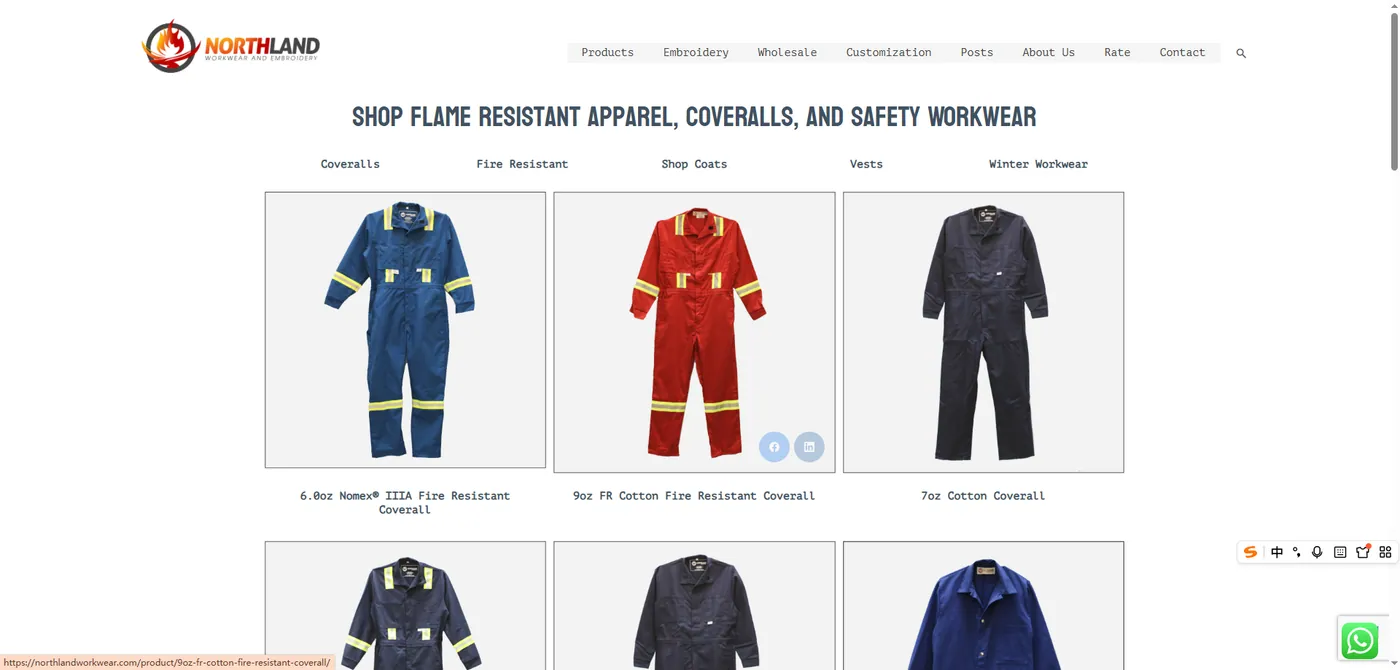
| Northland Workwear | Rugged cold-weather jobsite coverage | Edmonton, AB | Nomex IIIA Insulated FR Coverall | In-house since 1989; Made in Canada; verify CSA Z96 class and shell weight | FR; NFPA 2112 and ASTM F1506; reflective tape |
| Sew-Wear | Small-batch cut-and-sew and private label | Canada (confirm factory) | Quilted coverall; request the current style | Canadian brand; factory unconfirmed; do not use where FR is required | Insulated, not FR |
| Wildrose Garments | Regional western Canada contract sewing | Edmonton, AB | Insulated and welder coveralls; request the model | 100% Canadian-made positioning; Edmonton plant; check FR/hi-vis stock depth | Insulated; Nomex 3A, Indura and Proban versions listed |
1. Atlas Workwear: Arc-Rated Depth for Oil, Gas and Utilities
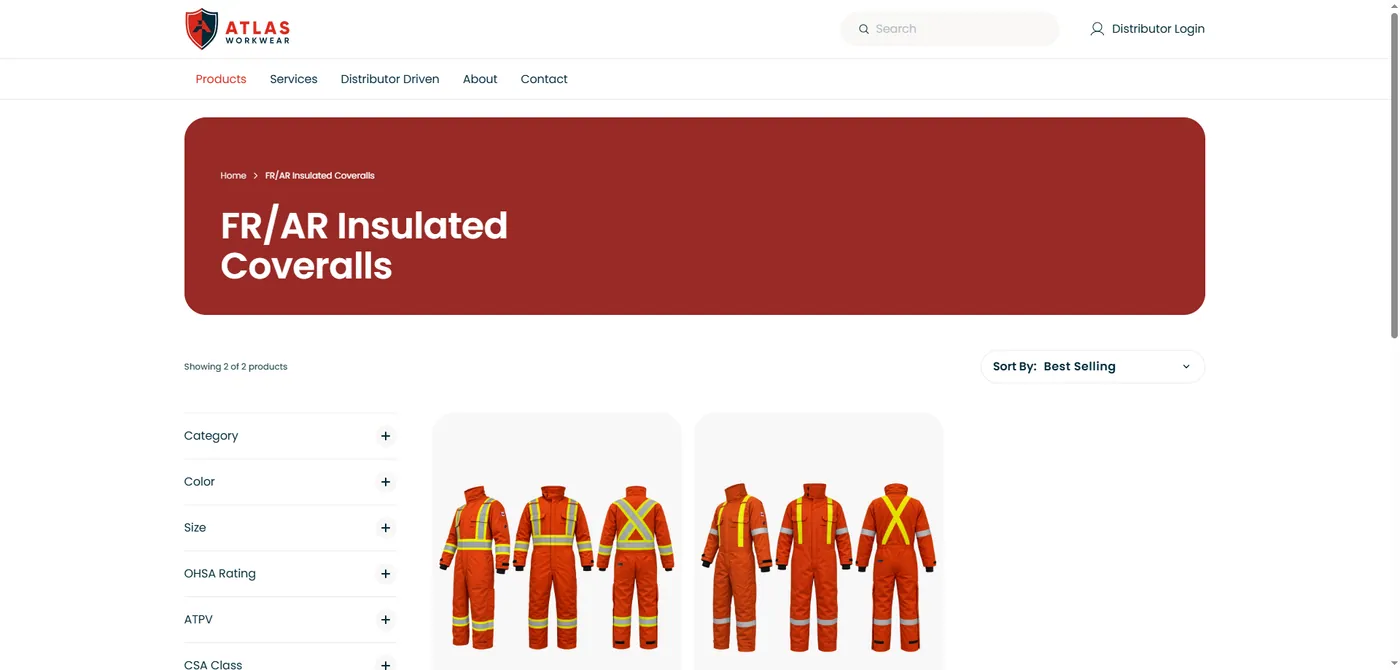
Warmth is not the spec that gets a winter coverall approved. Arc rating, FR trims, and documented visibility are. Atlas Workwear comes first because its Guardian line is built for dual-hazard FR/AR work in oil and gas, utilities, and mining, and electrical contracting.
The SKU to review is the Atlas Guardian FR/AR Hi Vis Insulated Coverall, style 21954. Atlas publishes an ATPV of 56 cal/cm² (CAT 4), UL certification to NFPA 2112, and compliance claims against NFPA 70E, ASTM F1506, CSA Z462, CSA Z96, and EN ISO 11611/11612/14116.
The garment page lists a pre-shrunk 8 oz 88% cotton / 12% nylon shell, 14 oz FR modacrylic insulation, and CSA Z96-22 Class 3 Level 2 reflective striping. Sizes run XS–7XL in regular and tall.
Atlas sells through Canadian distributors, so stock and lead time depend on the distributor. Treat the entry as a documentation test, not a product browse. Run our checklist on every quote you send:
- Exact insulated-coverall SKU
- FR fabric, trims, and arc rating
- CSA Z96 visibility status for that SKU
- Manufacturing origin, distributor access, MOQ, and replenishment lead time
“FR” on a line sheet means nothing if the zipper tape, reflective tape, or thread is wrong. A great coverall that cannot be replenished in February is a liability. The approval test is paperwork tied to style 21954, not the Atlas name.
2. Big Bill: The Familiar Label for Mixed-Trade Fleets
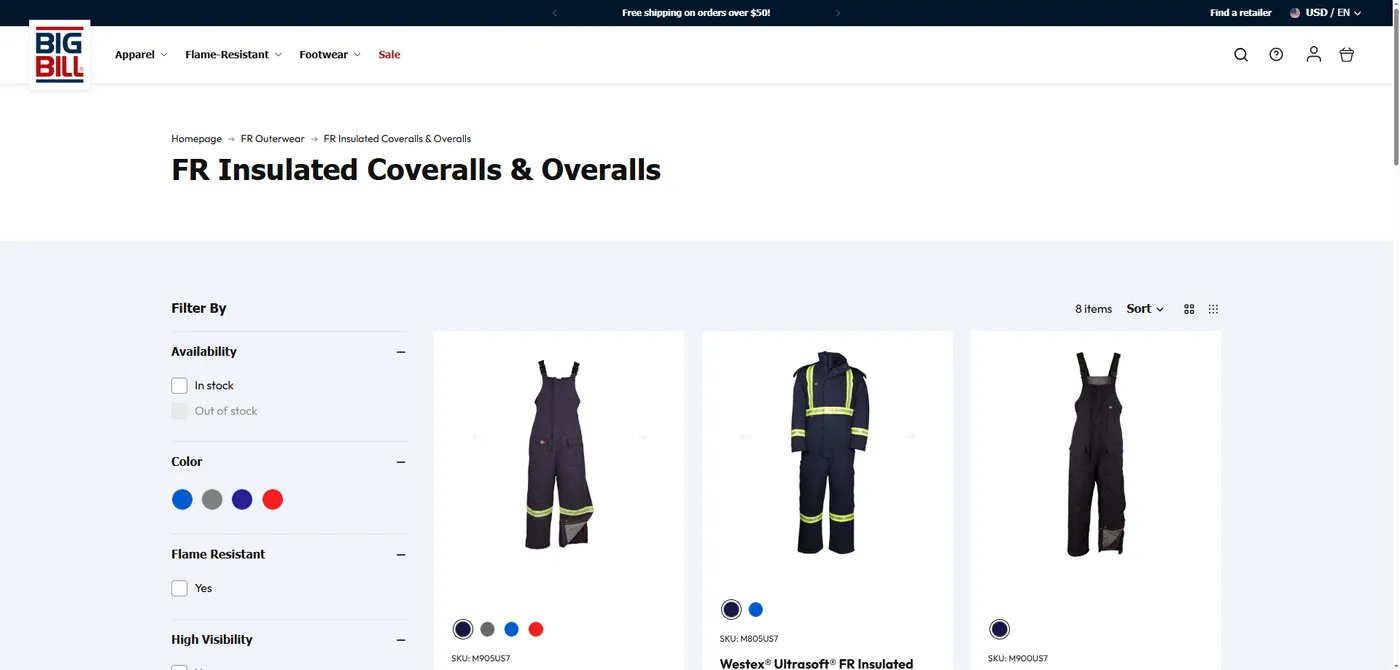
Big Bill is one of the best-known Canadian workwear names. The label makes it a familiar anchor for mixed crews, not proof every winter coverall is the same. On a shortlist of insulated coverall manufacturers in Canada, it stands out because supervisors know the label.
The company was founded in Coaticook, Quebec, and its made-in-Canada page lists insulated styles including the 837 Premium Twill Insulated Coverall and the M800USD Westex Ultra Soft Duck Insulated Coverall, which is arc-rated.
Big Bill also states that some coverall lines are made in Mexico. Country of origin therefore depends on the SKU, not the brand.
Big Bill suits mixed trades: construction divisions, yards, transport, agriculture, and general outdoor work. Supervisors know the fit, workers accept the label, and repeat ordering is easier across crews.
Before you award, pull SKU-level proof: made-in-Canada status by model, shell, insulation weight, high-vis or FR options, zipper durability, tall sizes, and stock continuity.
Check the origin tag on every box, and run our construction workwear checklist if fit concerns surface. Big Bill is a fleet benchmark, not a blanket approval.
3. Keltek: Made-in-Canada FR With Model-Level Paperwork
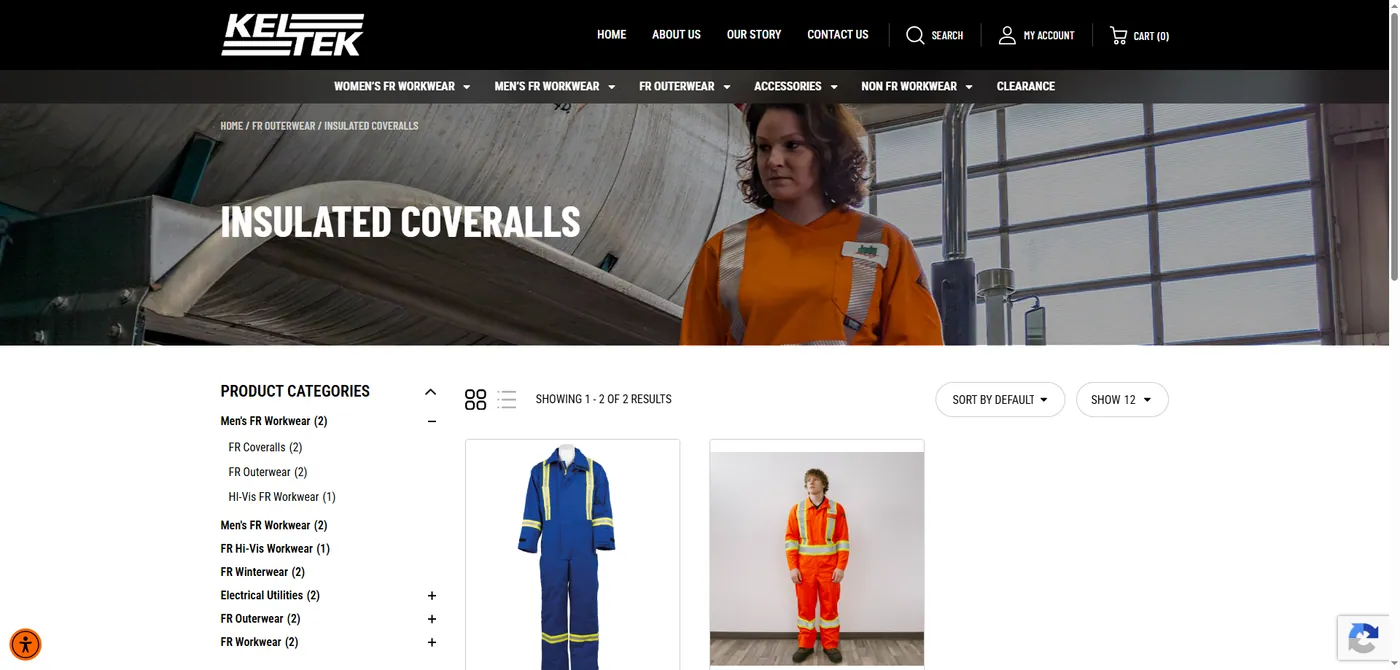
A warm coverall can still fail the hazard review. Keltek fits when insulated winter wear must combine cold-weather insulation with flame or arc protection. This is not a general winter-comfort garment.
Keltek’s CSA FR insulated coverall is a dedicated winter FR garment. The product page lists a 9 oz 88% cotton / 12% high-tenacity nylon shell, 7 oz FR modacrylic insulation, CSA Z96 Class 3 Level 2 reflective trim, Nomex thread, and Nomex-taped brass zippers.
It is rated to NFPA 70E PPE Category 4, with an ATPV of 40.3 cal/cm². The product page states Made in Canada, and the company is based in Morden, Manitoba.
Interrogate the model before buying:
- Confirm ATPV and CAT level.
- Check FR lining, insulation, zipper tape, reflective tape, and thread compatibility.
- Get laundering limits and logo or embroidery rules in writing.
- Check men’s and women’s fits by model and size range.
Keltek is a serious Canadian-made FR winter coverall option when your team can read the spec sheet. If the seller cannot tie ATPV, CAT, lining, trims, wash limits, and fit data to the exact SKU, keep shopping.
4. Calko Group: Custom Industrial Outerwear and Contract Supply
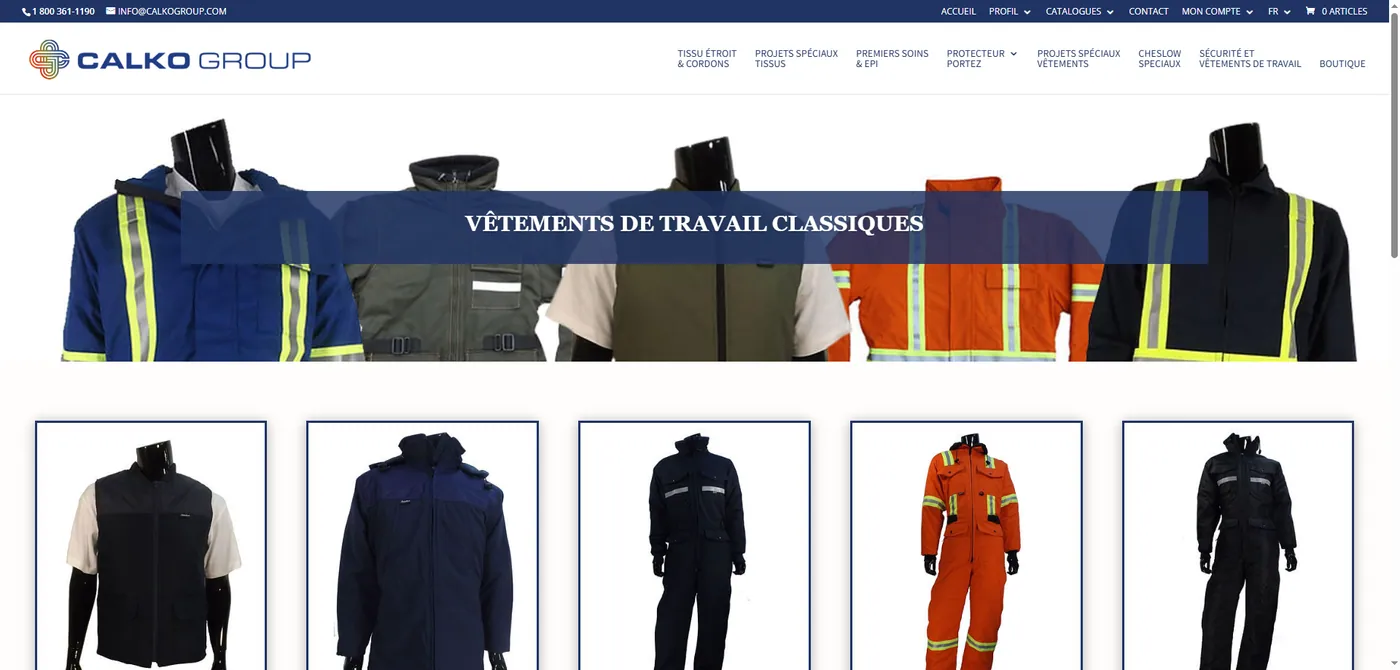
Off-the-shelf winter coveralls rarely fit a multi-site industrial program. Calko Group belongs on a shortlist for contract supply and customization, not just as a stock order.
It is a Montreal manufacturer founded in 1954, with a 250,000 sq ft plant, and it acquired Confection Lamartine in 2024, adding cold-weather workwear capacity.
Its safety and workwear line lists lined industrial and protective clothing, 3-in-1 hi-vis for northern mining, extreme-cold parkas, and FR/AR options.
Calko also uses nearshore and overseas capacity, so confirm whether your model comes from the Montreal plant. Treat Calko as a program partner, then verify the operating model.
Before quoting, confirm four things. Is Calko the manufacturer, assembler, importer, or distributor for this model? Which insulation and shell fabrics can they source? Do they offer CSA Z96 or FR pathways for the model? How do they control decoration, MOQ, price breaks, and order response?
Calko merits a formal RFQ when a program needs flexible contract supply and custom industrial outerwear. Verify the operating model and the production country first, then lock MOQ, price breaks, and lead time.
5. Louis Hébert: Quebec-Made Winter FR Coveralls
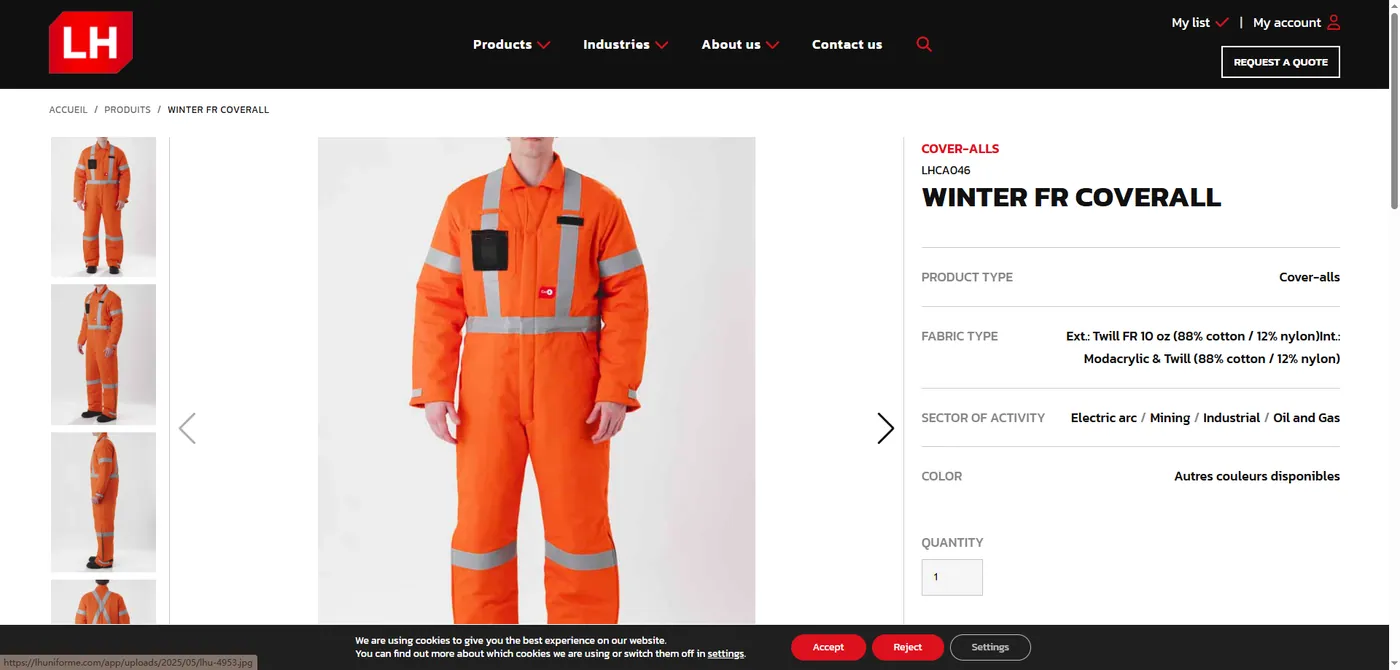
A single winter coverall order is easy. Keeping a multi-site program in compliant, matching winter PPE is not.
Louis Hébert is a Laval, Quebec manufacturer founded in 1966; its flame-resistant division dates to 2006, and it supplies custom uniform and protective-equipment programs from its Quebec production.
The winter FR coverall to ask about uses a 10 oz 88/12 outer shell with modacrylic insulation, made in Quebec. Louis Hébert’s coverall collection also lists Nomex IIIA, arc-resistant, and welder models, which makes the model number the first question, not the brand.
Do not confuse catalog breadth with winter depth. Before you quote, confirm:
- Insulated-coverall SKU depth and exact model number
- Private-label versus stocked supply
- Model-level FR certification, fill weight, shell, lining, and size curve
- Delivery, replenishment, and cross-site standardization, following CCOHS PPE guidance before the pilot
Treat this as a program review, not a blind product buy. Verify fill weight, shell, size curve, and replenishment in writing; if those answers do not come, make it a secondary bid.
6. Northland Workwear: Rugged Cold-Weather Jobsite Coverage
Cold stress peaks on full outdoor shifts, and CCOHS publishes the thresholds crews should follow.
Northland Workwear & Embroidery Ltd. is an Edmonton manufacturer that has sewn in-house since 1989 and supplies FR coveralls, parkas, and bib overalls to oil and gas, firefighting, utilities, and trades across Alberta and northern BC.
It fits municipal operations, outdoor maintenance, and construction support teams that need dependable stock.
This is not Big Bill’s licensed Northland Duck coverall; the two are separate product lines.
The model to review is the Nomex IIIA Insulated FR Coverall. Northland lists a 6 oz Nomex IIIA shell, FR modacrylic quilted insulation, NFPA 2112 and ASTM F1506 certification, reflective tape, and dual brass breakaway zippers. Sizes run S–4XL with lengths from 36R to 64T, and the product page states Made in Canada.
Its wholesale page lists dealer accounts with no minimum order and a two-to-three-week turnaround; confirm that applies to the order size.
Verify these before quoting:
- Shell weight and abrasion resistance in gsm
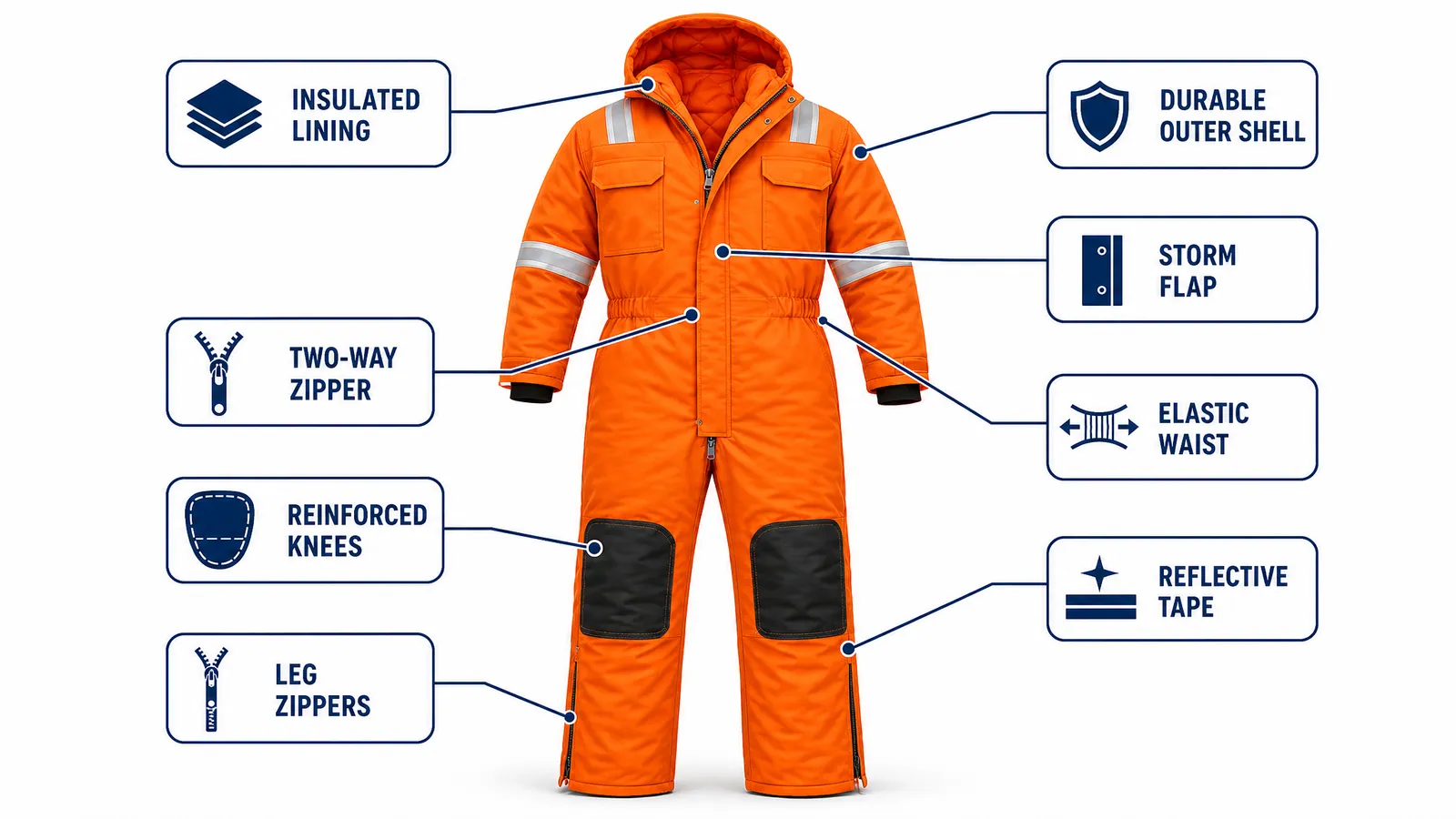
- Reinforced knees, cuffs, and pocket edges; storm flaps; two-way and leg zips
- Reflective layout mapped to CSA Z96 classes
- Sizing across the curve and stock continuity through February
For construction support teams, tie the review to construction infrastructure needs and ask for replenishment dates in writing.
7. Sew-Wear: Small-Batch Cut-and-Sew and Private Label
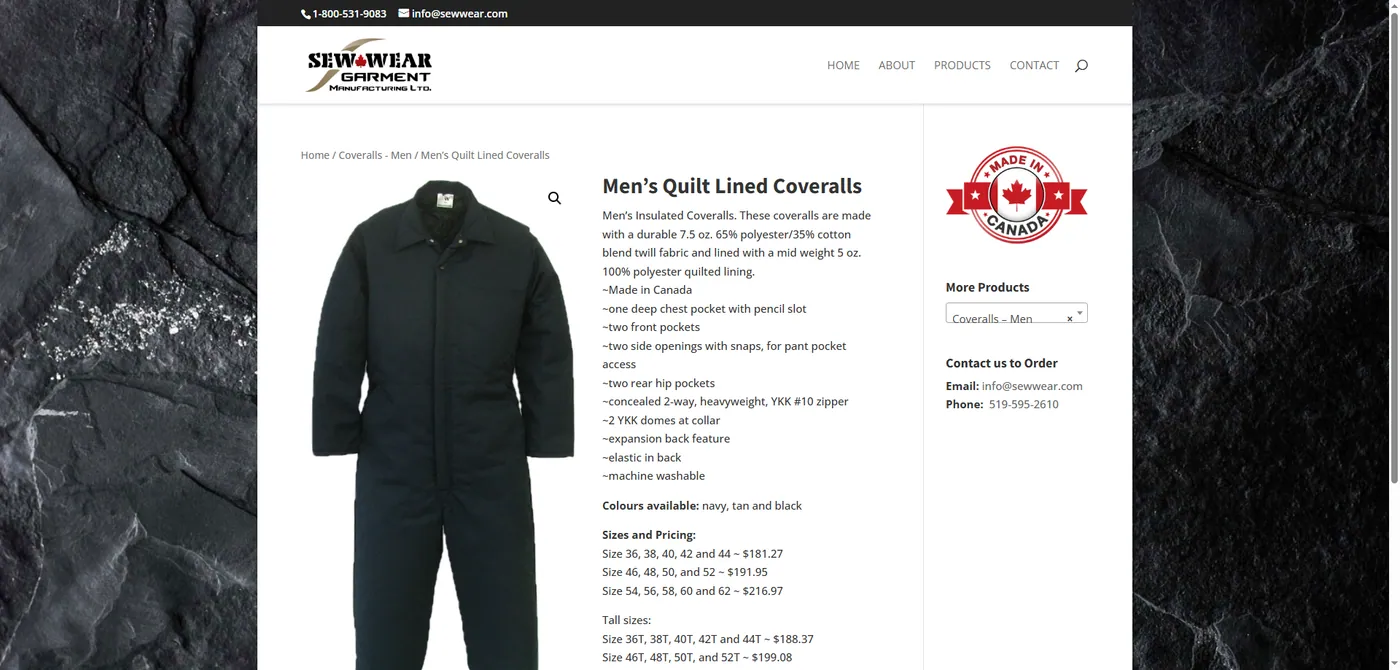
Mass-market branding does not solve a fit problem. For a shortlist of insulated coverall manufacturers in Canada, Sew-Wear matters when a program needs pattern tweaks, private-label trims, or a faster development loop. It fits prototype iterations and smaller runs, not just a logo on a stock garment.
One warning matters most: the quilted coverall is an insulated, non-FR style. Do not put it into an FR/AR program. For general cold-weather work it is a candidate; for arc flash or flash fire, ask for a different model and the test report that covers it.
We have not confirmed the factory behind that style; treat this as a brand-level lead, not a verified manufacturing source.
Ask custom-program questions on the first call. Can Sew-Wear adjust fit by size range, source private-label zippers and trims, and map reflective tape to the CSA Z96 layout? If the factory avoids sealed-sample commitments, treat that as a red flag.
Use this buyer-verification checklist before sampling:
- Decoration method and FR thread or tape compatibility
- Sealed, signed-off samples
- Packaging, carton labeling, and wash performance
- Escalation path, factory ownership, and OEM decision criteria
Sew-Wear is worth a formal RFQ when customization and smaller-batch agility matter more than brand recognition. Do not approve production without signed samples, FR decoration proof, packaging specs, wash data, and a named escalation contact.
8. Wildrose Garments: Regional Contract Sewing in Western Canada
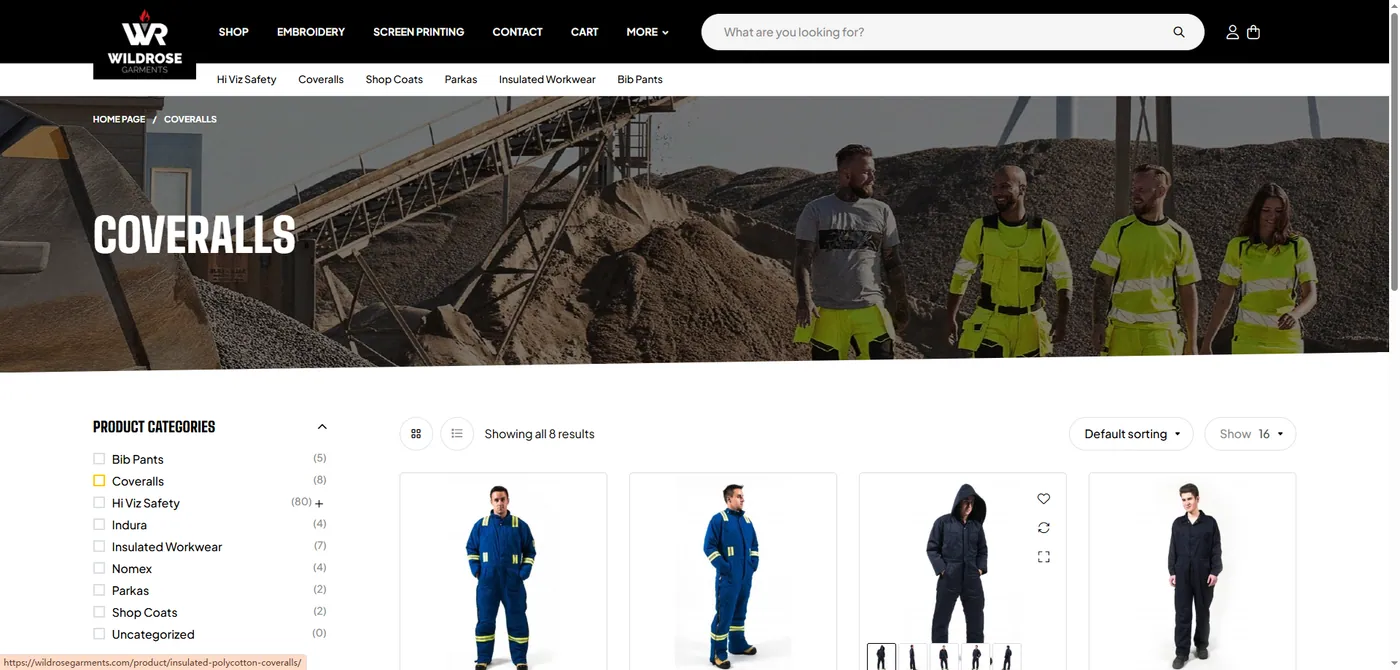
Wildrose Garments Mfg. Ltd. suits a niche buyer in a Canadian insulated-coverall review: one who needs quick answers, local replenishment, and contract sewing close to rollout. It is an Edmonton manufacturer founded in 1989, and it markets itself as 100% Canadian-made rather than imported assembly.
Its range includes coveralls, welder styles, parkas, and insulated or high-visibility workwear, with Nomex 3A, Indura, and Proban versions listed.
It also offers embroidery and screen printing from the Edmonton plant. If your winter program includes specialized runs or closer sampling communication, put Wildrose on the review list.
Confirm these before sending a sample PO:
- Insulated coveralls as a core product
- Certified winter PPE depth by SKU, including CSA Z96 hi-vis
- Domestic production share, pattern and grading, women’s sizing
- Service level after delivery
Do not assume local means deep winter stock. Regional makers often communicate faster but carry thinner FR or high-vis inventory. Get proof in writing, and ask for the production floor contact before you book a sample slot. If coveralls are not a core SKU, test one sample before any fleet order.
How to Build a Winter Coverall Procurement Plan That Meets Compliance?
Match the program type to the first call:
| Program | First call | Why |
|---|---|---|
| FR/AR winter work in oil, gas, utilities | Atlas, Keltek, Northland | Published FR and flash-fire specs; confirm the arc rating per SKU |
| Mixed-trade fleet with familiar sizing | Big Bill | Broad distribution and a recognized label |
| Contract supply across provinces | Calko | Montreal plant plus contract capacity |
| Quebec-made FR with local production | Louis Hébert | Laval plant and an FR model line |
| Small-batch custom or private label | Sew-Wear | Cut-and-sew flexibility; its quilted coverall is non-FR |
| Regional western Canada supply | Wildrose | Edmonton contract sewing |
A shortlist is not a procurement plan. Start with the job, not the catalog. Before requesting a quote, write down six facts: jobsite temperature band, exposure time per shift, activity level, precipitation, visibility risk, and whether the garment is general winter workwear, CSA Z96 hi-vis PPE, or FR/AR PPE.
Warmth is a comfort spec; compliance is a documentation spec. A warm coverall can still fail an arc-flash or visibility audit.
Step 1: Define Your Hazard and Climate Profile
- Record the coldest expected temperature and wind chill.
- Estimate continuous outdoor time, sweat rate, rain, snow, and wet-spray exposure.
- Map traffic and equipment visibility risks.
- Map each hazard to its standard: CSA Z96 for high visibility, CSA Z462 and NFPA 70E for arc flash, and NFPA 2112 or CGSB 155.20 for flash fire.
Step 2: Build the RFQ Checklist
Send every supplier the same checklist. It makes replies comparable and exposes gaps.
- Style and fabric. SKU, shell fiber and gsm, insulation fill weight and loft.
- Construction. Reinforcement zones, two-way and leg zips, storm flaps, FR tape.
- Size and labels. Men’s, women’s, tall; care and size labels.
- Laundering. Wash temperature, cycle limits, and dry instructions; follow NFPA 2113 care guidance and our coverall care guide.
- Commercial terms. MOQ, price breaks, lead time for each model, February stock.
- Documents. CSA Z96, CSA Z462, NFPA 70E, NFPA 2112, ASTM F1506, or CGSB 155.20 as relevant.
Step 3: Verify the Supplier and Sourcing Model
Ask if the supplier is a manufacturer, importer, or broker. The answer changes lead time, accountability, and replacement cost.
Before comparing quotes, run the scope through our best custom workwear manufacturers list and the how to choose a custom workwear manufacturer checklist so every supplier answers the same questions.
For FR garments, control the logo and embroidery: non-FR thread or backing can void protection. Heavy winter FR coveralls also trap sweat, and wet insulation loses loft, so check wicking liners and vent placement on every sample.
Price and schedule belong in the same RFQ. Use our bulk wholesale workwear pricing guide to compare quotes like for like, and custom workwear MOQ to size the order.
Lock custom workwear production time by model before the PO.
Step 4: Place a Controlled Pilot Order
Order a small pilot batch, custom or stock. Test fit, warmth, moisture, and visibility on site. Only then scale to a full rollout. Log the results against the RFQ checklist and resolve any spec gap with LantaoWork before the fleet order.
Terms used in this guide.
- ATPV. Arc thermal performance value, in cal/cm², from an arc-rating test.
- CAT / PPE category. The NFPA 70E arc-flash PPE category linked to an arc rating.
- CSA Z96. The Canadian high-visibility apparel standard, with classes and levels.
- NFPA 2112. The US garment standard for protection from flash fire.
- CGSB 155.20. The Canadian workwear standard for protection against hydrocarbon flash fire and occasional flame.
- FR and AR. Flame-resistant garments resist ignition; arc-rated garments carry a measured ATPV. A garment can be one without the other.
FAQs About Insulated Coverall Manufacturers in Canada
1. Are these companies actual manufacturers, brand owners, or distributors?
Not always. Some own the sewing floor, some assemble from imported shells, and some only distribute. The mix changes lead time and accountability.
Before awarding volume, confirm the SKU, country of origin per model, and who owns the production line. Ask for the factory name in writing; if the seller stalls, treat the bid as a reseller offer.
2. What standards matter most for winter safety coveralls in Canada?
It depends on the hazard. For visibility, the program needs CSA Z96 class and test data tied to the exact SKU.
For arc flash, check CSA Z462 and NFPA 70E plus the ATPV and CAT rating.
For flash fire or occasional flame, ask for NFPA 2112 or CGSB 155.20, the Canadian workwear standard. Warmth never replaces these documents.
3. Can I add logos to FR insulated coveralls without affecting compliance?
Yes, but only if the decoration is validated. Standard polyester thread, fusible backing, or a glued patch can void FR protection. Ask the supplier to approve the method, thread, backing, and placement in writing for that SKU; if they cannot name an approved method, move the logo to a non-FR outer layer.
4. Should I buy from a Canadian supplier or a custom overseas workwear factory?
Match the source to the timeline. Choose a Canadian supplier for fast replenishment, smaller local runs, or bilingual service; choose an overseas factory for OEM fit changes, private-label trims, and better MOQ efficiency on planned rollouts.
Overseas programs work best planned 90–120 days out with sealed samples locked early. Before committing to a wider uniform program, compare this shortlist with the USA coverall shortlist and map the remaining categories against your spec.
5. What is the warmest insulated coverall for Canadian winters?
There is no single warmest model. Warmth depends on fill weight and loft, the wind barrier, the liner, and the layers underneath. A heavier coverall worn during hard work can trap sweat and lose insulation value.
Ask for fill weight, shell weight, and the supported temperature range, then pilot the garment in the actual cold and activity level.
6. Is CSA Z96 the same as ANSI/ISEA 107?
No. CSA Z96 is the Canadian high-visibility standard; ANSI/ISEA 107 is the US counterpart. Their classes and levels are not interchangeable even when a garment carries both marks. Ask for the class, level, and reflective-trim test data on the SKU, and confirm the standard the jurisdiction requires.
7. How do I prove a coverall is made in Canada?
Ask for the origin label, cut-and-sew location, and domestic content by SKU. A brand-level “Made in Canada” statement is not SKU-level proof.
The Competition Bureau’s Made in Canada guidance sets the claim rules, so the supplier should explain which criteria it meets and back it with a written origin statement; check the first carton against it.
8. What MOQ and lead time should I expect for custom insulated coveralls?
Our quoted floor is 100 units per style. With custom dye or trims, the effective minimum often lands at 200–300.
Lead time is model-specific: get it in writing, and for overseas programs plan 90–120 days from sealed sample to delivery. Domestic stock moves faster, but confirm size and color before committing to a rollout date.

Leave a Comment
Your email address will not be published. Required fields are marked *