Table of Contents
The short answer Sedex is the platform; SMETA is the audit. A 2-pillar audit covers labor and safety; a 4-pillar adds environment and business ethics. Neither is a certificate — approval depends on report date, audited legal entity, the production site on your PO, and whether corrective actions have closed.
Last quarter, a compliance director sent me a factory approval pack: an audit PDF, a Sedex screenshot, and a quotation for 8,000 workwear sets. The audited legal entity did not match the sewing site on the quote.
The badge looked clean. The evidence did not hold. No one had checked the audit date, the site scope, or whether the corrective action plan had closed.
That pattern repeats. Senior buyers accept “we are Sedex audited” as verified proof. It is not. This guide to SMETA audits starts with the distinction: a Sedex login shows that documents were uploaded, not that the audit covers your site or your legal entity.
In workwear and enterprise sourcing, the cost lands on the brand: retailer onboarding stalls, claims collapse under scrutiny, and procurement teams rarely get a second attempt at the same factory.
This guide draws on official Sedex documentation, third-party audit practice, anonymized LantaoWork compliance data, and an expert briefing from a certified APSCA auditor.
The figures cover 15 CAPRs closed between 2024 and 2026 and four mock audits; they are internal observations, not industry averages. I receive no payment from Sedex or any audit firm. I have watched buyers approve factories on a screenshot alone.
A useful SMETA review is not about badges. It is about scope, evidence, and corrective-action closure — so this guide works through both pillar scopes, the audit sequence, what each scope costs, where a report stops being evidence, and the questions to ask before a PO moves.
What Is a SMETA Audit?
SMETA is a third-party social compliance audit of one production site. An approved audit company reviews records, tours the floor, interviews workers, and issues a report plus a corrective action plan.
Sedex vs SMETA
SMETA (Sedex Members Ethical Trade Audit) is an audit methodology, not a certification. It standardizes how a site is assessed for labor, health and safety, environment, and business ethics.
Sedex is a data-sharing platform for audit reports and self-assessment questionnaires (SAQs). Last month, a buyer sent me a supplier’s Sedex login as “proof of compliance.” It is not.
Membership only allows data sharing; the SAQ is self-reported. Think of Sedex as a library card: it gives access, not proof of reading. SMETA is the book report.
The methodology references the ETI Base Code and ILO labor standards. The current version is SMETA 7.0; the next section covers what changed.
The Two Pillar Scopes
Sedex audit requirements usually follow this baseline sequence:
- Register the site on Sedex.
- Complete the supplier profile and site data.
- Complete the SAQ accurately.
- Define the audit scope upfront: 2-pillar or 4-pillar.
- Book a third-party company on Sedex’s approved list.
- Share the resulting report and CAPR with linked buyers.
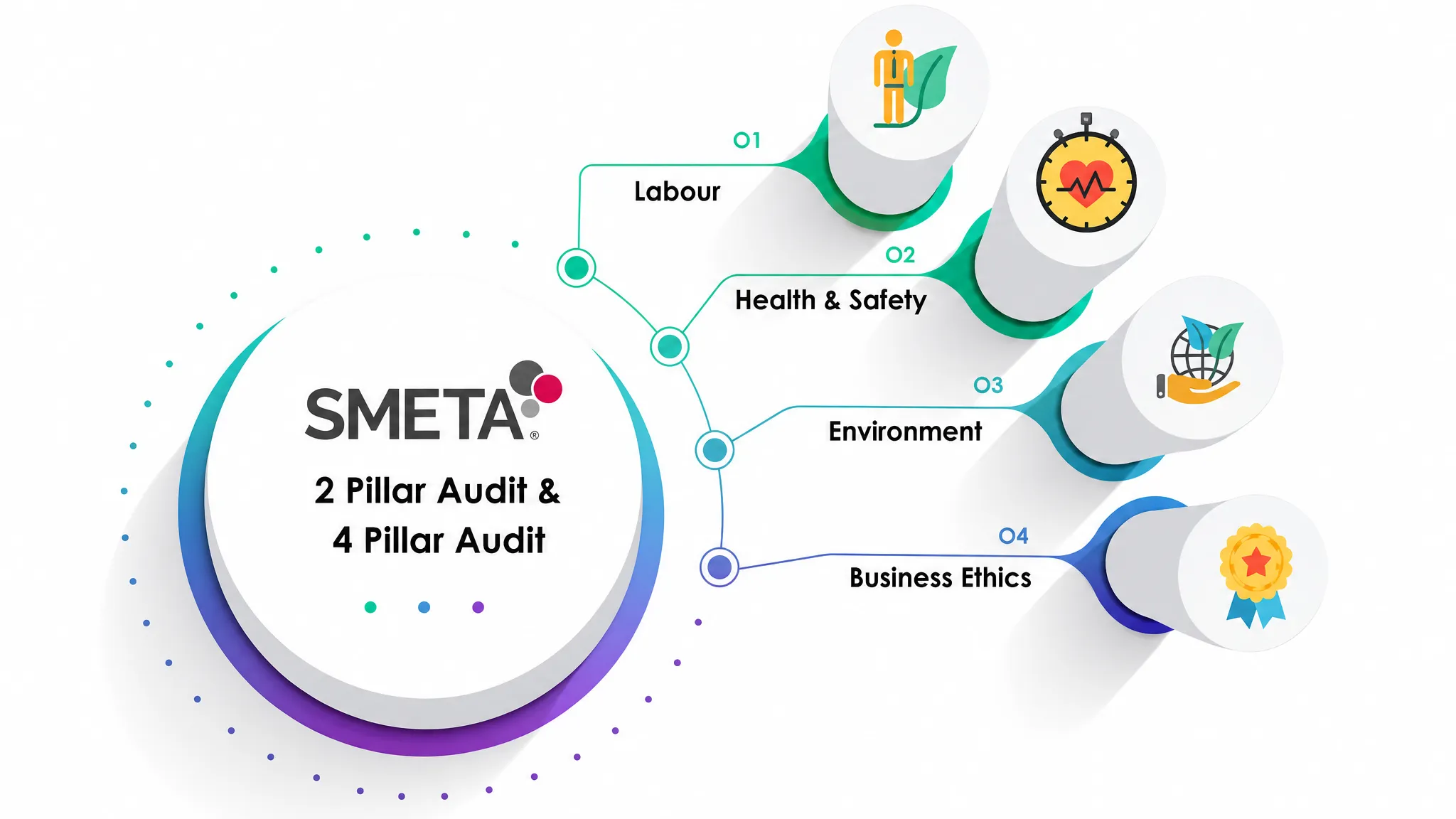
The two scopes differ by two pillars:
| Pillar | 2-Pillar | 4-Pillar |
|---|---|---|
| Labour Standards | ✓ | ✓ |
| Health & Safety | ✓ | ✓ |
| Environment | ✓ | |
| Business Ethics | ✓ |
One single-site factory chose 2-pillar to control cost; a multi-site group needed 4-pillar for three European buyers; a subcontract-heavy program had to define scope for every production location. The same choice applies to custom workwear and heavy industry programs.
What the Audit Produces
SMETA produces an audit report and a corrective action plan report (CAPR), not a certificate. Sedex-approved Affiliate Audit Companies perform the audit, and lead auditors hold APSCA registration.
The production manager on the sewing floor told me: “Buyers ask for a certificate. We show the CAPR. They don’t know the difference.” The auditor interviewed 15 workers over three days.
A CAPR lists every finding with a root cause, a fix, an owner, and a closure date. Worker interviews are part of the visit; a follow-up audit is an on-site check.
🧠 Author’s Take: The report is a snapshot of one visit. The CAPR is the part that predicts risk.
What Changed in SMETA 7.0?

SMETA 7.0 replaced the previous version in late 2024, and most reports issued now follow its structure. Four changes matter to a buyer reading the file.
| Change | What it means for the report |
|---|---|
| Four finding types | Non-Compliance (legal or regulatory breach), Non-Conformance (gap against the SMETA requirement), CAR (Collaborative Action Required), and Good Example |
| Four criticality levels | Business Critical, Critical, Major, Minor |
| Management Systems Assessment | A graded view of how the site manages compliance, not just what the audit found on the day |
| Semi-announced scheduling | Audits moved to semi-announced scheduling from July 2025, so preparation cannot be staged around a known date |
SMETA 7.0 separates a non-compliance (a legal or regulatory breach) from a non-conformance (a gap against the SMETA requirement). The auditor found 12 non-conformances at our Tuesday audit, and we closed the CAPR in 45 days.
Reports are normally uploaded to Sedex within 5 to 10 working days of the closing meeting. Sedex’s Complete SMETA Audit Guide sets out the full finding definitions and verification routes.
Inside the SMETA Audit: The Operating Playbook
https://www.youtube.com/watch?v=ZA0pIPM9LdU
Think of a SMETA audit as two engines bolted to one frame. The paper engine lives in Sedex Advance: the profile, the SAQ, the payroll files. The physical engine is the site itself: who is standing at which machine at 7:40am. The audit only holds up when both engines turn together.
We ran four mock audits on workwear sites in the past year, stopwatch in hand, and failures almost never came from the paperwork we expected. They come from the gap between what a document says and what a worker does at 9:15 on a Tuesday morning.
Here is the full sequence, the 30-day countdown, the red flags an auditor looks for, and the buyer-side checks that catch mismatched sites.
The End-to-End Audit Workflow
One live audit ran nine stages from first email to accepted closure: 61 days to CAPR issuance and another 45 to verified closure.
- Buyer requirement lands. Confirm the required scope and recency window (many buyers require reports less than 12 months old).
- Site setup in Sedex Advance. Verify the legal entity, address, and headcount.
- SAQ completion or refresh. The SAQ adapts to site size, so question counts vary. It covers labor, health and safety, environment, and business ethics. Every number you enter is cross-checkable. Our last refresh took 11 hours of reconciliation against payroll.
- Scope decision. 2-pillar or 4-pillar, in writing, before booking.
- Audit booking. Book a Sedex-approved Affiliate Audit Company with an APSCA-registered lead auditor.
- Document pack assembly. Stage everything the auditor will request.
- On-site audit. Opening meeting, site tour, document review, worker interviews, closing meeting. Allow 1 to 3 days depending on headcount. Worker interviews usually take 25 to 40 percent of the day, off the floor, in the local language, away from supervisors.
- Report upload and CAPR issuance.
- Evidence and closure. Non-compliance and non-conformance findings close only when the auditor accepts your submitted evidence.
The 30-Day Countdown
Day 30 to 21: Governance. Name one audit owner and one deputy. Freeze the site boundary: legal entity, workshop, warehouse, dormitory, canteen, subcontractors.
Then confirm the buyer’s scope and recency expectations. Pull prior findings and the repeat-issue log. Open a control tracker with owner, evidence location, and closure date.
Day 20 to 14: Payroll and working hours. Organize records by month and worker ID. Cross-check timecards, attendance, overtime, wage slips, bank transfers or cash acknowledgments, social insurance, and leave.
Then reconcile hours worked against hours paid. Flag manual edits, missing signatures, and off-ledger payments. Build an exception log with explanations.
A 500-worker factory generates at least 3,000 payroll records a month across six document types, and auditors spot-check a sample rather than the full set.
Day 13 to 10: Health and safety pack. Fire drills, extinguisher inspections, machine guarding, electrical inspections, first-aid training, PPE issuance logs, chemical inventory with SDS access, accident records, evacuation maps, emergency lighting, dormitory and canteen checks.
This is the record set OSHA’s safety-management guidance expects to see.
Day 9 to 7: Walk-through and worker communication. Run a mock tour at shift change, not mid-shift, when real traffic flow and exit discipline reveal themselves. Remove blocked exits, expired signage, broken guards, unlabeled chemicals, and locked egress.

Then test whether posted policy matches real practice. Brief supervisors on process, not scripts. Tell workers they hold confidential interview rights, and prohibit coaching in writing.
Day 6 to 3: Management systems. Review grievance channels, disciplinary policy, anti-harassment rules, recruitment controls, young-worker screening, and business ethics. For 4-pillar, add permits, waste manifests, wastewater and emissions controls, anti-bribery training logs, and whistleblowing records.
Then run a retrieval drill: any requested record in under 3 minutes. The SMETA methodology builds the labor and management-system items on the ETI Base Code; the 4-pillar additions follow local environmental law as well.
Day 2 to 0: Final readiness. Stage the master audit index on paper and on disk. Confirm translator, HR lead, EHS lead, payroll lead, and site map. Validate the worker roster against current headcount. Prepare an honest disclosure list of unresolved issues.
Want all four worksheets in one email instead? Write to info@lantaowork.com.
Three Red Flags an APSCA Auditor Looks For
A certified APSCA auditor, who asked that their firm not be named, described three signals that never appear in a public Sedex summary:
- Red flag 1: Records look clean, but real-time line staffing, shift-change behavior, or a production bottleneck suggests undeclared overtime pressure.
- Red flag 2: PPE is available but not integrated into actual workstation behavior. The auditor called this “performative compliance.”
- Red flag 3: Emergency preparedness exists on paper, yet drill routes, exit discipline, and worker recall collapse under live questioning.
A polished Sedex dashboard is not proof of compliance. It proves nothing until the auditor verifies behavior on the floor and tests it against the file.
Buyer-Side: Five Checks in Sedex Advance
- Request access to the supplier’s site profile.
- Confirm the exact legal entity and address.
- Verify audit scope and report date.
- Confirm uploaded evidence shows follow-up closure.
- Compare the audited site to the actual PO production location and nominated subcontractors.
That last check caught the mismatch in my opening example. Sourcing teams usually meet it during manufacturer shortlisting, long before MOQ and lead time are negotiated.
Choosing Scope and Cost: 2-Pillar vs 4-Pillar
I have watched buyers overpay for 4-pillar audits when 2-pillar cleared their risk. I have also seen buyers under-spec when their brand was exposed. Here is the decision lens I use with clients.
Where 2-Pillar Is Often Sufficient
Choose 2-pillar for initial screening, lower-risk categories, labor and safety basics, and buyers with limited sustainability reporting obligations. It covers the risks that cause most supplier failures.
Client support work shows 2-pillar audits close CAPRs faster. Average closure time ran 45 days for 2-pillar versus 68 days for 4-pillar. Most common root causes: working hours and PPE records.
Request CAPR closure evidence and the site profile before you approve. (Anonymized LantaoWork data, not universal industry averages.)
Where 4-Pillar Creates Stronger Value
Insist on 4-pillar for enterprise workwear with public ESG commitments, multi-country sourcing, exposure to environmental or anti-bribery scrutiny, and high-visibility corporate accounts.
Environment and business ethics coverage reduces the risk of reputational damage from bribery allegations, permitting failures, and environmental enforcement actions.
The same dataset shows 4-pillar CAPRs take longer, but verified closure gives you defensible claims. Most common root causes here: environmental permits and anti-bribery training.
A shared report also lets buyers compare sites on one criteria set, and one uniform program ran the same 4-pillar scope across four sites, cutting duplicate audit spend by roughly 18% in year one.
Decision Matrix
| Buyer scenario | Recommended scope | Why | Additional documents |
|---|---|---|---|
| Initial screening | 2-pillar | Cost-effective, core risks | CAPR closure, site profile |
| Lower-risk products | 2-pillar | Lower exposure | Recent report, SAQ |
| Enterprise ESG | 4-pillar | Defensible claims | Environmental permits, anti-bribery policy |
| Multi-country sourcing | 4-pillar | Consistency, reduced duplication | Site-by-site CAPRs |
Benchmark the current audit scope against buyer expectations before the next sourcing cycle. A mismatch can cost a contract, and scope reshapes which custom workwear manufacturers make your shortlist.
What a SMETA Audit Costs
Fees are quoted in auditor-days plus travel, not as a fixed product. Four things move the number: pillar scope, site count, the interview load that headcount creates, and whether closure needs a follow-up visit.
Compare quotes on auditor-days and deliverables, not the headline fee. The audit fee is rarely the expensive part; rework and air freight on a shipment approved without evidence cost more.
Broader Value
4-pillar coverage makes a sustainability claim easier to defend. The frame sits in the UN Guiding Principles on Business and Human Rights and the EU Corporate Sustainability Due Diligence Directive.
The Limits of a SMETA Report — and When to Escalate

A SMETA audit is evidence, not immunity. A January report with no overtime findings missed a June violation. It records one day of verification, not the future.
A Snapshot, Not a Permanent Badge
Many buyers require reports less than 12 months old. Conditions drift inside that window. One site passed in March with clean hours. By August, seasonal overtime pushed weekly hours past 60. The audit did not fail. It expired.
Sedex’s audit guide confirms reports are point-in-time, not certification. Sedex’s 2025 SMETA Evolution consultation treats a report as no longer robust evidence of current conditions after 24 months. That is the outer ceiling; buyer contracts usually shorten it. Re-check payroll and hours between audits.
Scope Gaps: The Audited Site May Not Be the Production Site
One audit covered a single legal entity. The PO named a different sewing unit. The report did not cover that satellite site. The subcontractor was not disclosed. One report does not cover sister factories, satellite units, or nominated subcontractors. Compare the audited site to the PO location.
The CAPR Trap: Closure Needs Verified Evidence
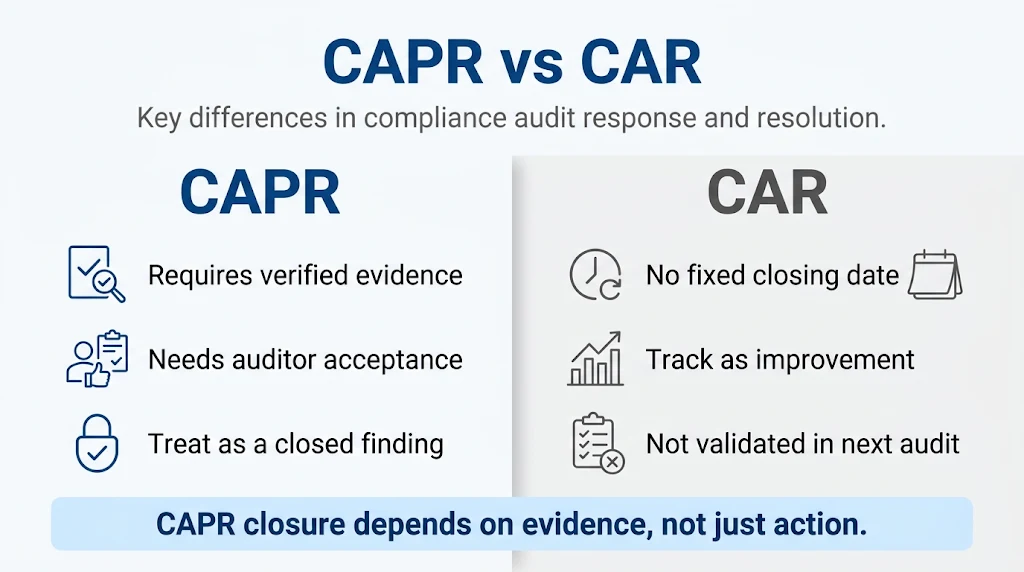
A CAPR is not proof of closure until the auditor accepts evidence. That applies to non-compliance and non-conformance findings.
A CAR (Collaborative Action Required) is different: it carries no fixed closing date and is not validated in the next follow-up audit, so track it as an improvement item rather than a closed finding.
In the same anonymized data, 4-pillar findings took about half again as long to close. Closure drags from permit delays, payroll remediation, safety retrofits, and ethics-policy rollout.
A robust CAPR needs a finding summary, root cause, correction, preventive action, owner, target date, evidence, and verification route. Read it critically:
- Does the root cause fix the system?
- Is the evidence dated after the fix?
- Did the auditor verify closure on site?
Fast closure often means superficial fixes; slow closure signals systemic change.
Factory Friction: Why Fixes Stall
Factories do not fail audits on purpose. Records sit across HR, finance, EHS, and production; seasonal overtime peaks before audits; upgrades cost capital and downtime.
One sewing operator answered in a dialect the translator could not follow, which added two days to the visit. Proving preventive action is harder than a one-time fix.
When to Escalate Beyond the Report
If the CAPR looks thin, escalate. Request a follow-up site visit, a focused payroll review, or subcontractor disclosure, and walk the PO site with a factory audit checklist yourself.
The report covers social compliance, not product performance. FR fabric and seam strength sit with a third-party inspection, not with the auditor.
Facing friction? Request a supplier-document review or factory-readiness consultation through our contact page.
Want both worksheets in one email? Write to info@lantaowork.com.
Frequently Asked Questions About SMETA Audits
1. Is SMETA a certification?
No. SMETA is an audit methodology. The output is an audit report plus a corrective action plan report (CAPR) uploaded to Sedex.
Certification is issued by a scheme against a standard such as SA8000 or ISO 14001, the way product certifications cover fabric and PPE. SMETA does not work that way, which is why buyers ask for the report and the CAPR rather than a logo.
2. What is the difference between 2-pillar and 4-pillar SMETA?
A 2-pillar audit covers labor standards and health and safety. A 4-pillar audit adds environment and business ethics. The 4-pillar scope includes everything in 2-pillar, so a site serving buyers with mixed requirements usually books 4-pillar once rather than two separate audits.
3. How long is a SMETA report valid?
There is no formal expiry date. Many buyers require a report less than 12 months old, and Sedex treats a report as no longer robust evidence of current conditions after 24 months. Treat the report as a snapshot of the audit day and re-check payroll and hours between visits.
4. Who performs a SMETA audit?
A Sedex-approved Affiliate Audit Company performs the audit, and the lead auditor holds APSCA registration. The buyer does not audit its own supplier, and the supplier cannot self-certify. The site’s role is to prepare records and evidence, not to run the audit.
5. What is a CAPR in SMETA?
The CAPR is the corrective action plan report issued with the audit report. It lists each finding, the root cause, the correction, the preventive action, the owner and a target date. A finding closes only when the auditor accepts evidence; CAR items have no fixed closing date and are not verified in the follow-up audit.
6. How much does a SMETA audit cost?
Audit fees are quoted in auditor-days plus travel. Scope, site count, headcount and whether closure needs a follow-up visit move the number most. Compare quotes on auditor-days and deliverables rather than the headline fee, and budget for the internal time to assemble records as well.
7. Can a factory fail a SMETA audit?
SMETA produces findings rather than a pass or fail grade. The practical answer is that a site can fail a buyer’s approval even when the audit itself is complete: an expired report, an uncovered production site, a critical finding without a credible CAPR, or an undisclosed subcontractor will stop an order.
Final Thoughts: The Evidence Standard That Protects Your Order
Our final take: a platform login is not an audit. Your decision is narrower — 2-pillar may cover a narrow social-compliance need, while 4-pillar reaches environment and business ethics.
After that review, report scope, site identity, recency, and CAPR closure status matter more than any logo. Regulators and buyers are moving toward stricter due diligence, and scope plus closure evidence will become non-negotiable.
Before you approve a supplier, ask these seven questions:
- What is the exact legal entity and address on the audit report?
- Is the report 2-pillar or 4-pillar?
- When was the audit conducted and by whom?
- Are any findings still open?
- How were corrective actions verified?
- Does this report cover the actual production site for my PO?
- Are subcontractors involved, and if so, what audit evidence exists for them?
If you need help reviewing supplier documents or preparing for an audit, our services cover how that work runs. The seven questions above protect an order better than any badge.
This guide is intended to help buyers and factories evaluate evidence more rigorously. Audit scope and supplier suitability should be assessed against the buyer’s own compliance policy, product risk, and customer requirements.

Leave a Comment
Your email address will not be published. Required fields are marked *