Table of Contents
The short answer A UAE address does not prove manufacturing, FR capability or batch-ready coveralls. This list screens coverall manufacturers in UAE and their suppliers on what each publishes for oil, gas and EPC.
I checked all twelve on 12 November 2026, using company sites, public registries and downloadable certificates. A factory audit would go further; this was a desk screen.
In the table, “Not disclosed” means the figure was not findable in public sources; “None published” means the company’s own material names no standard for that line. Neither is proof the capability is missing.
Disclosure: No supplier paid for placement. LantaoWork manufactures coveralls and competes with several companies listed below, a conflict disclosed here rather than buried.
12 UAE Coverall Manufacturers and Suppliers at a Glance
Four of the twelve name a standard or an MOQ. Only one names both. The gaps matter as much as the figures, because they mark what belongs in the first RFQ. Skim the standards and MOQ columns first, then use the best-fit column to decide which profiles are worth reading in full.
| Company | Base | Coverall evidence | Best fit | Standards cited | MOQ / lead time |
|---|---|---|---|---|---|
| UC Uniform | Ajman | In-house floor, five protection tiers incl. FR and ESD | FR and hi-vis coveralls | EN ISO 20471, 11611 and 11612 | 25 pcs (50 for FR/ESD/hi-vis); 14-21 working days |
| UAE Uniforms | Bur Dubai | Standard, hi-vis and FR-treated coveralls | Small runs, fast turnaround | None published | 10 pcs; 7-10 business days |
| Imperial Clothing | Hamriya Free Zone, Sharjah | FR, arc-rated, hi-vis and chemical-resistant coveralls | FR and arc-rated coveralls | NFPA and ANSI-ISEA claimed | Not disclosed |
| Promo Plus Textile | UAE | Coveralls, lab coats and safety trousers listed | Industrial PPE and branding | ANSI and CE claimed | Not disclosed |
| Emirates Industries | Al Quoz, Dubai | Coveralls in custom uniform range | Local replenishment | Not disclosed | Not disclosed |
| The Uniform World | Deira office; Ajman factory | Industrial and safety workwear; branded coveralls supported | Coordinated programs | Not disclosed | Not disclosed |
| Milano Group | Industrial Area 13, Sharjah | Corporate, hospitality and industrial range; coveralls visible in catalog | Corporate branding | None published | Not disclosed |
| FineFit Uniforms | Muwaileh, Sharjah | Workwear listed; coveralls not a named category | Sizing and reorders | None published | Not disclosed |
| Emporium Gulf | UAE | Corporate apparel; coveralls visible, not a featured category | Corporate and light industrial | None published | Not disclosed |
| AMM Global FZE | Sharjah | Workwear listed; coverall lines sourced, not a named category | Sourcing and consolidation | None published | Not disclosed |
| ACE High Global Fashion | Ajman | Customized uniforms; coveralls not a named category | Visual customization | None published | Not disclosed |
| Studio by BP | Dubai | Corporate, medical, aviation and labour uniforms; coveralls not featured | Brand presentation | Not disclosed | Not disclosed |
1. UC Uniform: Ajman Factory With Published Standards and Weights
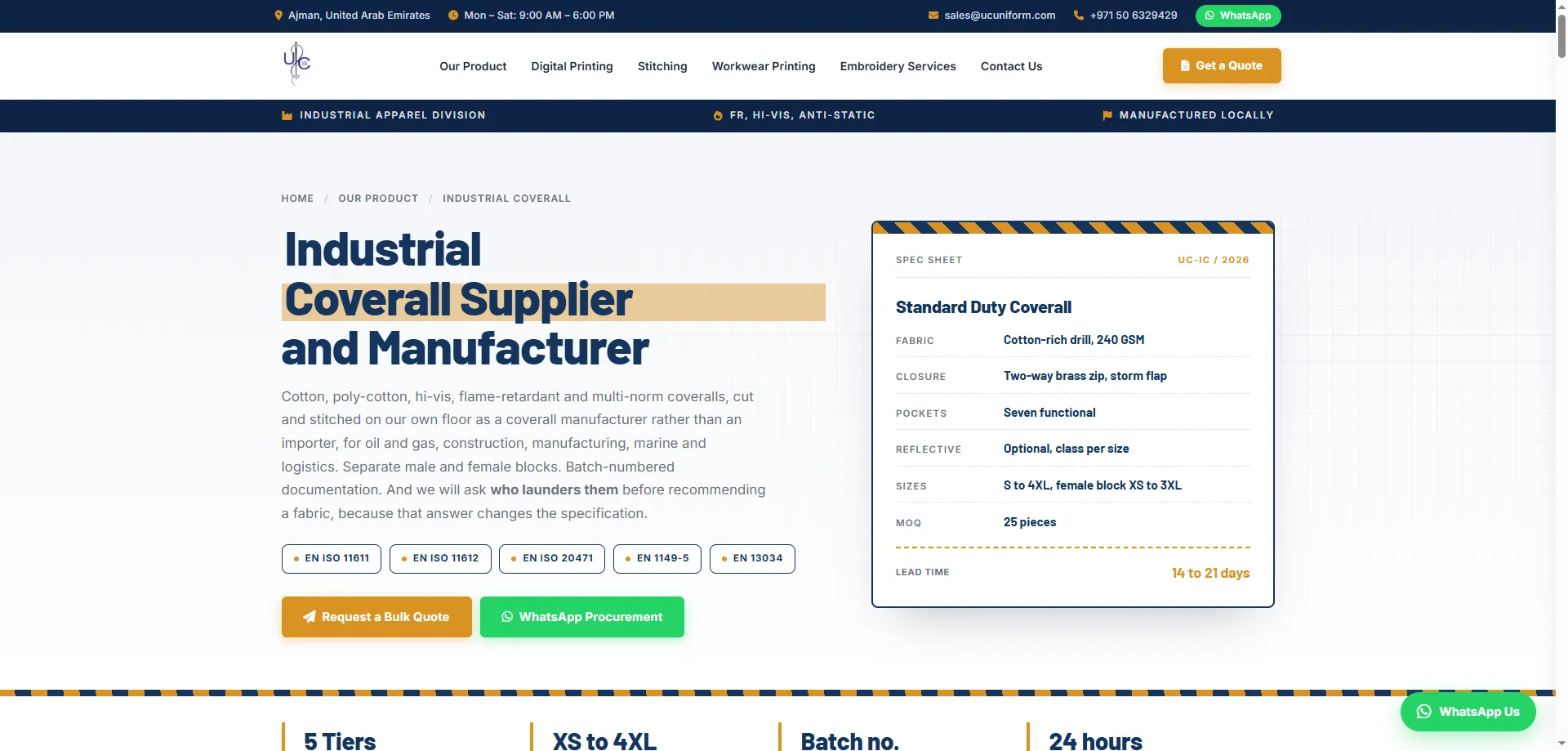
UC Uniform gives its base as Al Nuaimia 1, Ajman, and a business listing dates the company to 2008. Its industrial coverall page is the most specific of anything on this list: five protection tiers, each naming its fabric weight in GSM.
The tiers run from 180 GSM hi-vis polyester through 220 GSM cotton drill and 240 GSM poly-cotton to 260 GSM FR cotton and 280 GSM multi-standard FR. The FR lines reference EN ISO 11611 and EN ISO 11612, the hi-vis line references EN ISO 20471, and anti-static and ESD suits sit alongside them.
Numbers like that do more for a procurement decision than claims do. MOQ is 25 pieces per design on cotton and poly-cotton, rising to 50 for FR, ESD and hi-vis. Reorders off a stored spec start at 10 pieces.
Samples take 48 to 72 hours, bulk production 14 to 21 working days from sample approval, and urgent orders 7 to 10 days.
The catch is the address. The site sells as a Dubai supplier while the listing places the operation in Ajman. Confirm where the SKU is cut and sewn, and ask for the EN ISO 11612 report tied to the fabric batch you are quoted.
🧠 Author’s Take: Compare the 260 GSM and 280 GSM FR fabrics on cost and heat load before choosing. In UAE summer conditions that 20 GSM gap is a comfort decision, not a spec detail.
2. UAE Uniforms: Bur Dubai Workshop for Fast, Small Runs
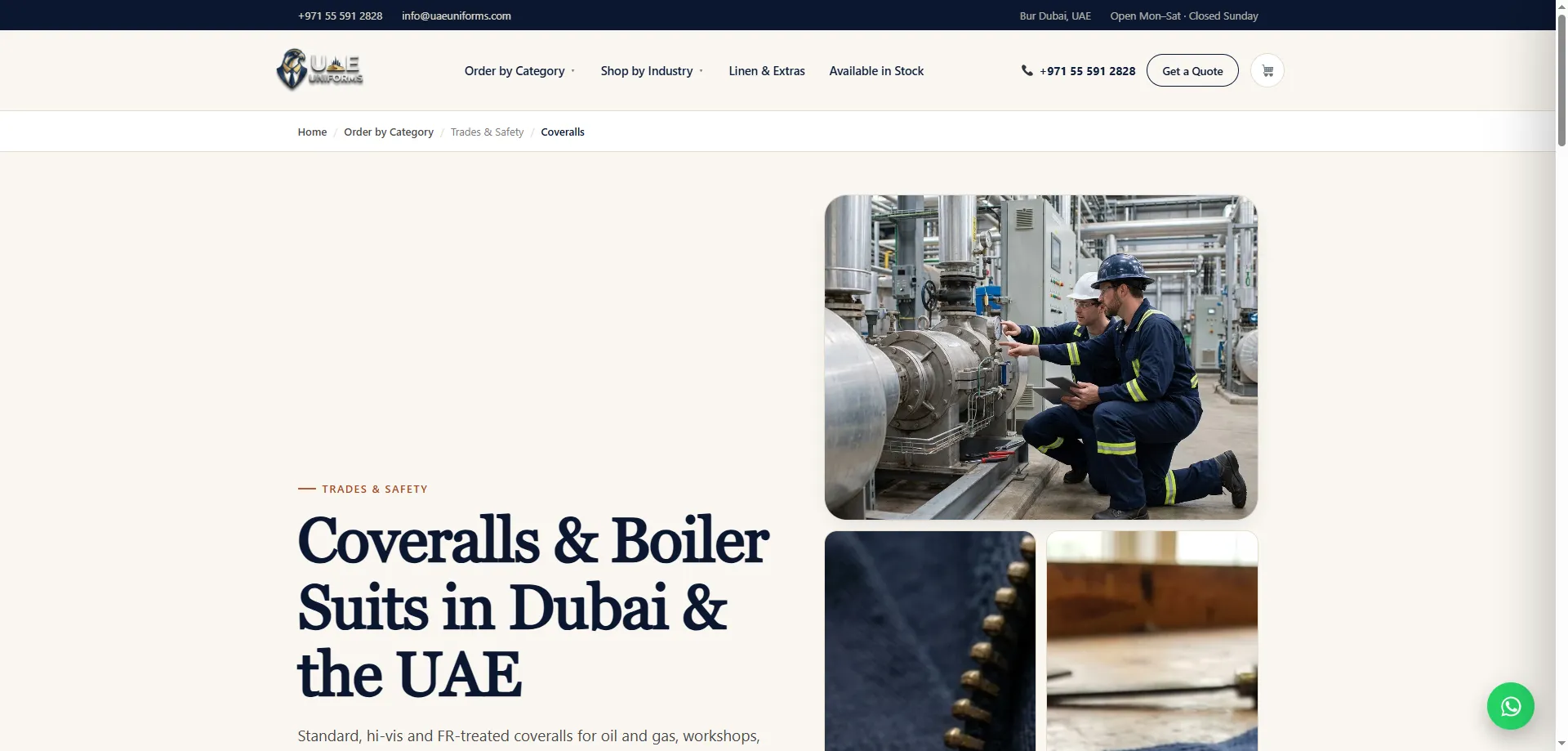
UAE Uniforms runs its own workshop in Bur Dubai and answers the two questions buyers ask first.
MOQ is 10 pieces per design across the whole coverall range: standard, hi-vis and FR-treated. Lead time is 7 to 10 business days from sample approval. Pattern-making, embroidery and QC all happen in-house at the Bur Dubai site, and the business dates to around 2010.
That combination suits a site manager topping up a crew mid-contract. It is not built for a project buyer ordering in thousands. The gap here is documentation, since no test standard is listed for the FR-treated line.
FR-treated is not FR-certified. A flame-resistant finish is not the same as a garment tested to EN ISO 11612, and the difference only surfaces after an incident. Before the FR line goes anywhere near oil and gas work, get the garment-level report.
🧠 Author’s Take: The 10-piece MOQ makes this a cheap way to trial a supplier. Trial the FR line only with a test report attached; otherwise keep the order to non-FR industrial work.
3. Imperial Clothing: FR and Arc-Rated Coveralls From Sharjah
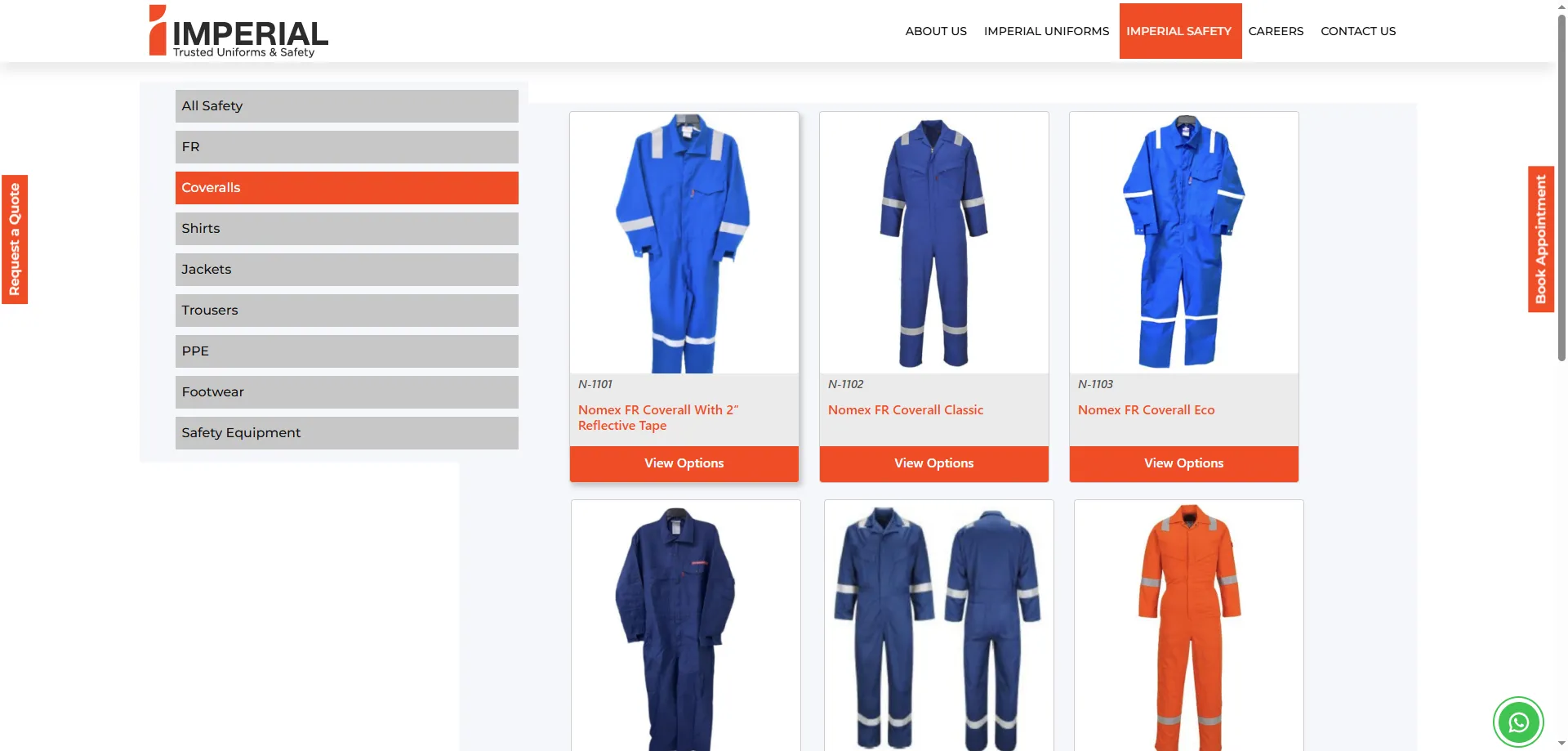
Imperial Clothing trades as Imperial Clothing FZE in Hamriya Free Zone, Sharjah, and sells into Dubai and the wider UAE.
The range goes further into protective territory than most of this list: FR, arc-rated, hi-vis and chemical-resistant coveralls, plus mechanic and workshop coveralls with triple-stitched seams.
The company says its industrial workwear is PPE-compliant and that certificates are available on request.
“On request” is the phrase to watch. It means no document backs the claim, so the burden lands on your RFQ: name the standard, name the SKU, and ask for the report itself rather than a compliance statement. No MOQ is given either, which usually means it moves with the order size.
🧠 Author’s Take: Hold the NFPA and ANSI-ISEA references as claims until the certificate arrives, and check that the certificate names the fabric and style you are actually buying.
4. Promo Plus Textile: UAE Protective Clothing and Branded Workwear Supplier
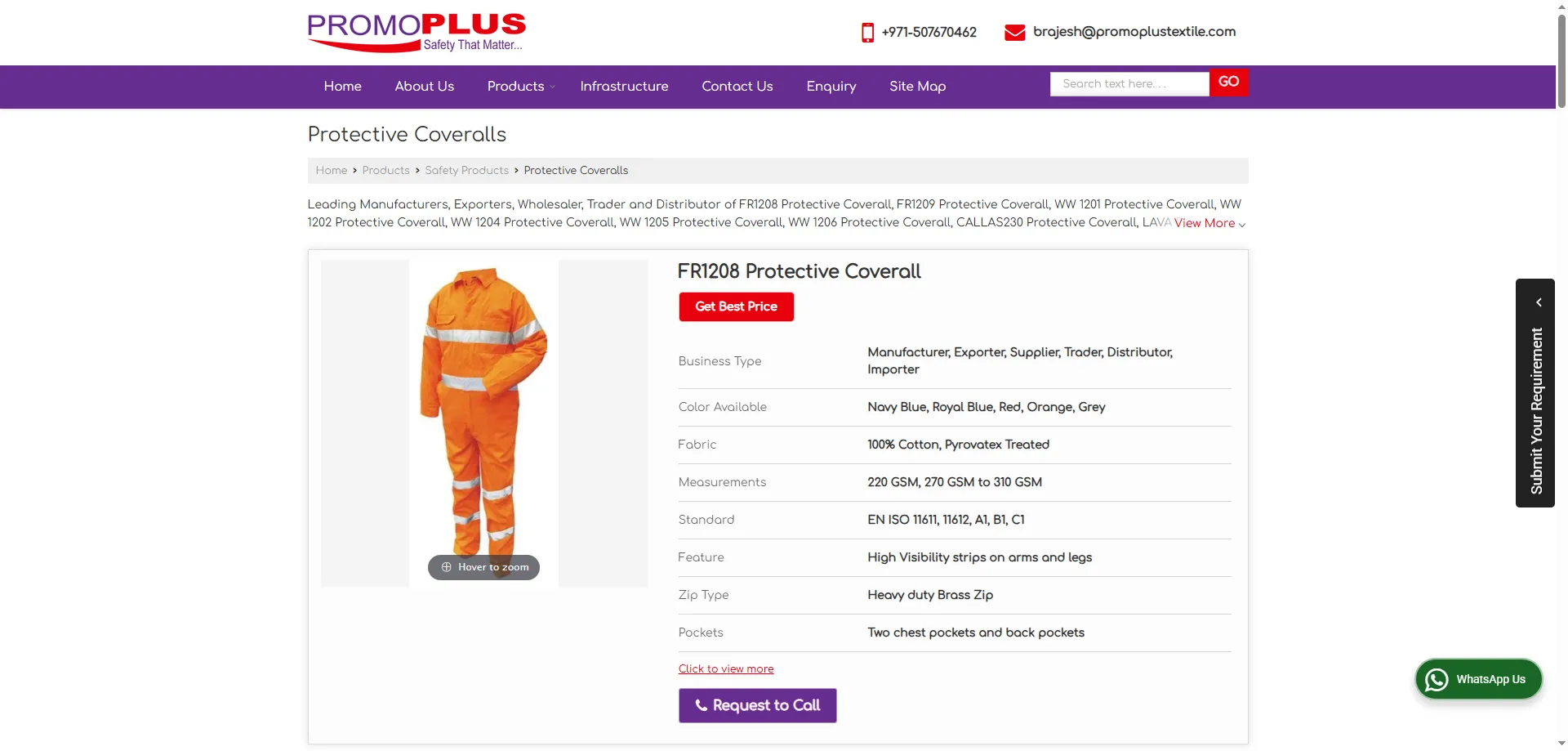
Promo Plus Textile makes and distributes protective clothing and safety supplies in the UAE, and the product list runs wider than the branding angle suggests. Coveralls, safety trousers and lab coats sit next to helmets, gloves, eye and face protection and safety footwear.
The customer base they name (foundry, cement, steel, power and gas) is industrial, not promotional.
That breadth is why they are on this list. One order can cover coveralls and the rest of a plant’s PPE kit, which cuts the number of vendors a shutdown schedule has to juggle.
Certification is where to slow down. The company calls its products ANSI and CE certified, but a distributor’s compliance statement can name a standard the supplier holds rather than the garment in your order.
Ask for the test report per style, then check reflective tape placement on a finished garment instead of a mockup.
For branding-heavy orders, the embroidery thread has to suit flame-resistant fabric without choking airflow, and a 20-wash print durability test belongs in the plan before rollout.
🛡️ Our Verdict: Worth a shortlist slot where one vendor has to cover coveralls plus general site PPE. Weaker where you need a single, fully documented FR coverall program.
🧠 Author’s Take: Establish where the order will be made, since the company describes itself as both manufacturer and distributor and the sewing floor may not sit in the UAE.
Test the safety file before the logo file.
5. Emirates Industries: UAE Industrial Coverall Manufacturer Profile
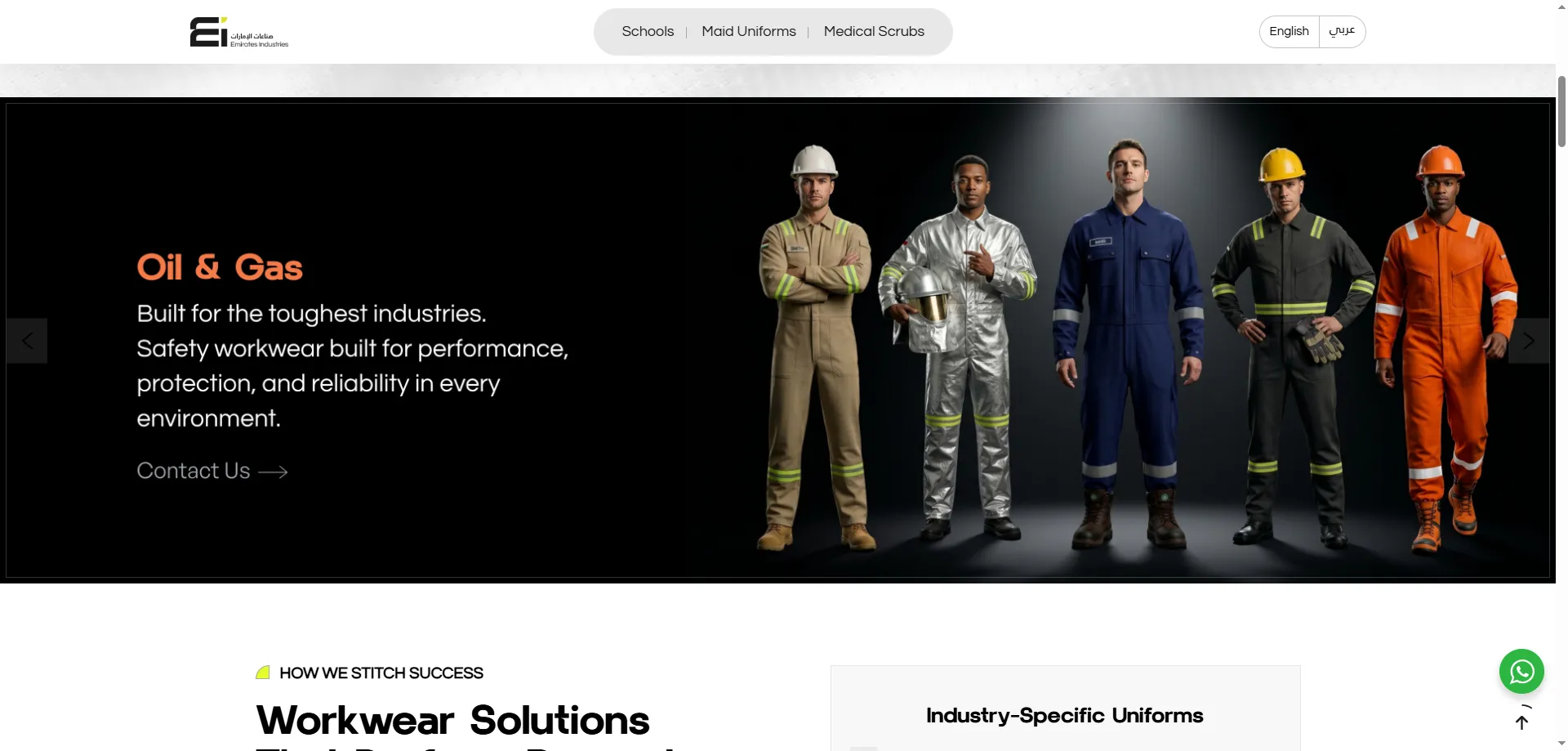
Emirates Industries LLC (emiratesind.com) works from Al Quoz Industrial Area 2, Street 22, in Dubai, and traces back to 1978 as part of Belhoul Group.
The company’s own figures put the plant at roughly 32,000 to 40,000 square feet, with 313 sewing machines, 250-plus staff and output of around 1,500 garments a day.
Its catalog lists industrial coveralls for oil and gas, construction and marine crews, along with high-vis and flame-resistant versions. For multi-site infrastructure programs, the construction and infrastructure solution covers the wider brief.
Emirates Industries sells as both manufacturer and supplier. That dual role suggests local stock plus some control over production, but ask where the sewing actually happens. If the answer holds up, they are the obvious local benchmark to price everything else against.
I put them first for buyers who need fast replenishment inside the UAE, because a local address cuts shipping friction. That is not a reason to skip the basics.
Ask for FR and anti-static test reports at SKU level, and for fabric weights that suit UAE summer heat. Which lighter-weight FR fabrics do they offer, and at what GSM?
Then confirm branding options, embroidery or screen printing, and get the real MOQ rather than the website number.
Ask how they handle repeat orders and color consistency, and find out whether they own production or coordinate a wider supply chain. That last answer changes what you are taking on.
🧠 Author’s Take: Pin down sample lead time and whether FR testing happens in-house or at a third-party lab, then insist on a pre-production sample in the exact fabric weight.
6. The Uniform World: Ajman Factory Workwear Option for Branded Coveralls
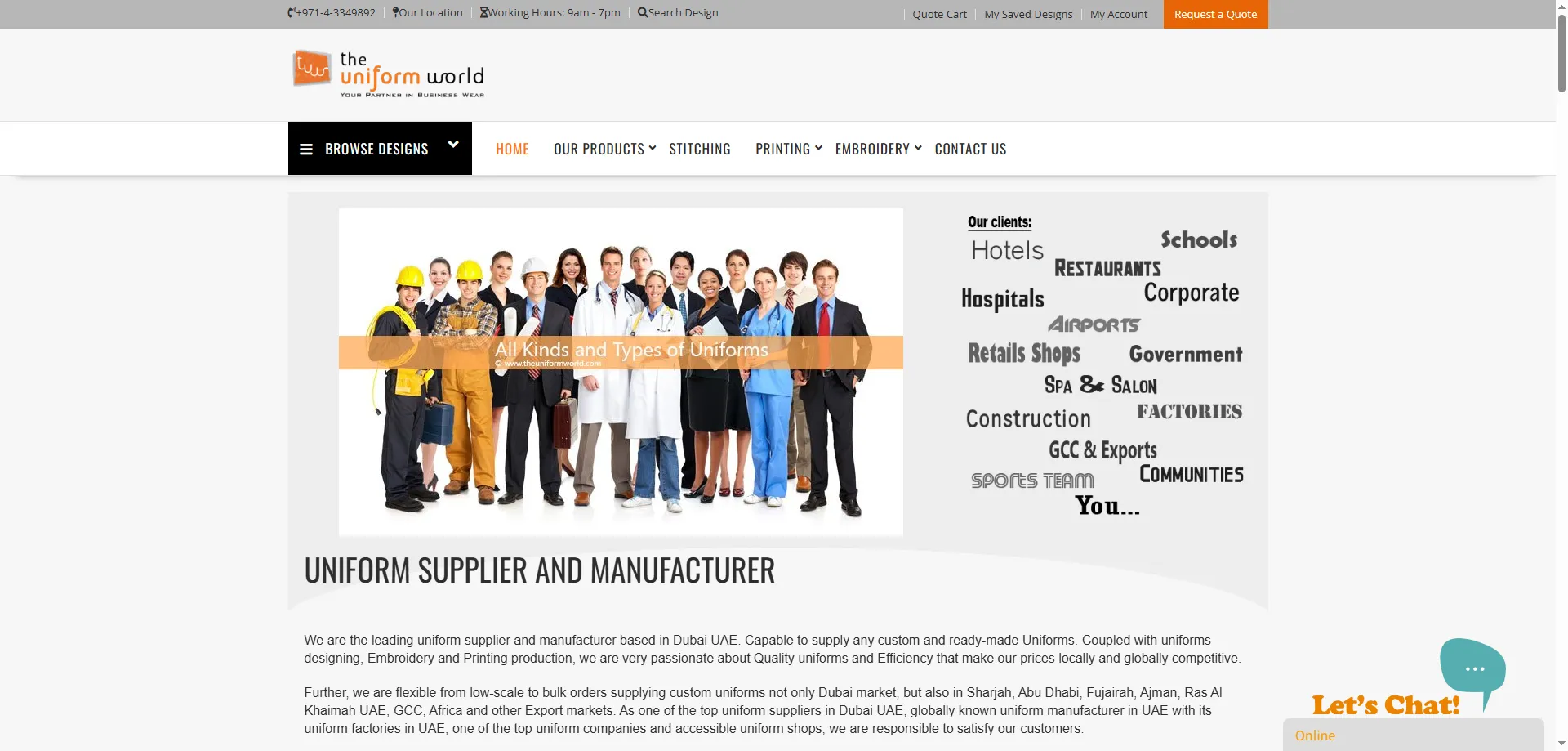
Most UAE coverall suppliers sell PPE. Fewer can run a coordinated uniform program across several sites. The Uniform World (The Uniform World Tailoring & Textiles LLC, theuniformworld.com) is closer to the second group.
It keeps an office at Port Saeed in Deira and a factory in Ajman’s industrial area, and business listings put its start around 2011. The range covers industrial workwear, not just hi-vis vests, and the factory handles embroidery and printing for branded coveralls.
Manufacturing workwear is clearly the strength here. Proving protective performance is a separate job, and I reject brochure wording on FR or arc flash.
Match the document to the hazard: EN ISO 20471 for hi-vis, EN ISO 11612 or NFPA 2112 for flame and flash fire. Ask for each one by SKU, and specify reflective tape make, width and placement.
Mixed crews need size-set management confirmed in writing, along with sample approval and a plan for color consistency between repeat batches. Company-level certificates are everywhere in this market; the report on the garment is the one that protects you.
🛡️ Our Verdict: A good fit for coordinated uniform programs in construction, facilities and light industrial crews. Less proven for high-risk oil and gas.
🧠 Author’s Take: A fabric test report is not a garment certificate. Make that distinction in the first RFQ.
🚀 Actionable Insight: Require SKU-level test reports and written sample approval before a multi-site rollout.
7. Milano Group: UAE Coverall and Uniform Supplier Profile
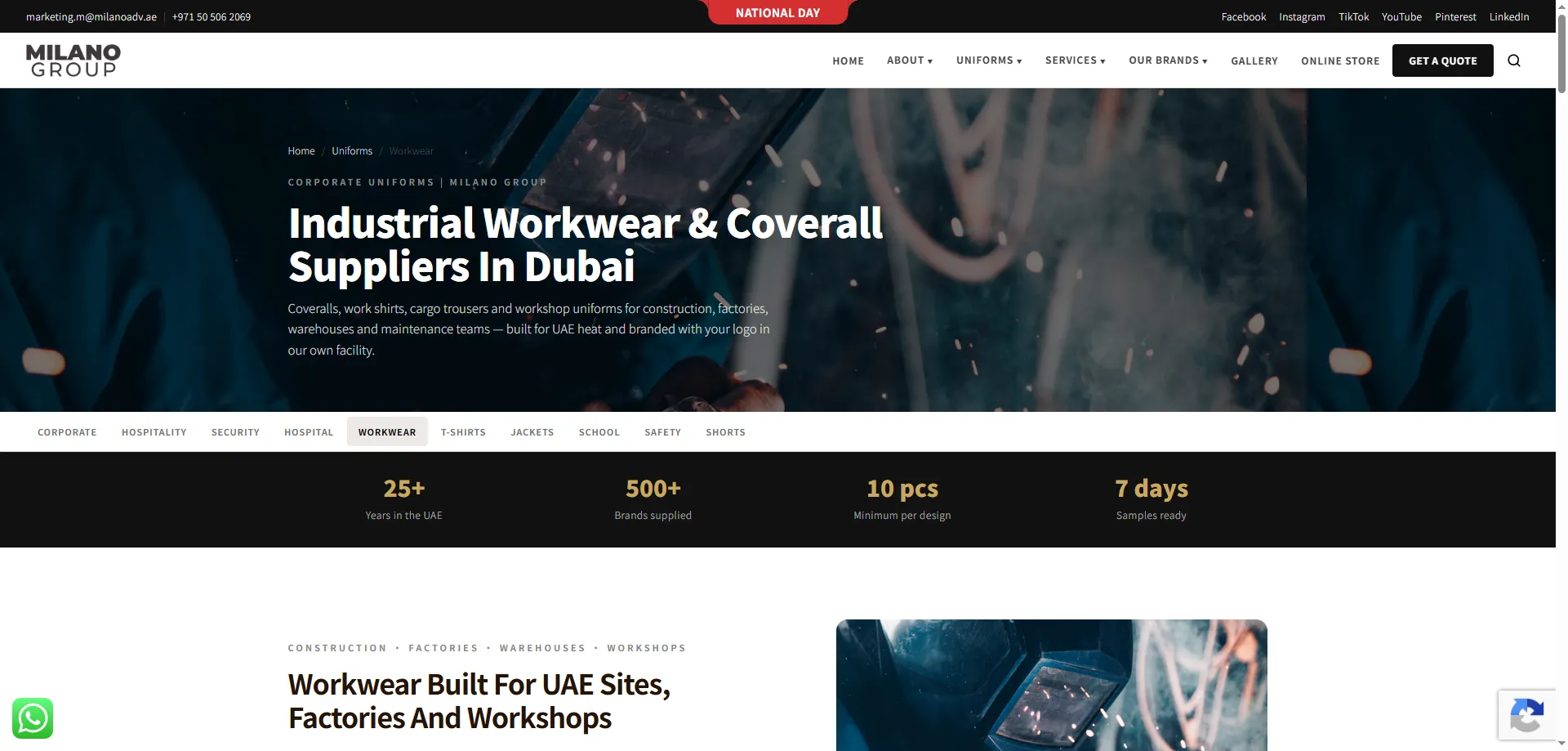
Milano Group is a uniform maker in Sharjah with a wide corporate and industrial catalog: uniforms for office and hospitality clients, industrial workwear, plus coveralls, shirts, trousers and branded programs.
Selling general apparel is not the same as making an industrial coverall. Before anything else, separate the fashion and corporate lines from the oil, gas and construction line.
🛡️ Our Verdict: Best fit is mid-size facilities, hospitality groups and light industrial teams buying branded uniforms with local account support. For heavy industry, treat them as unproven.
Ownership comes first. Ask who runs the sewing floor and who handles trims, then confirm in writing whether any work is subcontracted and put a clause in the PO banning subcontractors you have not approved.
FR thread, FR-capable trims and reflective tape all need checking by SKU. Ask for custom pattern support and a size-set plan, and test replenishment at project scale rather than one order at a time.
🧠 Author’s Take: Get the factory address and a coverall sample in hand before adding them to a tender. The catalog answers fast. The ownership question does not.
8. FineFit Uniforms: UAE Workwear Supplier Profile for Fit and Repeatability
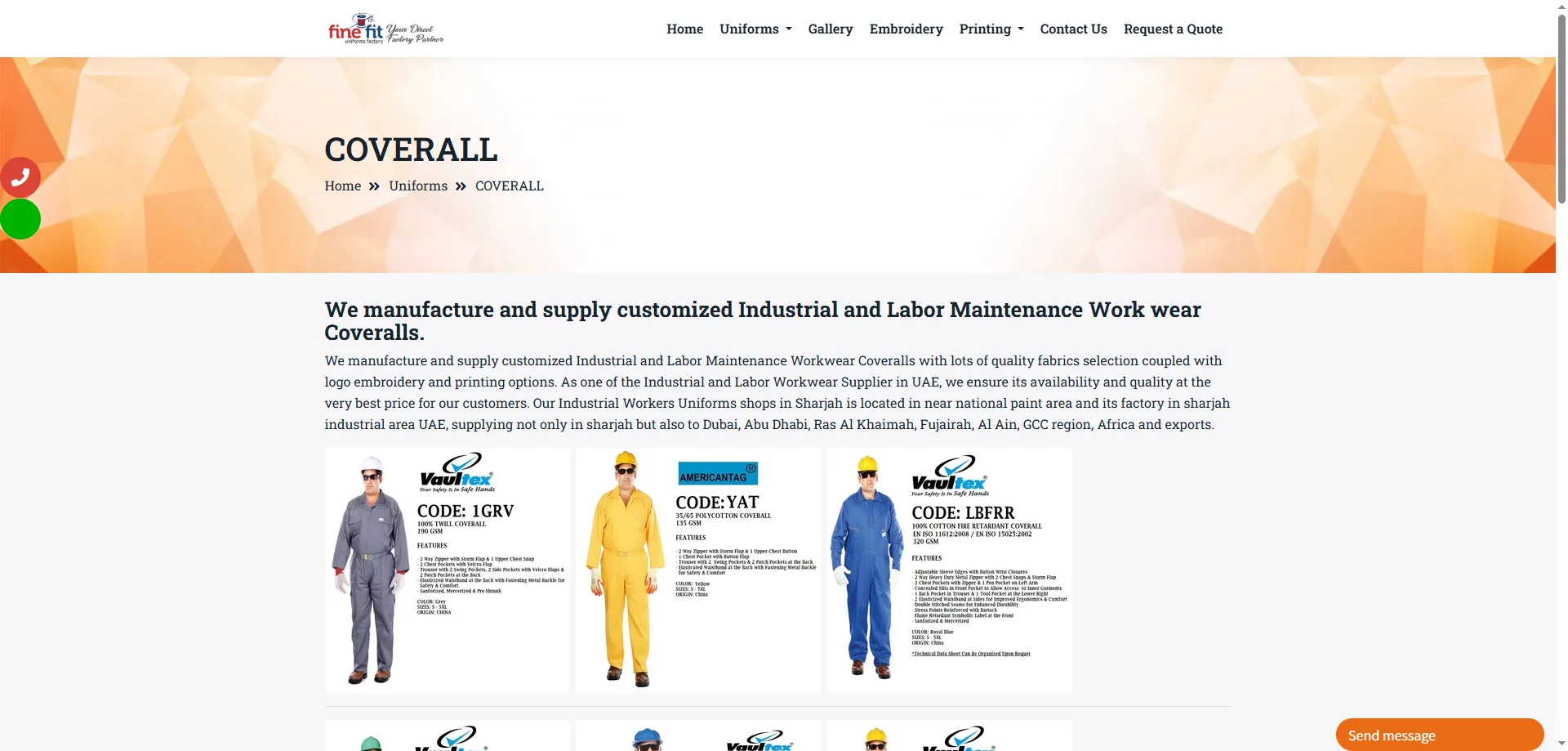
Inconsistent sizing between batches is one of the commonest ways a multi-site rollout goes wrong. FineFit Uniforms, based in Sharjah, builds its offer around fit and tailoring rather than price alone. If a size 52 coverall sits differently across two orders, the site store turns into an argument.
They matter most to procurement teams carrying large headcounts, where fit management drives both replacement costs and how willingly workers wear the garment. Ask how they hold grading across sizes, and whether female sizes are genuinely available or bolted onto a male baseline.
A 12-piece grid is enough to start with. Lock that grading table before you scale, because it is the document every replacement order gets cut against.
🧠 Author’s Take: Order the same size set twice, measure key points (chest, sleeve, inseam) against the grading table, and approve each size set in writing.
9. Emporium Gulf: UAE Uniform Supplier Profile for Broader Corporate-to-Industrial Sourcing
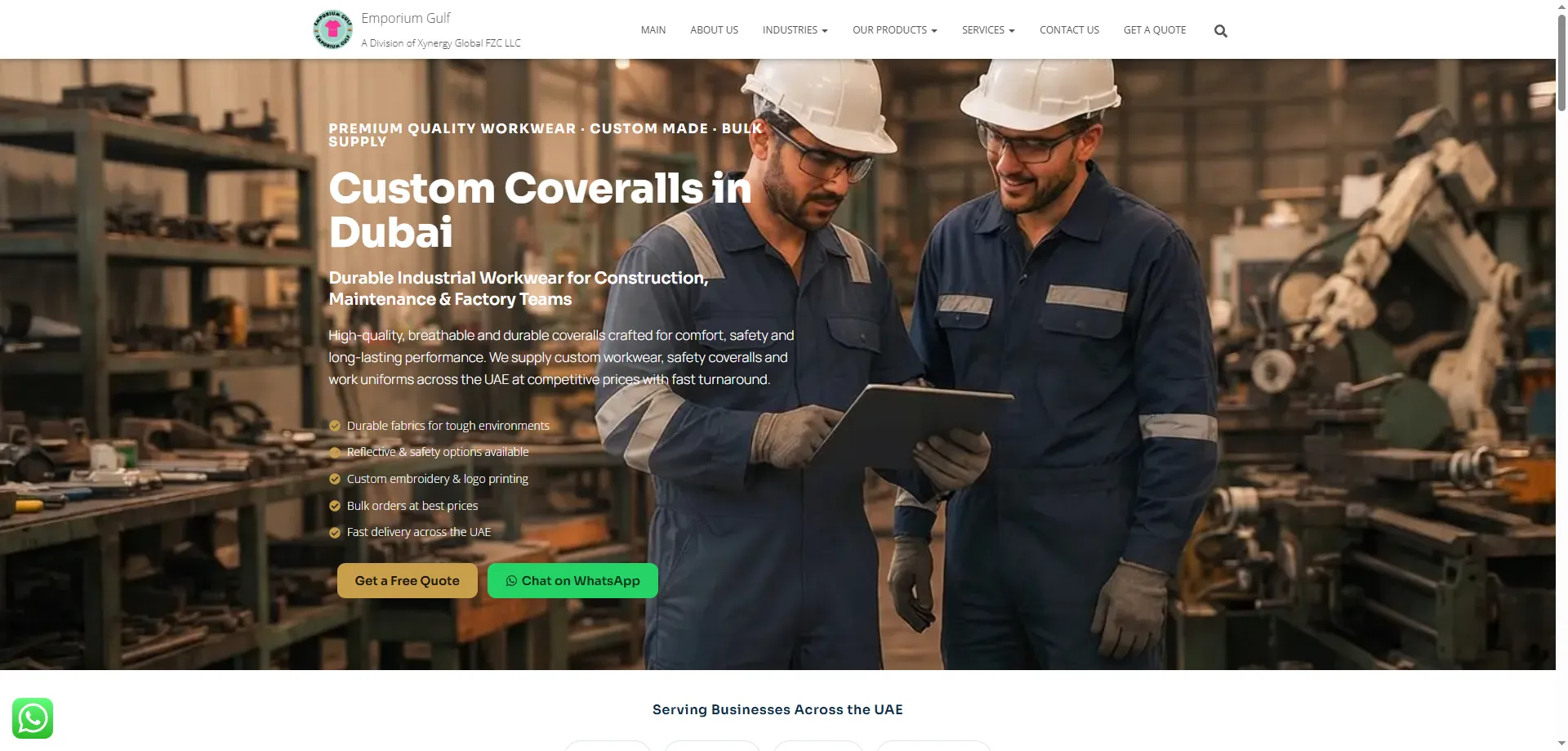
Emporium Gulf keeps a wide UAE catalog, led by corporate uniforms and hospitality apparel with industrial workwear alongside. Coveralls appear in it, but not as a category they push. Read that as an adjacent offer rather than proof of heavy industrial depth.
The case for them is consolidation: office, hospitality and light industrial crews on one purchase order, with one supplier to chase instead of three.
Then test the industrial half of the catalog. Ask for protective-garment test reports by SKU rather than company certificates. Confirm the project-order discipline you need: one written size set, one delivery schedule, one named account owner.
Check how the packaging arrives on site too, since individual worker bags, size labels and site codes all cost money to sort out afterwards. Finally, find out whether industrial coveralls are core work for them or a line added to the catalog.
🛡️ Our Verdict: Broad catalog, limited public evidence on industrial coveralls. Get the SKU-level report and a repeat-order lead time before adding them to a mixed rollout.
10. AMM Global FZE: Free-Zone Sourcing Option for Coveralls and Project Workwear
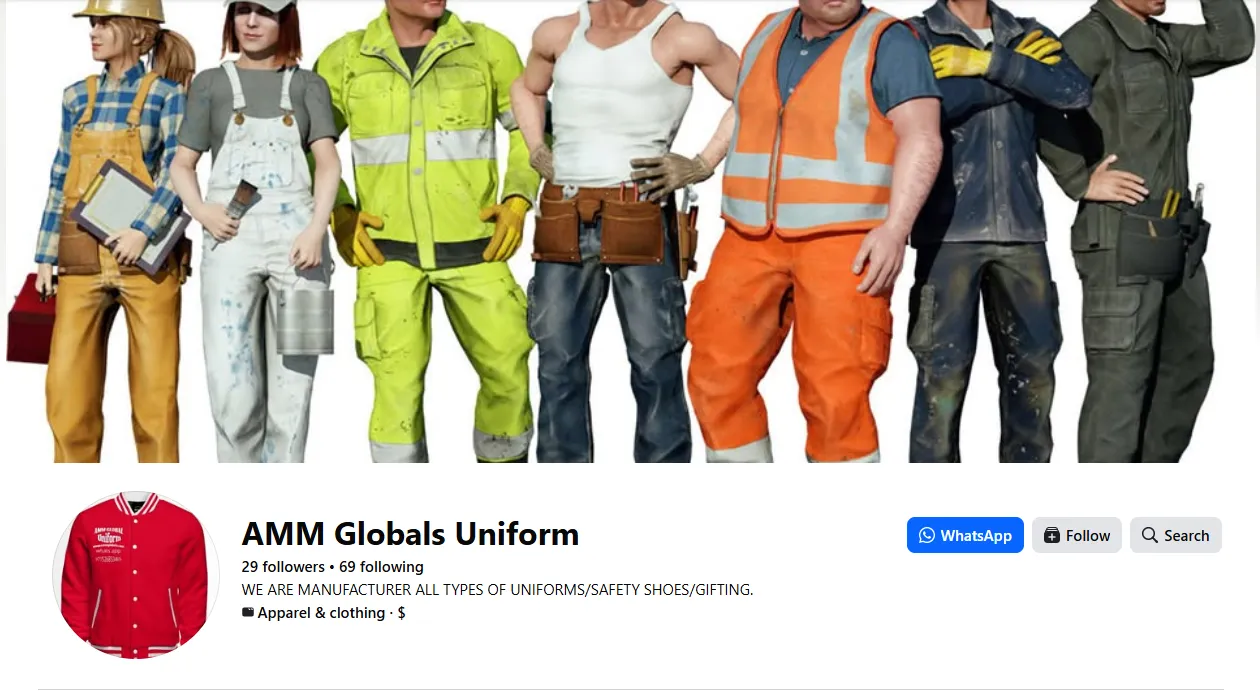
AMM Global FZE describes itself as a UAE free-zone trading house rather than a sewing floor. Sourcing, consolidation and distribution is the model here, and nothing on their side shows owned garment production. That is not automatically disqualifying. It does change what you have to verify.
Expect an import-first mix, and establish which coverall lines they stitch locally versus what lands from overseas. From there, test Incoterm flexibility, MOQ thresholds and customs readiness.
GCC projects live on paperwork. Ask for the certificate of origin and the Arabic commercial invoice, confirm UAE MoIAT or Saudi SASO conformity where it applies, and get a named clearance contact before the first shipment.
Sampling reports and AQL inspection data on the imported batch matter more than anything else here, because you inherit whatever their upstream factory ships.
🛡️ Our Verdict: Strong for mixed imports, regional replenishment and catalog breadth. Weaker where you need garment-level FR traceability.
🧠 Author’s Take: Get the Incoterm (for example CIF Jebel Ali or DDP into Saudi), MOQ and origin mix in writing before bidding.
11. ACE High Global Fashion: Custom Garment Supplier Profile for Industrial Coverall Screening
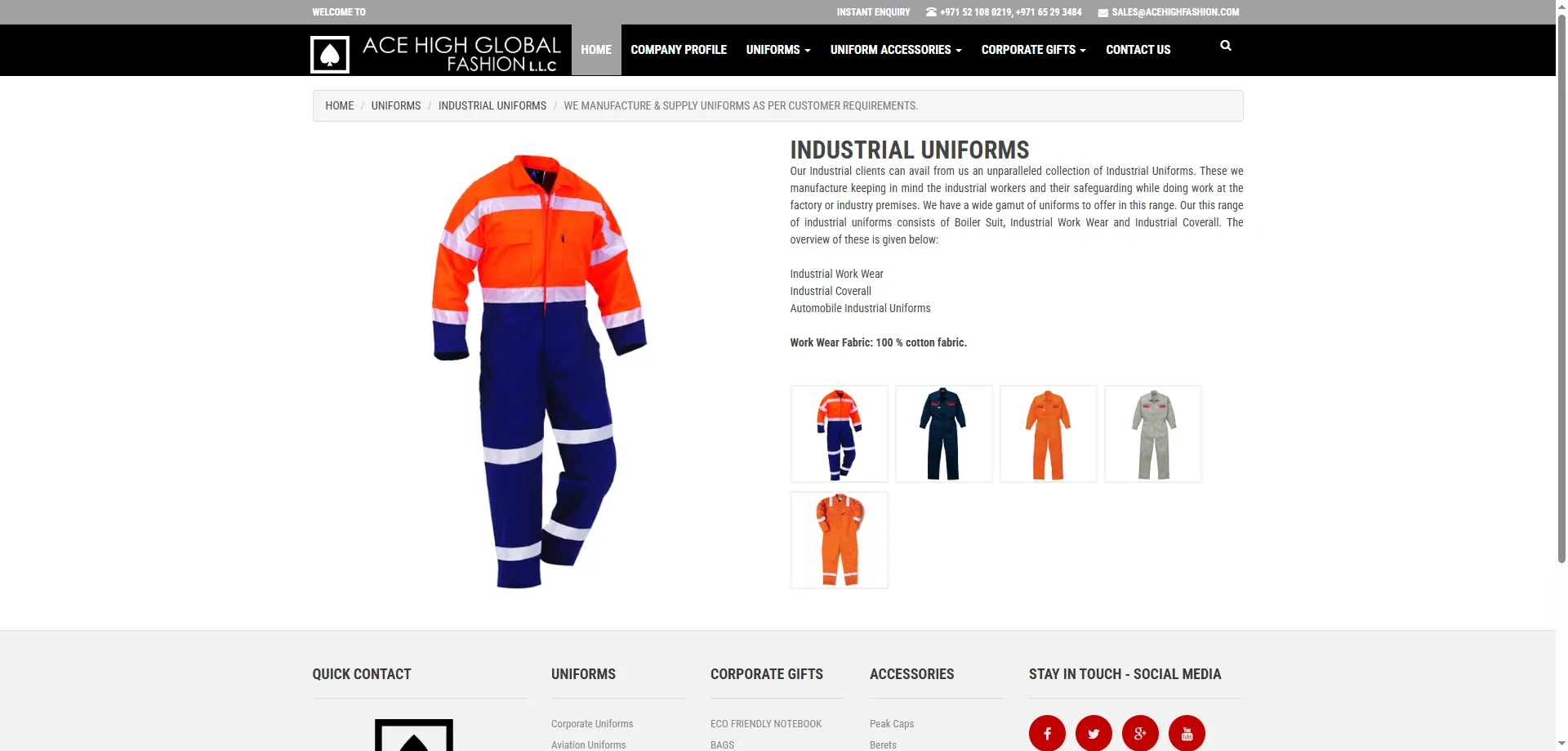
ACE High Global Fashion looks like a custom garment supplier, not a PPE factory. Fashion apparel and customization lead, with UAE sourcing and logo work close behind. None of that is evidence of industrial coverall capability.
If you do test them, start on construction: double-needle seams, bar-tacks at stress points, reinforced knees, industrial zippers. Check fabric sourcing by SKU and ask who weaves the shell. If FR or anti-static comes up, the answer has to include a garment-level test report, not just a finish name.
Wash performance needs to be shown under ISO 15797, not a home-wash claim, and PPE compliance has to name the standard, such as EN ISO 11612. Then see whether ACE can work from a technical spec at all, or only from a logo file.
🛡️ Our Verdict: Use ACE for visual customization and fit. For heavy industry, make them prove durability first.
🧠 Author’s Take: Send a full coverall tech pack, then judge the written answers on construction, fabric origin, wash testing and PPE certification, not just the logo mockup.
12. Studio by BP: Bespoke Uniform Design Option for UAE Workwear Programs
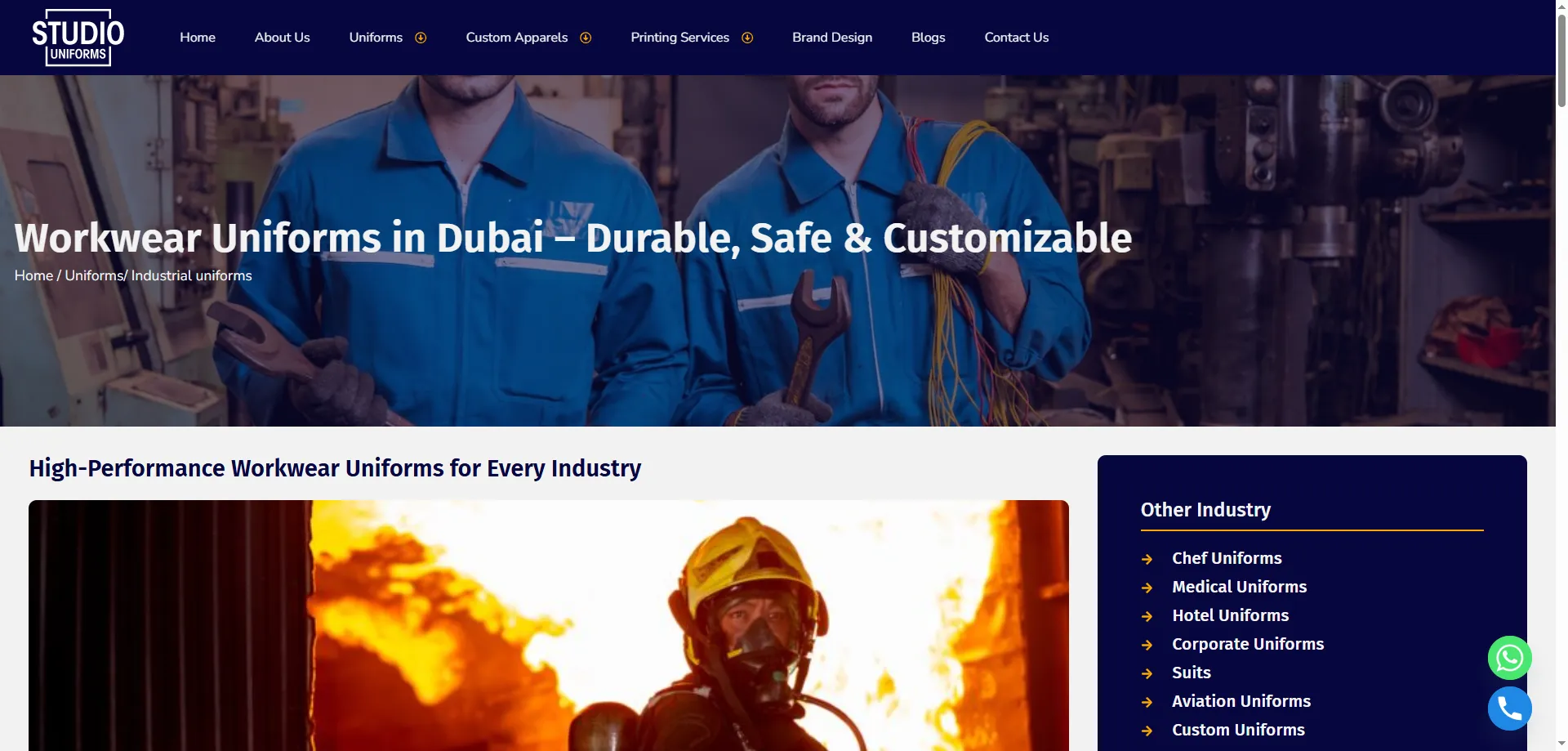
Where most names on this list sell PPE, Studio by BP sells image. The range leads with bespoke uniforms, corporate apparel and logo application, and industrial coveralls are not something they push.
They are worth a look for premium brand presentation: hotel lobbies, retail floors, front-of-house teams. Custom patterns, fabric selection and logo placement all look strong, and design control is genuine. Industrial depth is a different question, though.
Sample them for site work only if you are willing to check fabric weight against the hazard spec and look for bar-tacks at the crotch and knees.
Heavy industry needs the fabric engineering settled first: SKU-level FR test reports against EN ISO 11612 or NFPA 2112, an answer on how dense embroidery affects heat dissipation, double-needle seams, reflective tape placement, and a 12-piece size trial run on site.
🛡️ Our Verdict: Strong for design-led corporate uniforms. For oil and gas coveralls, a garment-level FR report is the minimum entry ticket.
What UAE Rules Change the Coverall Specification?
Two local rules settle more of a coverall order than most buyers expect.
Conformity is a UAE document, not a European one. PPE sold in the UAE falls under Cabinet Decision No. 34 of 2016, administered by the Ministry of Industry and Advanced Technology after ESMA’s functions merged into it in 2020.
Category II PPE needs ECAS registration and a conformity certificate. Category III needs the Emirates Quality Mark, with a factory assessment attached.
A CE mark or an EN test report on its own satisfies neither, and the labeling has to be Arabic or bilingual. Ask a UAE supplier for the ECAS or EQM reference against the exact style you are buying.
The working window is narrower than the year suggests. The MoHRE midday break bans outdoor work in direct sun between 12:30 and 15:00 from 15 June to 15 September, with penalties starting at AED 5,000 per worker.
Crews go back out while the temperature is still near its peak rather than skipping the heat, so breathability and fabric weight carry more of the load. That is the argument for specifying GSM per garment instead of buying off a phrase like “summer weight”.
Neither rule shows up in a supplier’s brochure, and both belong in your own specification. Coverall safety standards sets them out in full.
FAQs About Coverall Manufacturers in UAE
1. How do I tell a UAE coverall manufacturer from a supplier or trading company?
Ask who owns the sewing floor. In my audits I request four things: the factory address, the trade license activity, production capacity and a live video of the coverall line.
A real manufacturer can name the plant and show you QC staff. A trading house coordinates supply instead. That can work, but you are buying from a sourcing node rather than a factory.
2. Which standards should I ask for on oil and gas or welding coveralls?
Ask for the standard that matches the hazard: EN ISO 11612 for heat and flame, EN ISO 11611 for welding, EN 1149-5 for anti-static, NFPA 2112 for flash fire, or whatever the site specifies.
Then get garment-level test reports tied to the exact SKU and fabric batch you are buying. Company certificates do not protect your crew.
3. What should I ask about MOQ, sampling, golden-sample approval and lead time before issuing a PO?
Put all four in writing before the PO. Pin the MOQ down by SKU and color, and get sample lead time and bulk lead time as separate figures.
Sign and keep a golden sample recording fabric weight, trims, logo placement and measurements. Then add AQL 2.5/4.0 inspection and a commitment on repeat-order lead time.
4. Is local UAE sourcing always cheaper than importing?
No. Compare total landed cost, not unit price. Local sourcing wins on small, urgent repeat orders and low MOQs.
Import can win at bulk volume, once you add freight, duty, VAT, SASO or ECAS paperwork and the odd clearance delay. On custom FR coveralls, certification and rework risk usually decide which route comes out cheaper.
Next Step: Compare a Factory Quote Against This Shortlist
Every supplier on this shortlist has to be judged on the same criteria — use the custom workwear manufacturer guide to score them, then confirm MOQ per style before you treat two quotes as comparable.
If an overseas comparison quote would help, send LantaoWork your SKU list along with the target standard, volume and destination. Either way, pick the final vendor on product-level documentation rather than company-wide claims.

Leave a Comment
Your email address will not be published. Required fields are marked *